Septic tank pumping every three to five years will outperform any miracle additive on the market, yet homeowners continue to chase expensive bottles promising bacterial boosts that your system already produces naturally. After fifteen years living with and studying rural septic systems across the Southeast, I’ve seen what actually separates the properties with thriving systems from those facing five-figure repairs — and it has nothing to do with additives, gadgets, or complicated tricks. It comes down to understanding how your buried infrastructure functions and committing to straightforward maintenance habits.
Rural property owners often treat their septic installation as a set-and-forget utility. The tank sits underground, drains work invisibly, and the system simply operates without fanfare. That detachment works fine until something breaks. In reality, the distinction between a system delivering reliable service for thirty years versus one that collapses within a decade almost always traces back to foundational knowledge and consistent practices. No mystery. No expensive components. Just clear understanding of what lives beneath your yard and how to maintain it responsibly.
Everything you need appears below: operational mechanics of your installation, realistic pump-out intervals, red flags that demand immediate attention, prohibited materials and safe practices, strategies for keeping your drainfield healthy, and clarity on which situations require licensed expertise. Revisit this resource seasonally. Share it with household members who use water. Return to it when concerns arise. Consider this your personal reference manual for septic ownership.
Understanding How Your Septic Installation Functions
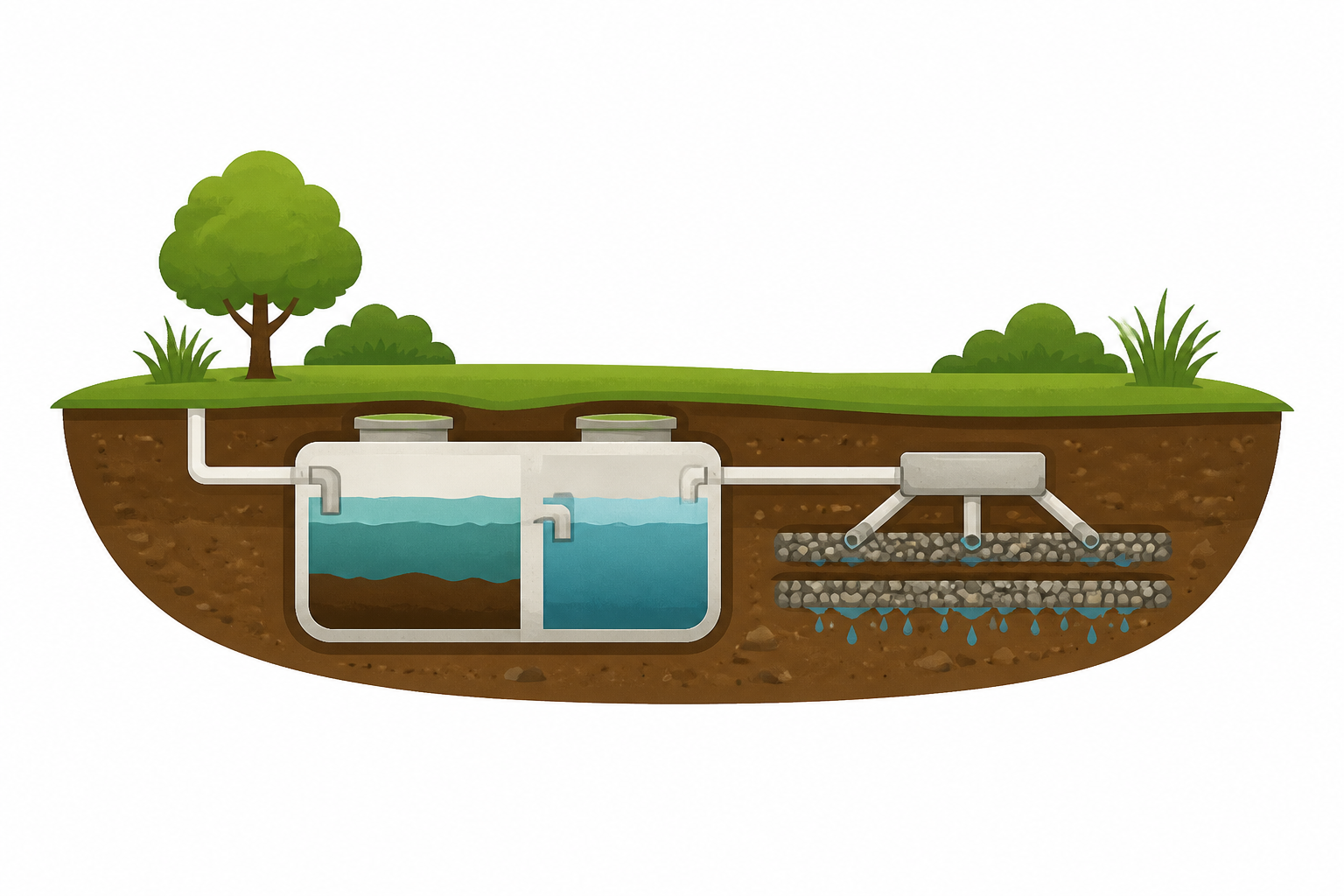
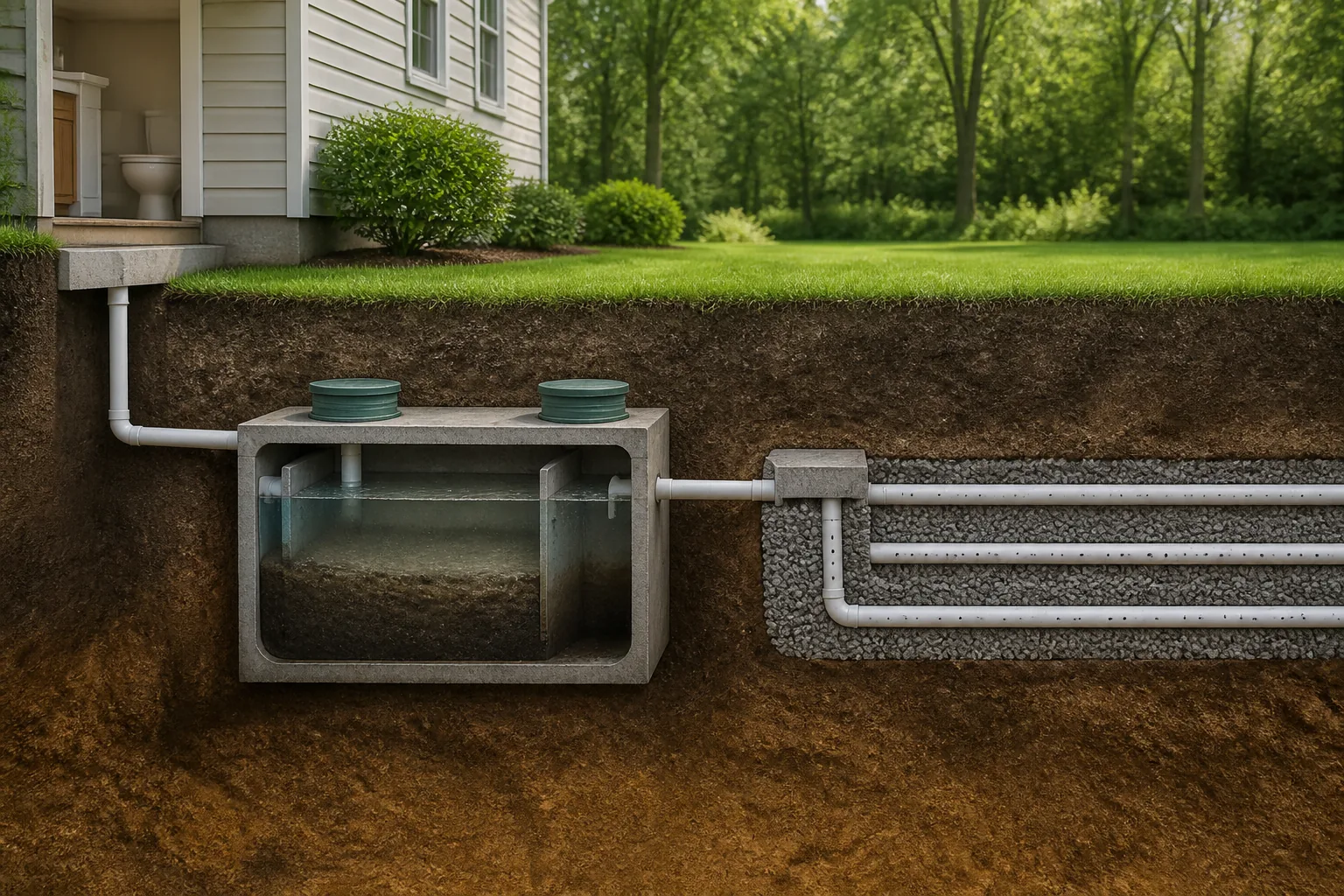
Many property owners picture a septic system as simply “a large underground container.” That perspective misses half the operational picture. A traditional installation consists of two interdependent parts: the storage tank and the absorption field (commonly termed a leach field or percolation field). Both require understanding.
Household discharge travels into the septic tank as the first destination. Within the tank environment, heavy materials drop downward and accumulate as sludge. Buoyant substances — fats, oils, and tissue — rise upward and form a scum layer. The middle section, termed effluent, eventually exits into the absorption field. Microbial action within the tank gradually decomposes solids continually. Yet biological processes alone cannot eliminate all waste matter. This biological limitation necessitates periodic tank emptying.
The absorption field represents where actual water purification occurs. Effluent distributes via perforated conduit across gravel beds, then soaks downward via natural gravity into surrounding earth. Native bacteria and mineral particles eliminate contaminants and nitrogen-based compounds before groundwater absorption happens. A functioning absorption field represents an active ecosystem. Damage this living system, and you’re facing one of the priciest restoration undertakings available to homeowners.
Typical Tank Capacities and Property Implications
Residential installations typically range between 1,000 and 1,500 gallons in holding capacity. State regulations generally mandate a minimum 1,000-gallon capacity for three-bedroom residences. Properties with four sleeping areas generally demand 1,250 gallons or additional volume. Larger occupancy translates to elevated wastewater generation, which accelerates solids accumulation and compresses intervals between service appointments.
Uncertain about your tank’s capacity? Request your property’s engineered septic design from your county environmental health office. This paperwork typically documents tank volume, absorption field placement, design completion date, and subsurface characteristics. I advise all new property owners to obtain this file within thirty days of purchase. This document supplies tank dimensions, drainfield coordinates, installation timeline, and ground composition information — all data you’ll eventually require for decisions or repairs.
Establishing Your Tank’s Maintenance Calendar
Single most critical maintenance responsibility you’ll have: adhere to a consistent tank-emptying routine. I tell every neighbor who asks — avoid waiting until symptoms become obvious. Once you observe unpleasant odors or sewage backflow, considerable internal degradation has already started.
Standard recommendations from the EPA and state health authorities suggest emptying between every thirty-six and sixty months. Yet this window depends on multiple household characteristics. A household of four occupants sharing a 1,000-gallon capacity should empty closer to thirty-six months. A pair of retirees in identical tank size may successfully extend toward the sixty-month window.
Food disposal systems considerably modify this calculation. Households with operational food grinders should decrease their service interval by a minimum of twelve months per my field observations. Pulverized kitchen waste introduces substantial decaying material into your tank, filling the sludge layer much faster than most residents anticipate. [INTERNAL LINK: garbage disposals and septic systems]
Documenting Your Service Schedule and Measurements
Maintain documentation of each service. Record appointment completion dates, contractor identification, and sludge thickness before tank discharge. Professional contractors should measure accumulated sludge and scum before performing the emptying procedure. These measurements reveal the rate at which your tank accumulates waste — essential knowledge for scheduling subsequent appointments.
Regional variation affects service expenses substantially. Budget approximately $300–$600 for typical residential pumping across most American markets. Metropolitan regions with higher service costs might charge $500–$800 for identical work. When calculated annually across the three- to five-year interval, this equals roughly $60–$200 per year. Contrast this figure against absorption field reconstruction starting at $10,000–$30,000. The financial comparison becomes unmistakable.
Recognizing Red Flags Before Catastrophic Failure
Experienced professionals often read property conditions before departing their vehicle. Visible indicators abound for those trained to recognize them. Early detection frequently prevents needing complete system rebuilding versus basic repair work.
Homeowners first detect problems indoors. Sluggish water drainage across multiple fixtures — separate from isolated fixture failures — points toward tank saturation or internal baffle deterioration. Noise during drainage suggests mechanical stress or blockages. Foul-smelling air circulating indoors constitutes a serious warning requiring urgent response.
Ground-Level Signals Requiring Monthly Verification
Examine your absorption field quarterly. Dense, unusually vibrant vegetation appearing above field lines indicates subsurface effluent leakage — signaling soil saturation or internal obstruction. Persistently damp soil and spongy conditions present comparable concerns. Soggy regions or accumulated moisture adjacent to the tank itself frequently indicate failing internal components or overfilled capacity.
Unpleasant smells emanating from ground level, particularly proximate to absorption field or upwind from tank placement, warrant urgent investigation. A properly operating installation produces negligible odor at ground surface. Persistent foul odors within your property boundaries indicate operational problems. Contact a licensed contractor immediately — within forty-eight hours at most.
I prioritize outlet baffle assessment on every evaluation I perform. Baffle deterioration permits solids to escape directly into your absorption field — initiating irreversible system destruction. Baffle examination costs nothing when performed alongside routine pumping. Insist your contractor inspects the outlet baffle every service visit. [INTERNAL LINK: septic tank baffle inspection and replacement]
Comprehensive Guidelines for System Care and Harmful Practices
This portion addresses my primary focus during homeowner education sessions. Municipal sewerage networks tolerate considerable mistreatment. Septic installations demand respect. Substances you introduce directly influence system longevity.
Actions That Support System Health
- Select bathroom tissue designated septic-compatible or made from single-ply material. These dissolve more rapidly within tank conditions.
- Distribute laundry activities across multiple calendar days. Condensing numerous wash cycles into one day floods the tank volume with discharge, driving incompletely processed water into the absorption field.
- Address plumbing leaks promptly. A continuously running toilet contributes approximately 200 gallons daily — gradually devastating your system through volume pressure.
- Route gutter discharge and surface-level runoff away from absorption field perimeter. Waterlogged ground eliminates the porosity needed for proper absorption.
- Maintain written documentation regarding tank position, volume, and maintenance appointments. Archive this information alongside essential home documents.
- Arrange professional assessment every twelve to thirty-six months if your system surpasses twenty years of operation.
Practices That Cause System Damage
- Avoid flushing marketed “flushable” wipe products. Tank conditions don’t dissolve them sufficiently. I’ve retrieved massive tangles of these products from damaged baffles repeatedly.
- Never discharge cooking fats or vegetable oils through drains. Oil residues deposit within the scum layer and eventually restrict outlet baffle function.
- Eliminate frequent bleach-based drain remedies. Potent chemical formulations eradicate the beneficial bacteria sustaining your tank’s biological processes.
- Never introduce prescription medications, paint products, chemical cleaners, or industrial solvents. These substances disrupt bacterial colonies and contaminate subsurface water supplies.
- Avoid driving vehicles or constructing heavy installations overtop tank or absorption field zones. Ground pressure destroys perforated lines and may fracture concrete tank walls.
- Never position vegetation with deep root systems proximate to field installation. Root penetration represents a primary reason for conduit deterioration. Maintain a minimum forty-foot clearance between trees and absorption field piping.
I discovered the “flushable” wipe problem personally during my early career. I witnessed one North Carolina homeowner pay $2,400 for emergency servicing that directly resulted from three years of flushing these products. Marketing materials misrepresent their composition. Never believe the packaging.
Keeping Your Absorption Field Functional — Your System’s Most Expensive Component
Most residents concentrate maintenance attention on the tank alone. This is understandable — it’s the most conspicuous component. Nevertheless, when considering replacement expenses and failure likelihood, the absorption field demands equivalent vigilance. Tank restoration typically costs $3,000–$5,000. Absorption field reconstruction can reach $10,000–$30,000 depending on ground conditions, system dimensions, and local permitting requirements.
Your absorption field requires two fundamental conditions: properly oxygenated earth and volume capacity matching your water usage patterns. Anything compromising either requirement endangers the installation. Compression from foot traffic, equipment operation, or vehicle weight crushes microscopic earth pores responsible for fluid penetration. Excessive water introduction — surpassing the field’s processing capacity — waterloggs the biomat layer and obstructs percolation.
The Biomat Layer: Definition and Significance
A naturally occurring bacterial and microorganism accumulation, called the biomat, develops at the interface where gravel trenches meet surrounding soil. A properly proportioned, limited biomat layer enhances treatment effectiveness by capturing pathogens. However, excessive biomat development — resulting from solids overload or excessive water discharge — creates an impermeable seal across the trench foundation. Effluent becomes unable to disperse downward. Surfacing wastewater becomes the consequence.
System designs utilizing alternating field zones enable field restoration through inactivity periods. However, once biomat fails irreversibly — particularly when accompanied by root invasion or structural pipe damage — inactivity alone cannot restore function. Only comprehensive professional assessment can determine whether rehabilitation remains achievable or complete replacement is unavoidable.
As a general guideline, keep your absorption field planted exclusively with shallow-rooted turf. Regular mowing suffices for maintenance. Avoid supplemental irrigation. Don’t establish gardens or recreational structures nearby. Regard this region as essential infrastructure requiring protective measures. [INTERNAL LINK: drainfield protection and maintenance tips]
Situations Warranting Expert Intervention
I prioritize property owner knowledge and decision-making competence. Informed choices consistently outperform guesswork. Conversely, certain circumstances clearly exceed homeowner capability and require qualified specialists. Septic regulations exist for environmental and community health reasons. Incorrect repairs may generate public hazards and potentially invalidate system authorization.
Reach out to specialists immediately upon noticing sewage entering your residence. Get professional help right away if you observe wastewater surfacing across your landscape. Persistent odor problems spanning beyond forty-eight hours merit professional consultation. When acquiring property featuring an existing septic installation, engage an independent professional evaluator before finalizing the transaction. I provide this mandatory guidance to every property purchaser I advise.
Knowing Which Specialist to Contact
Septic specialists provide different service categories. Service companies that pump tanks perform waste removal but rarely diagnose mechanical problems. Licensed system assessors examine all system parts — tank integrity, baffle condition, distribution mechanism, absorption field — and document findings in written reports. System designers or engineering specialists participate when restoration, expansion, or new construction becomes necessary.
Routine maintenance requires engaging a licensed pumping service. Beyond pumping tasks, bring in an independent licensed inspector to evaluate concerns. Verify current professional licensure through your state’s health department or environmental agency website. Demand proof of credentials before hiring anyone. Never work with unlicensed operators.
Inspection fees differ regionally. Budget $150–$400 for comprehensive assessment including ground probing and distribution box examination. Some inspectors charge additional fees for video line inspection examining inlet and outlet piping. Video inspection pricing justifies itself for systems exceeding fifteen years since installation date.
Frequent Misconceptions and Homeowner Inquiries
Misconception #1: Marketed Additives Substitute for Professional Pumping
Bacterial cultures, enzyme formulations, and various chemical treatments constitute a billion-dollar marketplace driven substantially by marketing rather than science. The EPA has concluded that marketed biological products have not demonstrated ability to replace necessary periodic tank service. Your system naturally hosts countless bacterial colonies already performing the identical functions advertisements promise. Don’t spend money on these products. Stick with scheduled emptying instead.
Misconception #2: New Construction Automatically Means Proper Installation
I’ve discovered defectively installed systems in newly constructed residences. System quality depends entirely on contractor expertise and inspection rigor. Modern installations require post-installation examination following initial settling to ensure appropriate performance and design compliance. Just because officials issued permits doesn’t guarantee flawless construction. Approval documents confirm design acceptability — they don’t guarantee correct implementation.
Misconception #3: Unlimited Simultaneous Water Consumption
Concentrated water discharge creates significant absorption field problems. Entertaining many visitors while simultaneously running dishwashing appliances, handling multiple simultaneous laundry batches, and utilizing multiple showers pushes volume far exceeding system processing design. Stagger water consumption throughout your day. Install low-flow fixtures. Your absorption field performance will noticeably improve.
Frequently Asked Question: Where’s My Septic Tank Located?
Begin with your property’s engineered design documentation obtained from county officials. When unavailable, look for ground-level depressions or rectangular formations, typically situated fifteen to twenty-five feet away from your house’s main exit point. A slim metal probe — essentially a sharpened rod — permits locating tank access without excavation. Professional pumpers utilize identical methods for safe location. Never dig to find buried tanks without confirmed location information.
Frequently Asked Question: What Repairs Can Homeowners Attempt?
Homeowners may safely accomplish: discovering tank and field location, eliminating surface obstruction near field zones, observing warning indicators, and controlling family water consumption. However, tank access presents legitimate hazards. Septic tanks accumulate sulfurous hydrogen gas — acutely toxic in enclosed spaces. Never crawl inside or position your head directly over an exposed opening. Underground repair requires specialized training and protective equipment. Professional contractors possess this expertise. Trust professionals with subsurface work.
Putting This Complete Guide Into Action Today
Throughout my fifteen-year career conducting evaluations, managing repairs, and consulting with residential owners, one principle remains constant: system breakdown is nearly always avoidable and predictable in advance. Property owners experiencing premature failure almost invariably lack fundamental knowledge rather than experiencing bad fortune. Conversely, those extracting three or four decades of reliable service consistently demonstrate mastery of fundamentals and consistent maintenance practices.
This comprehensive reference supplies everything necessary to become the second category of owner. You grasp underlying mechanics. You recognize service intervals. You’ve learned which indicators demand urgent attention. You understand prohibited materials and field protection strategies. You recognize when professional help becomes necessary. This foundational knowledge positions you substantially ahead of most septic system owners I encounter.
Here’s my recommended starting sequence for every first-time homeowner I discuss systems with:
- Obtain your septic permit documentation from county environmental services within the coming week. Note tank capacity and installation completion year.
- Arrange pumping and inspection if you lack service documentation from the past thirty-six months.
- Perform quarterly inspection of your absorption field, checking for symptoms discussed above.
- Review your household drainage practices. Immediately discontinue wipes, cooking oils, and toxic chemicals.
- Program a calendar reminder for your subsequent pumping appointment based on your household needs and tank size.
Complete those five activities and your system management practices already surpass most homeowners’ approaches. Your septic installation lacks glamour or visibility — but it’s essential for every property operation. Maintain it with equivalent attention you provide to roofing or foundation work, and it performs dependably across multiple decades. Neglect it, and it will eventually demand response in the form of expensive reconstruction.
You understand what’s required. Questions will surface eventually — because they always do — and this resource remains available whenever clarification is needed.
Sources and further reading
About This Article

Written by Joel Grayson. Rural property owner who learned septic systems the hard way after my own failed 15 years ago. I created Backyard Septic to give homeowners honest, practical guidance on septic installation, maintenance, and troubleshooting. More about this site.
Scope and limits. Joel is an experienced rural property owner, not a licensed septic inspector. Have a licensed septic professional handle pumping, permits, and any diagnosis you plan to act on — and never enter a tank.
Verify this against a primary source
Specifics change, and your situation may differ from the one described here. These are the authorities worth checking directly:
- EPA SepticSmart — septic system care, inspection intervals and failure signs
- NSF International — treatment unit and tank certification standards