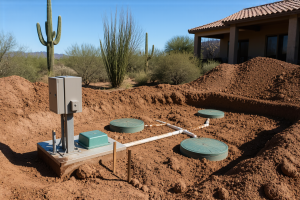
If you own an aerobic treatment unit in Mesa or Gilbert — Arizona permits and county records usually call it an advanced treatment unit, or ATU — maintenance is not optional the way it is on a conventional septic tank. Arizona regulates these as alternative onsite systems, and the state expects them to stay under a service agreement for as long as they are in the ground. That surprises a lot of people who bought a house in the East Valley and inherited an ATU without ever being told what came with it.
This is the companion piece to what an ATU costs to put in around here. This one is about what happens every year afterward.
Why ATU Maintenance Works Differently in Arizona
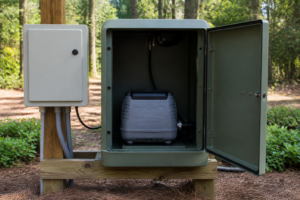
A conventional septic tank is a passive box. An aerobic treatment unit is a small, continuously running sewage plant in your yard: it has an air pump, a diffuser or aerator, a clarifier, usually a disinfection stage, and often a pump to move treated effluent out. Every one of those is a mechanical part with a service life, and when one stops, the treatment quality drops immediately rather than gradually.
Because of that, Arizona requires owners of aerobic and other alternative systems to keep an operation and maintenance agreement in place with a service provider certified for that technology, and to have the system inspected on a recurring schedule. The exact frequency is set by your permit and by the manufacturer’s requirements rather than by a single statewide number, so confirm yours with the Arizona Department of Environmental Quality and Maricopa County Environmental Services before you assume. What I see in practice across Mesa and Gilbert is service twice a year, which lines up with the service policy manufacturers have to supply on NSF/ANSI Standard 40 units.
There is one more Arizona-specific item worth knowing well before you need it: when a property with an onsite wastewater system changes hands in this state, a transfer-of-ownership inspection is required, and the report goes to the county. An ATU that has been out of contract for three years is a problem that surfaces at exactly the worst moment — two weeks before closing.
The ATU Maintenance Schedule That Actually Matters
Every month, by you
- Confirm the air pump is running. Stand next to it. You should hear it, and the housing should be warm but not hot.
- Check the alarm panel light. A silenced alarm with the red light still lit is not a resolved alarm.
- Look at the chlorinator tube if your system uses tablets, and top it up. In summer here, tablet consumption roughly doubles.
- Walk the drainfield or disposal area for wet spots and smell. Both are early signals.
Every six months, by a certified provider
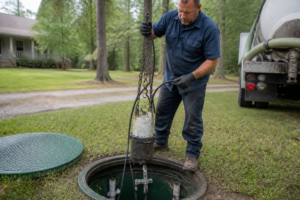
- Sludge and scum depth measurement in the trash and treatment compartments
- Aerator or diffuser inspection — the single most common failure point
- Air pump output check, filter cleaning, and diaphragm assessment
- Effluent quality observation, and disinfection verification if you are on chlorine or UV
- Control panel, float, and alarm function test
- Written report, which is the document that matters if the county ever asks
Every three to five years
- Pumping, depending on sludge accumulation rather than the calendar
- Air pump rebuild or replacement — four to seven years is realistic in this climate
- UV bulb replacement annually if you have UV rather than tablets
What ATU Maintenance Costs in Mesa and Gilbert
| Item | Typical East Valley cost | Notes |
|---|---|---|
| Semi-annual service contract | $300–$550 per year | Usually two visits; the common arrangement here |
| Single out-of-contract service call | $150–$275 | More expensive per visit, and no compliance paper trail |
| Chlorine tablets | $60–$140 per year | Higher than national averages — heat and usage drive consumption |
| Air pump replacement | $450–$900 installed | Every 4–7 years; heat shortens this |
| Aerator or diffuser replacement | $250–$600 | The most common non-pump repair |
| Pumping | $400–$700 | Every 3–5 years for most households |
| UV bulb | $90–$180 | Annual, if UV-equipped |
| Transfer-of-ownership inspection | $350–$650 | Required at sale in Arizona |
Budgeting somewhere around $600 to $900 a year all-in is realistic for a Mesa or Gilbert ATU once you average the consumables and the periodic mechanical replacements across the years. That is genuinely more than a conventional system, and it is the trade you accepted when caliche or lot size ruled out a conventional drainfield.
What Actually Fails First Out Here
The East Valley is hard on this equipment in three specific ways, and they show up in the repair record.
- Heat kills air pumps. A linear air pump sitting in full Phoenix-metro sun runs hot all summer, and diaphragms harden and crack years earlier than the same pump would fail in a temperate climate. Shading the pump housing — without blocking its intake ventilation — is the cheapest life extension available.
- Dust clogs intake filters. Air pump filters here load up far faster than the manufacturer’s interval assumes. A choked filter makes the pump work harder and run hotter, which loops back into the first problem. This is a five-minute check.
- Low water use concentrates everything. Plenty of Gilbert households are efficient with water, and snowbird properties sit empty for months. Aerobic bacteria need consistent feeding; long vacancies stall the biology, and the system needs weeks to recover after reoccupancy. If you leave for the summer, tell your service provider — there is a right way to lay a unit up.
Do You Have to Use a Contract, or Can You Maintain It Yourself?
You can and should do the monthly homeowner checks yourself. The semi-annual service is a different matter: Arizona expects it done by someone certified for your specific technology, and the written report is what demonstrates compliance. Doing it yourself does not produce that record, and it will not satisfy a transfer-of-ownership inspection.
My honest take after watching people try to save money here: the contract is not where to economize. A missed aerator failure runs the system anaerobic, and recovering treatment quality after months of that costs multiples of what the contract would have. Where you can save is by handling your own chlorine tablets and monthly checks, and by not calling for a service visit every time the alarm chirps after a heavy monsoon rain.
Common Questions
Is ATU maintenance in Mesa different from Gilbert?
Not meaningfully. Both sit in Maricopa County and fall under the same county environmental services program and the same state rules. Pricing runs slightly higher in the outlying areas of both simply because of drive time.
What happens if I let the contract lapse?
Practically, nothing happens until something goes wrong or you try to sell. Then it matters a lot: you need a current inspection at transfer, and a provider walking into a system that has been unserviced for years will usually find deferred repairs that all come due at once.
How do I find out what kind of ATU I have?
The control panel or the tank lid almost always carries a manufacturer plate — Jet, Norweco, Hoot, Clearstream and Aero-Stream are the names I see most in the East Valley. Failing that, Maricopa County holds the permit record for the address, and that will name the make and model.
Is an advanced treatment unit the same as an aerobic treatment unit?
In practice, yes. “Advanced treatment unit” is the wording you will see on Maricopa County permits and in ADEQ paperwork; “aerobic treatment unit” is what manufacturers and service techs usually say out loud. Both describe the same thing: a tank that aerates sewage so bacteria break it down before it reaches the soil. So if a company quotes you advanced treatment unit maintenance in Mesa or Gilbert, it is the same service agreement described above — compare the scope and the price, not the label.
Sources and further reading
About This Article

Written by Joel Grayson. Rural property owner who learned septic systems the hard way after my own failed 15 years ago. I created Backyard Septic to give homeowners honest, practical guidance on septic installation, maintenance, and troubleshooting. More about this site.
Scope and limits. Joel is an experienced rural property owner, not a licensed septic inspector. Have a licensed septic professional handle pumping, permits, and any diagnosis you plan to act on — and never enter a tank.
Verify this against a primary source
Specifics change, and your situation may differ from the one described here. These are the authorities worth checking directly:
- EPA SepticSmart — septic system care, inspection intervals and failure signs
- NSF International — treatment unit and tank certification standards