
I’ve spent 15 years in the field examining septic systems across the rural Southeast, and I can count on both hands the number of basements I’ve walked into where raw sewage was already pooling on the concrete. What catches me off guard just as often is how many property owners think their septic tank alarm does the same job as a sewer backup alarm system. These are two entirely different devices serving completely different purposes. If you occupy a flood-prone area, maintain a basement ejector pit, or connect to an aging municipal sewer main, you should know exactly what separates them—and whether one belongs in your home.
What Is a Sewer Backup Alarm System?
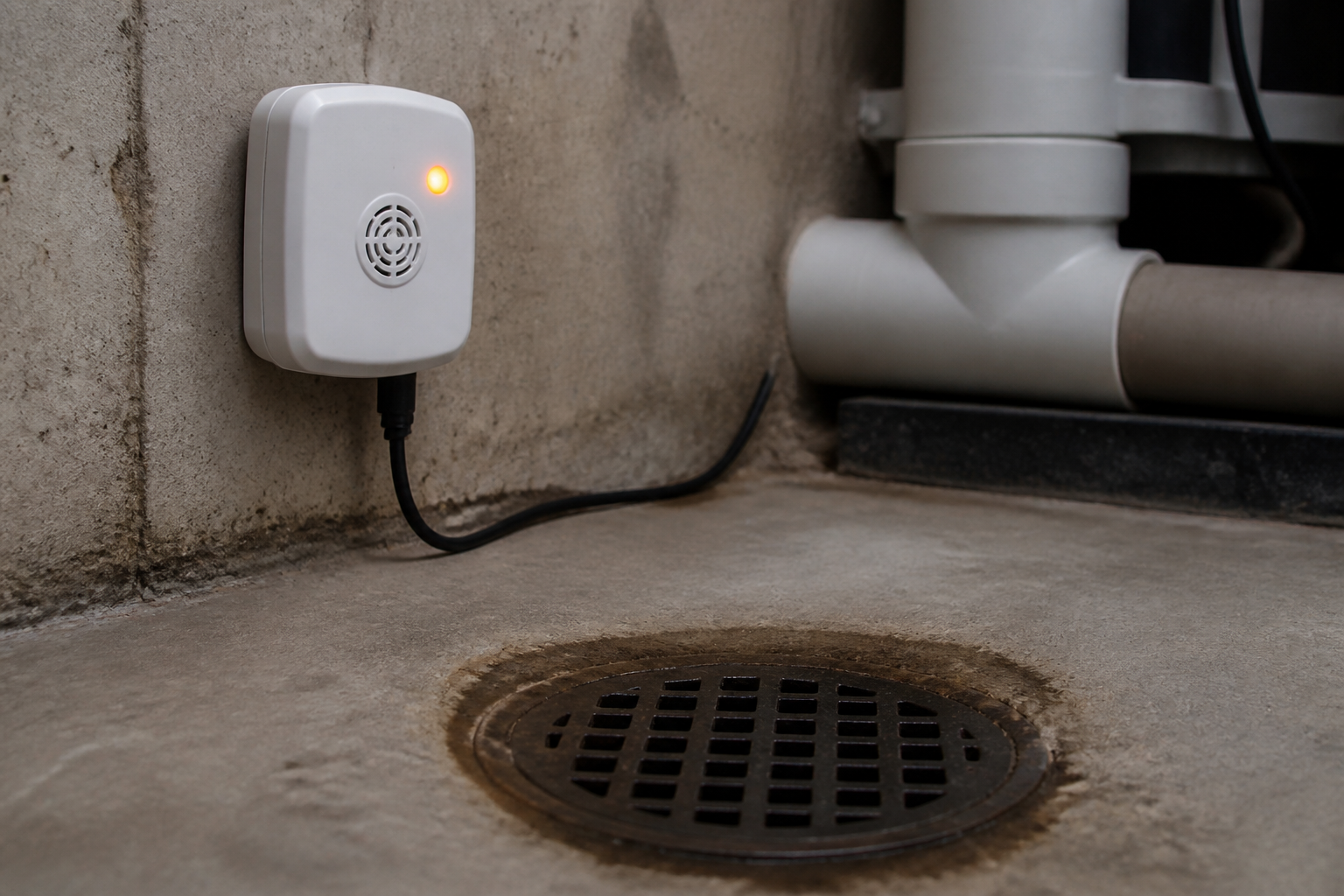
A sewer backup alarm system is an independent apparatus engineered to sense sewage or wastewater flowing backward through your household plumbing. It differs fundamentally from your septic tank’s ATU alarm (which keeps tabs on pump performance and elevated water within the tank chamber itself). Instead, a sewer backup alarm monitors conditions throughout your living space—particularly in basement floor drains, ejector pit chambers, or any fixture positioned below finished grade.
Sewage generally backs up into occupied areas when one of the following conditions develops:
- Municipal sewer lines become obstructed or reach capacity during torrential downpours
- Your septic leach field becomes waterlogged or ceases functioning
- Debris or root damage clogs the main discharge line connecting your house to the tank or municipal grid
- Your property sits in a location where rising groundwater penetrates basement walls and floors
- An ejector pump malfunctions in a dwelling with below-grade plumbing fixtures
The alarm detects liquid accumulating where it has no business being and alerts you ahead of untreated sewage spreading across your carpet, drywall, or stored belongings. From what I’ve witnessed on job sites, that advance notice gives you a small window to shut off your main water valve and get a plumber on the phone.
Two Types of Sewer Backup Alarm Systems
1. Passive Water and Sewage Sensors
These represent the most widespread and budget-friendly sewer backup alarm systems that I’ve put in homes. The mechanics are elementary: a buoyant float mechanism or electrical capacitor rests on your basement floor (or adjacent to a floor drain) and sends an alert tone or message to your phone the moment water rises in contact with it.
Common models include:
- GLENTRONICS Basement Watchdog (BAW-1) — Hardwired sensor with 88dB audio alarm, approximately $40–$50
- Govee WiFi Water Sensor — Wireless connectivity, transmits alerts via smartphone app, approximately $25–$35
- Ring Alarm Flood Sensor — Compatible with Ring Alarm platform, smartphone notifications, approximately $30–$40
- Aqara Water Leak Sensor — Integrates with multiple smart home platforms, diminutive footprint, approximately $20–$30
Typical investment: $20–$60 per unit.
Advantages:
- Minimal expense and straightforward self-installation
- Zero modifications to your plumbing infrastructure
- Wireless variations deliver messages to your handset regardless of your distance from home
- Quick deployment when your objective is solely protecting basement areas
Limitations:
- Detection begins only after moisture has built up noticeably on your floor
- Plug-in units demand a nearby electrical outlet; battery-dependent units require periodic battery swaps
- WiFi-reliant models hinge on internet signal and router function
2. Integrated Backwater Valve Alarm Systems
These represent a more elaborate setup in which alarm functionality is built directly into a backwater valve (also called a sewage check valve). The moment the valve encounters reverse pressure and shuts, it triggers an audible or digital alert at the same instant.
Sample options:
- Mainline Smart Backwater Valve with Alarm — Positioned in the main discharge line, triggers notification when valve closes, approximately $300–$400
- Ace Pumps Backwater Valve Systems — Built for heavy-duty applications, optional remote notification capability, approximately $250–$350
Estimated expenditure: $150–$400, labor for professional installation included.
Benefits:
- Blocks sewage from ever reaching your interior spaces (the valve stops reverse circulation)
- Notification arrives instantaneously when the valve engages, not after puddles form
- Avoids phantom alerts triggered by innocent water drips or condensation
- Delivers a more durable, professionally-graded installation
Drawbacks:
- Installation must be handled by a licensed plumber (municipal codes require it)
- Greater initial price tag
- Backwater valves demand routine evaluation and flushing to remain free of obstructions
Based on my years of fieldwork, I typically steer homes with persistent backup episodes or those situated in vulnerable flood zones toward backwater valve systems. For homeowners seeking an uncomplicated, economical safeguard, standalone water sensors fill the need admirably.
Where to Install a Sewer Backup Alarm
Placement determines how effectively the system functions. You must position your sensor wherever water will accumulate soonest during an actual backup. Here’s where I typically mount them:
- Floor Drain (Basement or Laundry Room): Situate the sensor directly atop or right next to the floor drain opening. This is the first location where water emerging from a backup will pool.
- Ejector Pit: Homes featuring a below-grade bath or laundry installation rely on an ejector pit as their lowest collection point. Affix the sensor to the inner wall of the pit or secure it to the pit cover so it responds when water height exceeds standard operation.
- Basement Corner or Low Spot: If your basement lacks a dedicated floor drain, locate the lowest geographical point and mount the sensor there. Backup water will naturally pool in such zones.
- Shower Drain (Below-Grade Bathrooms): Finished lower-level bathrooms with showers make excellent alarm sites because water escaping the shower drain signals a problem early on.
I deliberately steer clear of positioning sensors near active sump pump discharge lines—every pump cycle will generate a false alarm and render the system useless.
How I Install Sewer Backup Alarm Systems
For standalone water sensors (the type most property owners select), the setup procedure is uncomplicated. This is my standard method:
- Prepare the location: Make sure the flooring is completely dry and cleared of residue, dirt, or grease buildup. Contaminants on the surface compromise sensor accuracy and adherence.
- Orient the sensor: Rest the device on level ground in a way that allows the float mechanism or probe to move without obstruction. For floor drain installations, I frequently use a small plastic riser to keep the unit centered above the drain opening.
- Supply electrical power (hardwired models): For non-battery alarm systems such as the Basement Watchdog, connect to a GFCI outlet no farther than 6 feet away. Keep cords clear of foot traffic zones.
- Activate wireless connectivity (smart models): Complete the manufacturer’s mobile app enrollment procedure. Confirm your basement receives sufficient WiFi range—if coverage is weak, deploy a signal booster.
- Verify operation: Engage the test button found on the unit body. Confirm the alarm sounds clearly and that your app receives the notification message (if WiFi-equipped).
- Program alert preferences: On WiFi-capable equipment, enable push alerts and SMS notifications to your mobile number so you get alerted instantly round-the-clock.
This installation takes roughly 10 to 15 minutes from start to finish. Permits are unnecessary, and hiring a plumber is not required.
Smart Sewer Backup Alarms and WiFi Options
This post covers exactly what a sewer backup alarm does, the two main types I recommend to clients, where to install them, and what you should do when one goes off. This post contains affiliate links. As an Amazon Associate, I earn from qualifying purchases.