Should you spend $1,800 fixing the thing that’s failing right now, or bite the bullet on a $14,500 complete system overhaul? That question lands in my inbox and voice mail constantly, and the answer hinges on five or six specific factors that most contractors gloss over. I’ve evaluated this decision on more than 2,000 site visits across rural Georgia, Alabama, and Tennessee over the past 15 years, and the difference between a smart repair and a necessary replacement isn’t always obvious until you know what signals to look for.
The straightforward part: some repairs genuinely make financial sense and buy you years of functional system life. The harder part — the one I’m spelling out here — involves recognizing when repair estimates are chasing a problem that’s already systemic, and when throwing money at the tank or drainfield is just delaying the inevitable replacement you’ll need within 24 to 36 months anyway. I’ll show you how I calculate that inflection point using actual job pricing, real-world failure patterns, and soil and regulatory factors that shift the equation.
Breaking Down Septic System Components and Which Ones Are Actually Worth Repairing
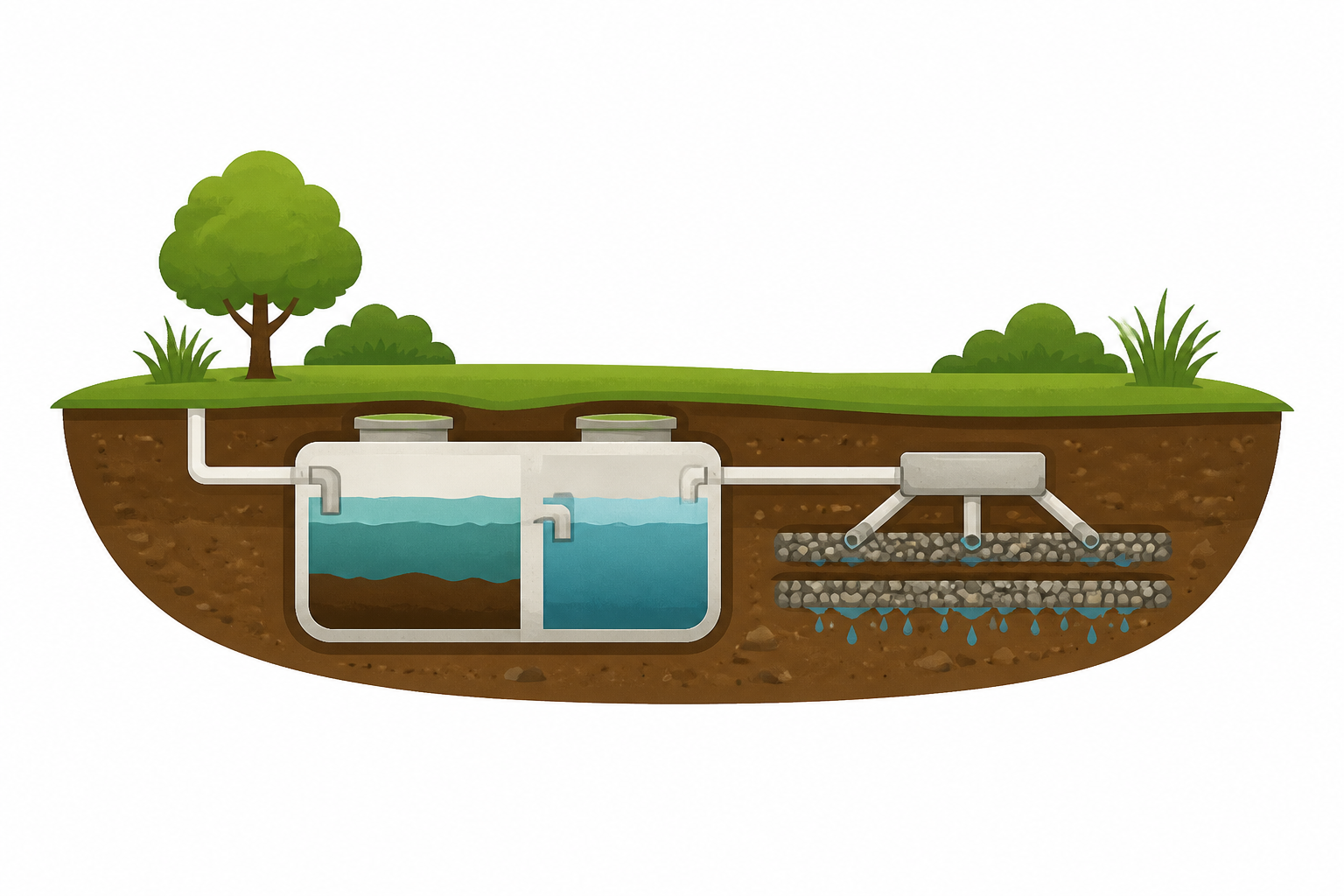
The word “septic repair” gets slung around loosely, but the system underground isn’t a single unified vessel. Four distinct pieces make up a working installation: the main tank chamber, the baffle assembly (inlet and outlet), the distribution box that splits flow to multiple laterals, and the drainfield itself. Failure in one piece doesn’t always mean failure everywhere. Knowing which component has broken down — and how badly — is the threshold question for repair versus replacement math.
Take a baffle failure. That’s concrete or PVC that’s cracked or separated inside the tank. Straightforward to swap out, usually finished in 120 minutes or so, running anywhere from $150 to $350 depending on tank depth and access. A distribution box with a structural crack or misaligned outlet ports? That’s typically $400–$800 to pull and reinstall a new one. Damaged supply lines running from tank inlet or outlet? Those can be excavated and replaced for $500–$1,200 depending on burial depth and soil compaction. All of these are legitimate, cost-effective repairs that genuinely extend system function. The problem emerges when the damage is beneath the soil in the drainfield absorption area itself.
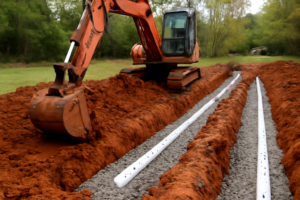
Drainfield repairs are where I see money disappear. Contractors pitch “restoration” approaches — using aeration or high-pressure jetting to unseal biomat or loosen compacted soil — at price points between $800 and $2,500. I’ll be direct: that might buy you another year or possibly 18 months. But if the soil underlying your field has been hydraulically exhausted, or if the biomat sealing the interface between effluent and soil has calcified, no jetting or air injection brings back reliable infiltration rates. You’re not repairing an injured system. You’re paying repair pricing to delay a replacement that’s already inevitable.
Actual Dollar Figures for Repairs and Full System Replacements
Abstract price ranges don’t help you make a concrete choice. Below are the real dollars I’ve invoiced and seen invoiced by peer contractors across Georgia, Alabama, and East Tennessee during 2023 and 2024. Regional variance of 10–20% may apply to your specific location, but these proportions are consistent across the rural Southeast.
Individual Repair Line Items and Labor
- Baffle replacement: $150–$400
- Distribution box replacement: $400–$900
- Inlet/outlet pipe repair: $500–$1,500
- Pump replacement (for pump systems): $800–$2,000
- Drainfield aeration or jetting: $800–$2,500
- Partial lateral replacement (1–2 lines): $2,000–$4,500
Full System Installation Costs in This Region
- Conventional gravity system (3-bedroom home): $8,000–$15,000
- Pump-to-drainfield system: $10,000–$18,000
- Mound system (poor soil or high water table): $15,000–$25,000
- Aerobic treatment unit (ATU): $12,000–$20,000 installed
That homeowner in Pickens County I mentioned? Her tank shell and interior baffles were structurally sound. Her distribution box had fractured and shifted, causing uneven flow distribution — one side of the drainfield was receiving a disproportionate load for years. Two of the lateral lines had gone completely saturated. Two others still had absorption capacity. We replaced the D-box, decommissioned the two dead laterals, and trenched two fresh ones into a spare section of her property. Final bill: $4,200. That system is still performing well after 14 months. That repair made mathematical and practical sense.
The Five Conditions That Signal You’ve Crossed Into Replacement Territory
Bookmark this section. Through nearly two decades of field inspection and repair decisions, these five circumstances consistently indicate that repair spending is being thrown at a deterioration pattern that requires system replacement instead.
1. System Age Exceeds 25 Years with No Major Component Upgrades
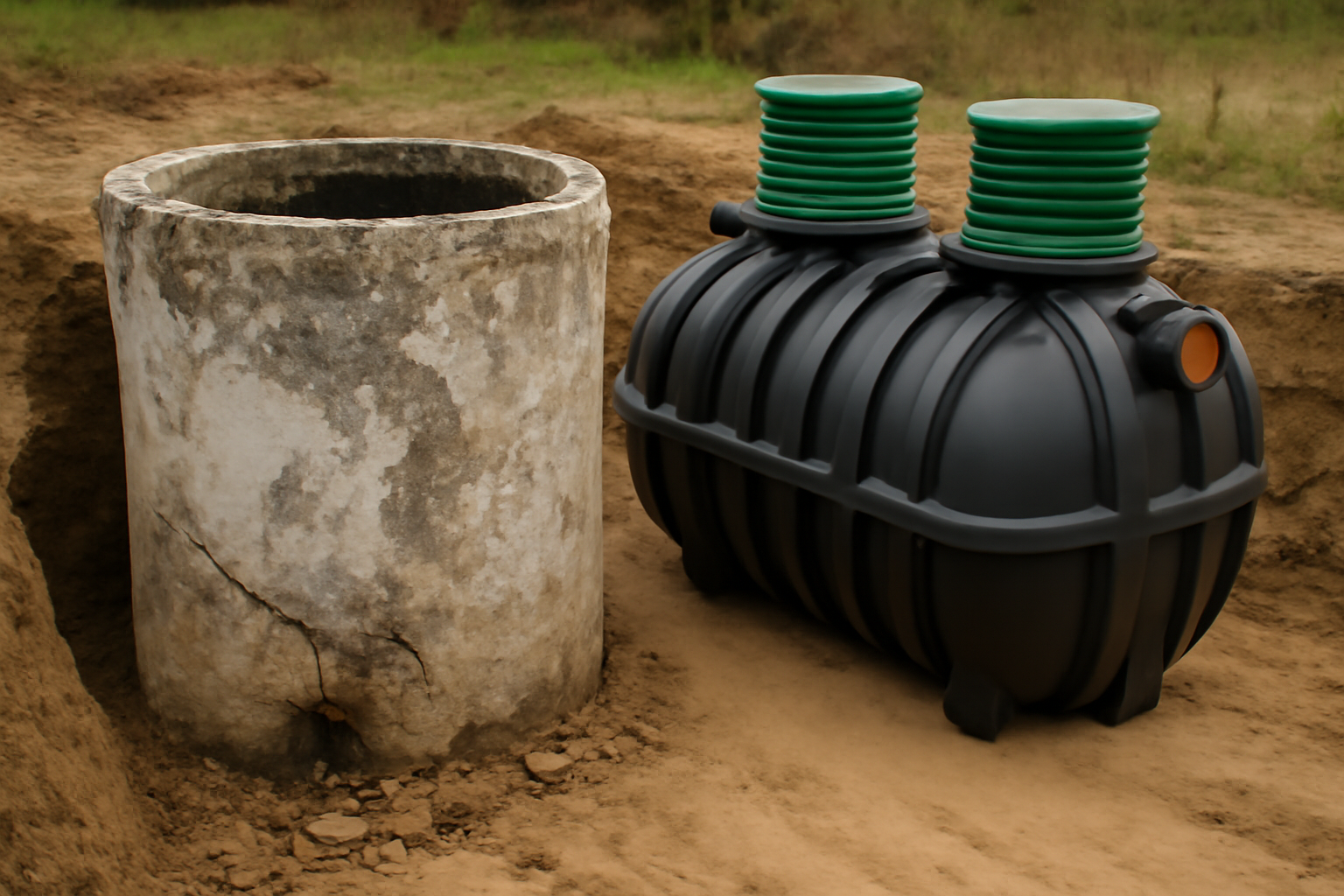
Concrete tank construction from the mid-1990s and earlier — especially tanks installed before the mid-1980s across the Southeast — frequently featured thinner concrete walls and minimal corrosion resistance strategies. Steel baffles were often tar-dipped, and that protective coating typically fails after 15–20 years of exposure to septic gases and moisture. Once a tank begins accepting groundwater through structural cracks, or once the internal components deteriorate structurally, you’re fighting a situation where individual repairs address symptoms, not the underlying tank viability. Additionally, Georgia Rule 511-3-1, Alabama ADEM Chapter 420, and comparable state health regulations mandate that when major permitted work is undertaken, system components must meet current standards. This regulatory layer frequently forces a full system upgrade anyway, making piecemeal repairs a waste of permitting effort.
2. Simultaneous Breakdown of Multiple System Pieces
I pull up to a property and identify cracked or deteriorated baffles, a damaged distribution box, and two or three lateral lines venting sewage. That’s not a single isolated failure. That’s cascading deterioration across the system. While each individual problem could be justified as a standalone repair, the pattern itself indicates systemic aging. Here’s my rule of thumb: if stacking up separate repair estimates totals 50% or greater than the cost of a complete replacement, I recommend replacement. Spending $7,000 to patch a failing $11,000 system isn’t prudent long-term stewardship of your property or your budget.
3. Drainfield Lacks Any Designated Backup or Expansion Area
EPA guidance for onsite wastewater systems explicitly recommends a reserve drainfield equal to 100% of the primary field’s treatment capacity. Many properties permitted decades ago were designed without reserve area due to lot size or regulatory requirements at the time. If your existing drainfield is fully in use and your lot doesn’t contain additional space meeting your county health department’s setback mandates — typically 10 feet from boundaries, 50–100 feet from drinking water wells — then you’re facing a redesigned system layout regardless of current repair costs. That drives a replacement scenario.
4. Sewage Reappears in Yard or Tank Within Weeks of Pumping
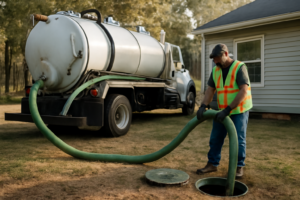
A pump-out temporarily relieves hydrostatic pressure and gives the drainfield a short window to accept effluent again. But if sewage backs up into your yard or tank within 30 days of pumping, your drainfield has functionally stopped infiltrating. I’ve witnessed homeowners pay for three separate pump-outs in a 12-month period at $400–$600 per service, totaling $1,800 in expenses, when they could have allocated that same money toward a new system installation. Instead, they continued limping along and eventually faced replacement at higher cost combined with the pump-out spending.
5. Soil Testing Shows Percolation Rates Have Shifted Significantly
Soil conditions evolve, particularly in clay-predominant soils found throughout the Piedmont and Appalachian regions of the Southeast. When a fresh soil percolation test reveals rates incompatible with your existing system’s design capacity, county health departments mandate a new system design meeting current-day soil conditions and loading standards. This regulatory mandate supersedes repair considerations. You’re not repairing anymore. You’re replacing to meet code.
How Maintenance Products Can Buy You Time — and What Their Limits Are
Facing a five-figure replacement invoice naturally prompts the question: can aggressive tank maintenance stall a failing system long enough to save capital or time-plan the replacement more strategically? Enzyme additive packets like RID-X won’t mend a collapsing drainfield or restore soil infiltration, but they genuinely do decelerate solid accumulation inside the tank itself.
Where enzyme products deliver
- Consistent monthly dosing — single packets eliminate guesswork or the need to measure and mix liquid formulations
- Measurably decreases sludge layer growth, which can earn you 6–18 months of system breathing room before urgent repair scenarios emerge
- Also functions as preventive medicine — when I deploy it in healthy systems, neighbors see longer intervals between pump-outs
Where enzyme products fall short
- Cannot reverse drainfield saturation or restore soil absorption capacity �� it’s a tank-level intervention, not a field-level fix
- Results surface gradually over 2–3 months of use, so they won’t provide quick proof-of-improvement if you need documentation immediately
I was skeptical the first time I recommended it to someone with a marginal system — I half-expected a call six weeks later saying it didn’t work. Instead, that homeowner’s next pumpout showed measurably less sludge, and she gained enough time to budget for repairs without panic. Pick up RID-X Septic Tank Treatment Pods — 6 Month Supply if you want a low-risk way to buy yourself time.
Sources and further reading
About This Article

Written by Joel Grayson. Rural property owner who learned septic systems the hard way after my own failed 15 years ago. I created Backyard Septic to give homeowners honest, practical guidance on septic installation, maintenance, and troubleshooting. More about this site.
Scope and limits. Joel is an experienced rural property owner, not a licensed septic inspector. Have a licensed septic professional handle pumping, permits, and any diagnosis you plan to act on — and never enter a tank.
Verify this against a primary source
Specifics change, and your situation may differ from the one described here. These are the authorities worth checking directly:
- EPA SepticSmart — septic system care, inspection intervals and failure signs
- NSF International — treatment unit and tank certification standards