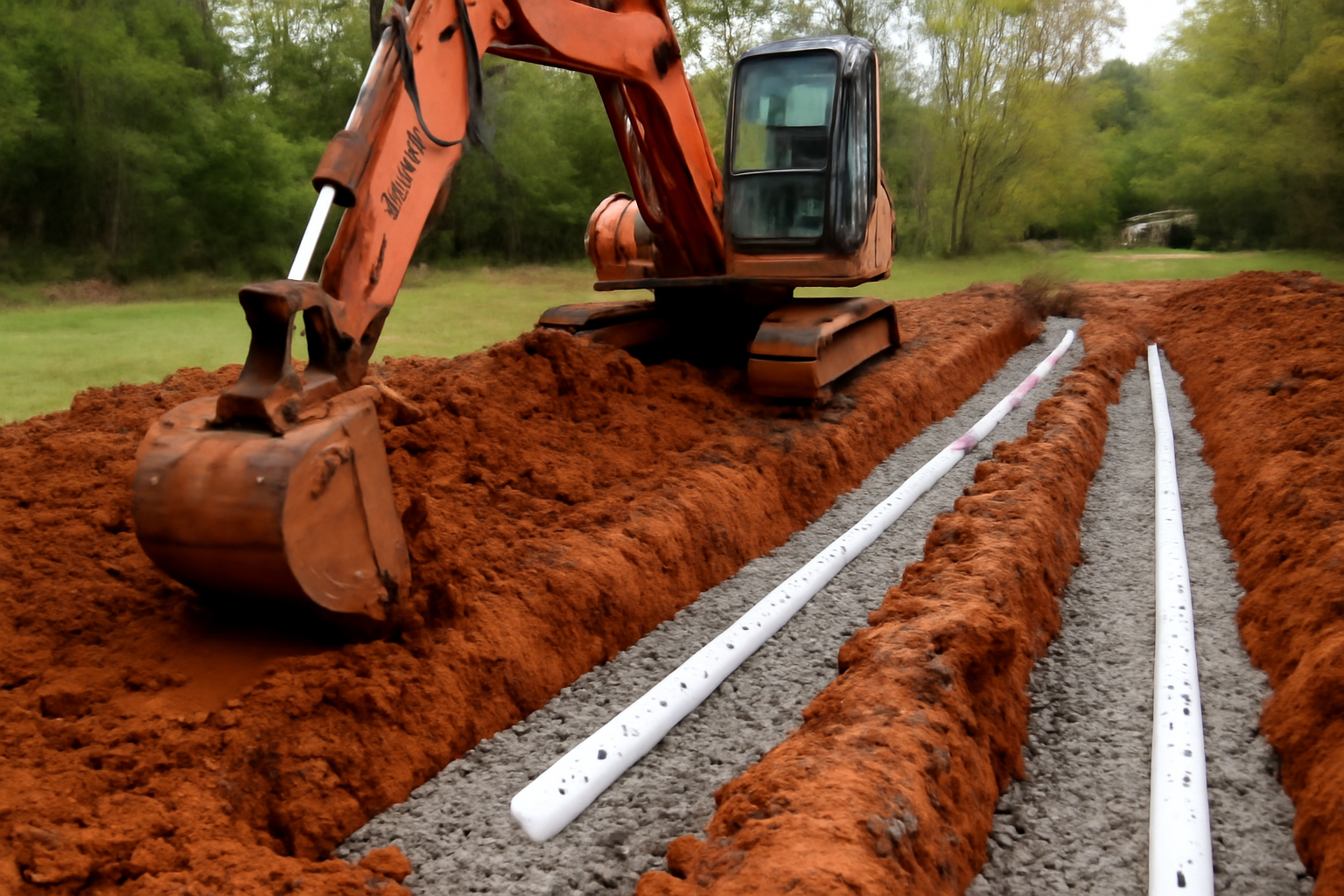
Three separate drainfield replacements quoted in the same season yielded three wildly different price tags: $7,400, $14,800, and $22,500. Each one sat in a different county, faced completely different soil and site constraints, and required a different system architecture to pass inspection. The reason those numbers scattered so far apart has nothing to do with contractor markup and everything to do with the variables that drive what actually gets installed underground. I’ve spent fifteen years watching failing systems come out of the ground across rural Georgia, Alabama, and Tennessee, and I’ve quoted hundreds of these jobs — so let me walk you through what I found on each one and why the costs landed where they did.
Most contractors skip the explanation and hand you a number, but here’s what actually matters: the pipe and gravel are often the cheapest components in the entire job. Permitting, soil analysis, site excavation, hauling away the old field, and regulatory compliance paperwork add up in a hurry. By the time a state health department gets its paperwork processed, the pipe becomes almost an incidental line item. Knowing what you’re actually paying for — and what drives each charge — is the difference between a smart decision and getting squeezed by someone who’s not transparent about scope.
Understanding the Real Cost Drivers Behind Drainfield Replacement
Before I detail these three specific projects, I need to explain the mechanics that move price up or down. Available space on your property and usable area for repair carry enormous weight. Most southeastern states enforce regulations derived from the EPA’s Onsite Wastewater Treatment Systems Manual, which mandates specific distances separating drainfields from wells, property boundaries, buildings, and surface water. Georgia’s EPD, for instance, demands a fifty-foot minimum clearance from drinking water wells. A tight lot can force you straight into an engineered alternative system just to squeeze in the replacement field legally.
Soil drainage speed is the second heavyweight factor. A traditional drainfield performs adequately when soil drains at a moderate pace — roughly between 30 and 60 minutes per inch during a perc test. When you encounter dense clay or soil that drains too fast, you’re immediately looking at alternative technologies: raised mound systems, drip fields, or other engineered solutions. I watched one homeowner’s bid jump from an estimated $6,000 to nearly $18,000 after perc results revealed impenetrable hardpan two feet below the surface.
Regional labor costs in rural counties usually run lower than metro areas, but accessibility and terrain can flip that advantage around quickly. A drainfield on a flat, accessible parcel is typically a two-day operation with standard equipment like a trackhoe. That identical installation on a steep grade in the North Georgia mountains stretches to three or four days and sometimes demands specialized, pricier machinery just to navigate the slope. Add in permit processing — normally ranging from $300 to $700 across southeastern counties — plus a mandatory percolation test at $200 to $500, and you’ve already spent $500 to $1,200 just to start the actual work.
Job #1: The Uncomplicated Installation Outside Talladega County, Alabama — $7,400
This first project involved a 3-bedroom residence in rural Talladega County, Alabama. The homeowner reached out after noticing standing water in the yard near the old drainfield location and experiencing sluggish toilet performance — both textbook signs of field failure from a 25-year-old system that had gone too long without regular tank pumping. My excavation and inspection revealed the laterals were completely sealed off by biomat, that thick, dark, oxygen-starved layer that blocks soil from absorbing any more liquid. Replacing the field was the only option.
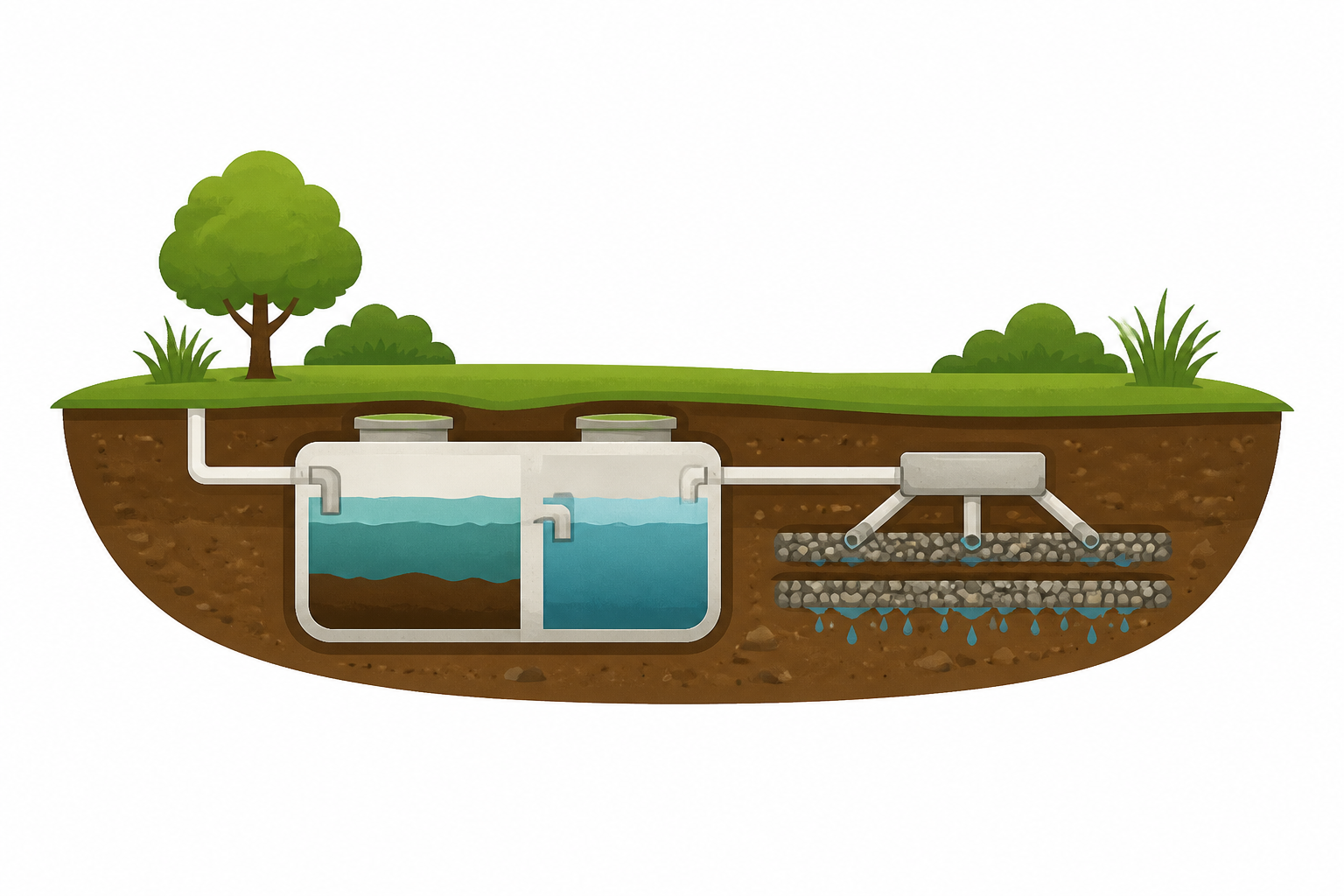
The circumstances broke in the homeowner’s favor: the property was level, well-cleared, and restoration area was plentiful. Perc results came back at 42 minutes per inch — perfectly centered in the conventional system comfort zone. The Alabama Department of Public Health charged $385 for the permit. The crew installed 300 linear feet of 4-inch perforated PVC split into three 100-foot runs, each nestled in a 12-inch gravel layer inside an 18-inch trench, all feeding back through a freshly installed distribution box. Materials ran to approximately $1,800 total. Two crew members worked two full days, with equipment support throughout.
The itemized breakdown looked like this:
- Permit and perc testing: $560
- Excavation and old system removal: $1,200
- Gravel, pipe, distribution box, fittings: $1,800
- Labor (two men, two days): $2,400
- Topsoil, grading, and seeding: $600
- Equipment rental and transport: $840
- Total: $7,400
This is about as efficient as a drainfield replacement gets to be. Good soil, adequate space, and a straightforward permitting process all conspired in the homeowner’s favor. Reality rarely cooperates this neatly.
Job #2: The Constrained Lot and Weak Drainage in Central Tennessee — $14,800
The second estimate presented an entirely different scenario. A 4-bedroom residence in a rural subdivision near Cookeville, Tennessee, sat on roughly three-quarters of an acre — but usable space was severely limited. A waterway bordered the rear portion of the lot, and a detached garage claimed a side section. After accounting for the mandatory setback requirements spelled out in Tennessee’s Department of Environment and Conservation regulations, the only feasible restoration zone was a narrow corridor maybe 40 feet wide running along the front boundary.
The perc test results were disappointing: 90 minutes per inch showed up in two of the three test locations. That enters marginal territory based on my field experience — once you cross the 60-minute threshold, an engineered alternative becomes the safer choice. Tennessee’s health regulator mandated a low-pressure distribution system with a dosing pump in this case, designed to meter effluent gradually across the field to compensate for the soil’s reluctance to drain. The pump assembly and its control electronics alone represented a $2,200 addition to the project scope.
I made a costly mistake on a similar Tennessee job years back: I underestimated the electrical infrastructure required to power the pump installation and came up $900 short on my estimate. I absorbed that loss. This time, I brought a licensed electrician in from the outset, and being upfront about that decision actually worked in my favor — the homeowner respected the transparency and I won the contract. Here’s the full financial picture:
- Permit, perc testing, and engineer’s site plan: $1,650
- Excavation and demolition of old field: $2,200
- Low-pressure pipe system materials: $3,100
- Dosing pump and control panel: $2,200
- Electrical hookup (subcontracted): $900
- Labor (three men, three days): $3,600
- Grading, topsoil, seeding: $750
- Equipment and transport: $400
- Total: $14,800
The gap separating Job #1 from Job #2 isn’t about how much I mark up my labor. It’s soil character, physical space, and how complex the system has to become to work. That’s where drainfield replacement cost really originates.
Job #3: The Engineered Mound System on a Hillside in North Georgia — $22,500
The third project ranked among the most demanding replacements I’ve handled in recent years, and complexity was the story. A 3-bedroom home with a rustic design sat on a Gilmer County, Georgia hillside sloping at approximately 15 degrees. The previous drainfield installation had been problematic from day one — laterals ran perpendicular to the slope instead of following contour, causing effluent to emerge downhill from the field. That’s simultaneously a system breakdown and a violation of Georgia EPD Rule 511-3-1 governing public health.
The perc test yielded no acceptable results anywhere in the designated area because an impenetrable layer blocked drainage at just 18 inches down. The Georgia county health department’s response was clear: obtain certification from a professional engineer to design a mound system — a constructed drainfield elevated above natural ground on imported sand and soil fill. Mound installations demand substantially more material, exponentially more labor, and much tighter installation tolerances compared to conventional fields. The engineering study and design itself cost the homeowner $1,800 before any equipment arrived on site.
Here’s what the complete project bill came to:
- Engineering design and site evaluation: $1,800
- Permit fees (county health department): $680
- Imported fill sand and topsoil (18 tons): $2,700
- Gravel, pipe, distribution system: $2,400
- Dosing pump and timer controls: $2,100
- Excavation and old system removal: $2,800
- Mound construction labor (four men, four days): $5,200
- Electrical work: $1,100
- Final grading, erosion control, seeding: $920
- Equipment, fuel, transport: $800
- Total: $22,500
That figure is hard to swallow, but the site and soil conditions left no lower-cost alternatives. The system type was determined by soil and site facts, not contractor preference, and the system type was what drove the price. A credible contractor couldn’t have delivered the same result for substantially less without skipping steps that would either fail health department inspection or underperform within a couple of years.
When a Tank Treatment Can Extend the Life of a Struggling Drainfield
There are situations where a drainfield showing early strain doesn’t immediately require complete replacement — specifically when excessive solid material from the tank is accelerating saturation. RID-X represents my standard first move when I’m trying to help homeowners buy time before committing to a five-figure system rebuild.
Where it delivers results
- The combination of bacterial cultures and enzymatic action genuinely reduces solid accumulation inside the tank, which translates to less debris reaching the drainfield — on systems that aren’t yet completely failed, this has measurably slowed saturation patterns in my experience.
- A six-month supply format eliminates the need for monthly application routines; homeowners insert a dosage pod every two months and maintain consistency, which is critical since sporadic dosing undermines the whole mechanism.
- The cost remains low enough to justify trying before spending $12K–$25K on a replacement — if treatment buys even two to three additional years of system life, most homeowners find that outcome worthwhile.
Where it falls short
- It’s not a cure-all remedy — tree roots permanently blocking laterals or soil saturation caused by field age won’t respond to any tank additive, yet I’ve fielded complaints from homeowners who expected RID-X to reverse irreversible damage.
- Maximum effectiveness appears when a system is neglected but not yet catastrophically broken; if sewage is already backing into your home plumbing, you’ve probably advanced past the point where preventative chemistry helps.
I once recommended RID-X to a neighbor as a stopgap and half-expected it to do nothing, but three months in their drains started flowing noticeably better—enough that they decided to hold off on the full replacement for another season. If you’re staring at replacement quotes and want to at least try extending your drainfield’s life, grab RID-X Septic Tank Treatment Pods – 6 Month Supply, Dual Action Enzymes and Bacteria to Break Down Waste & Prevent Backups.
Sources and further reading
About This Article

Written by Joel Grayson. Rural property owner who learned septic systems the hard way after my own failed 15 years ago. I created Backyard Septic to give homeowners honest, practical guidance on septic installation, maintenance, and troubleshooting. More about this site.
Scope and limits. Joel is an experienced rural property owner, not a licensed septic inspector. Have a licensed septic professional handle pumping, permits, and any diagnosis you plan to act on — and never enter a tank.
Verify this against a primary source
Specifics change, and your situation may differ from the one described here. These are the authorities worth checking directly:
- EPA SepticSmart — septic system care, inspection intervals and failure signs
- NSF International — treatment unit and tank certification standards