Cracked distribution boxes buried under tall grass, misplaced drain fields trickling sewage into seasonal runoff channels, tanks positioned where no pump truck can ever reach them — these are the daily reminders that owning a septic system on large acreage doesn’t mean the installation rules vanish. Homeowners with sprawling rural properties often tell me, “Joel, I’ve got 50 acres. Surely I can position that tank wherever makes sense for the house, right?” The answer is more complicated than the acreage might suggest. During my two decades installing and inspecting systems throughout rural Georgia, Alabama, and Tennessee, the most labor-intensive projects have frequently involved large properties where owners thought available space meant fewer constraints. My own first major acreage installation taught me this lesson forcefully — I failed to verify local setback ordinances thoroughly before excavation began, and the property owner suffered nearly 10 weeks of rework and additional expenses. Abundant land expands your choices significantly, yet it provides no exemption from setback mandates, soil-specific limitations, or the precise calculations that must be executed accurately from the outset.
Understanding this shift in perspective happened during a sprawling 75-acre residential project in the foothills outside Dalton. The homeowner had identified an inviting level clearing beside his property’s pond — excellent sightlines, natural elevation advantage — but fundamentally unsuitable for waste treatment. The earth composition leaned heavily toward clay, and subsurface water levels rose to approximately 18 inches during wetter seasons. Installing the treatment field became necessary 300 feet away from his initial preference. That adjustment added $6,800 in unexpected expenses and postponed construction by several additional weeks. That experience restructured my entire methodology for managing expansive rural installations.
What follows represents everything I’ve accumulated about system dimensioning and positioning across spacious rural land parcels. I’ll detail my methodology for calculating tank volume, techniques for identifying appropriate field locations, why mandatory separation distances remain non-negotiable regardless of available property size, and which miscalculations I repeatedly encounter from both property owners and some service professionals.
Why Expansive Acreage Creates More Complexity, Not Less
Extensive property footprints introduce expanded site selection possibilities accompanied by substantially elevated decision-making burden. A typical residential subdivision lot with half-acre dimensions offers virtually predetermined placement options. A property spanning 20, 50, or even 100 acres presents a menu of potentially viable installation sites — each wrong selection can trigger $10,000 to $30,000 in remedial reconstruction or complete system replacement expenses down the road. I’ve managed situations resulting in both outcomes.
The central error I continuously encounter involves treating property dimensions as the determining factor for suitability. Property size alone proves irrelevant. Your county’s environmental health authority — not acreage figures — establishes what locations satisfy code requirements. Throughout rural Southeastern jurisdictions, regulatory frameworks typically derive from state decentralized wastewater statutes that mirror EPA technical guidance for standard treatment arrangements. Ground composition classification, terrain inclination percentages, separation from groundwater sources, and distance to seasonal water elevation fluctuations determine feasibility. None of these variables shift depending on whether your deed shows 2 acres or 200.
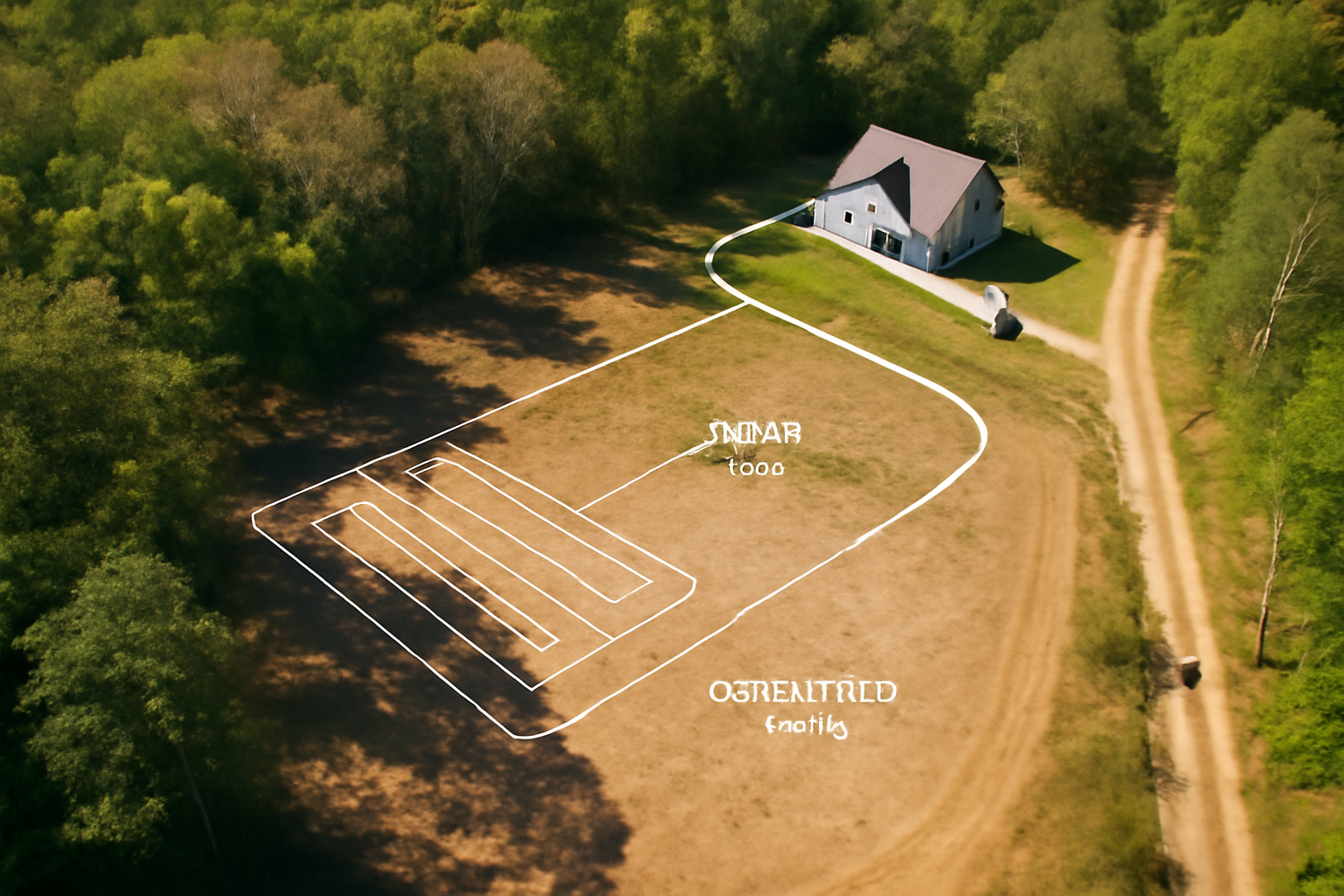
What large-scale holdings genuinely provide is positioning adaptability for contingency treatment zones and eventual system capacity upgrades. Most jurisdictions mandate identification and preservation of a secondary treatment area equaling 100% of your original drain field dimensions positioned alongside your primary installation. Smaller residential parcels frequently cannot accommodate any designated backup space. With expansive properties, I consistently map both the active treatment field and the reserved replacement location before finalizing any positioning decisions. That single planning action has prevented substantial complications for a good number of neighbors.
System Dimensioning Methodology for Expansive Rural Properties
Tank capacity determination depends on residential specifications rather than terrain dimensions. I establish requirements using bedroom enumeration — the methodology endorsed across most Southeastern state environmental programs. A three-bedroom residence typically mandates a bare minimum 1,000-gallon holding vessel. A four-bedroom residence demands no fewer than 1,250 gallons. Nevertheless, I seldom recommend minimum specifications on expansive rural holdings. Why? Spacious acreage properties routinely accommodate larger household populations, separate guest structures, or anticipated future room additions.
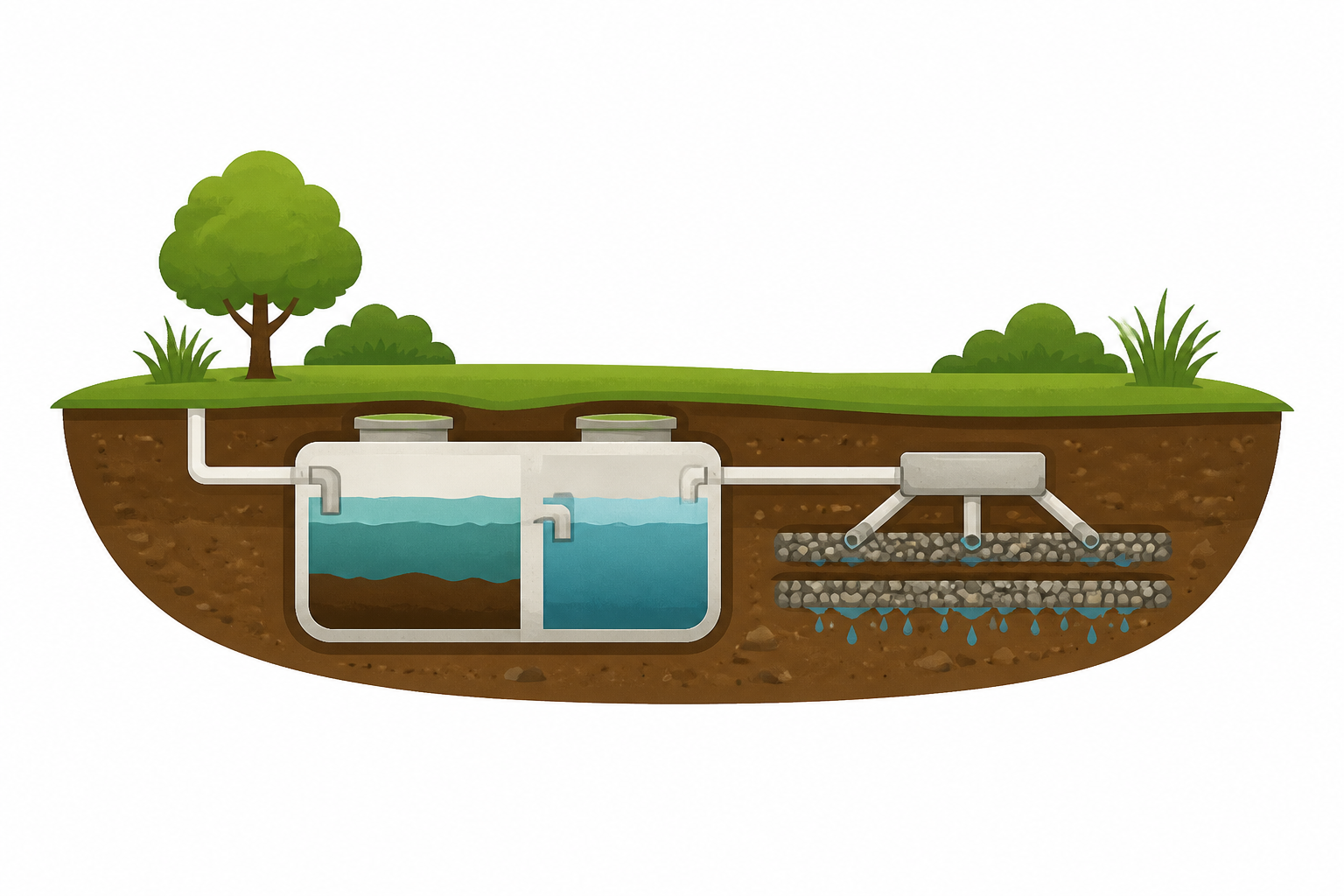
My typical specification for a four-bedroom countryside residence is a 1,500-gallon dual-chamber vessel. The dual-chamber arrangement facilitates superior particle settlement before treated water advances into the absorption field. This distinction grows increasingly significant in countryside installations because maintenance schedules often extend beyond typical suburban intervals — certain folks live in locations roughly an hour’s travel from accessible pump service providers. From my field observations, the supplementary $300 to $500 investment for expanded dual-chamber capacity compensates itself through extended system functionality.
Field Dimension Calculations Adjusted for Ground Composition
Treatment field dimensions fundamentally hinge upon your ground’s infiltration velocity — specifically, the timeframe required for wastewater traversal downward through soil strata. Prior to committing to any installation site, I execute percolation assessments and comprehensive soil profiling. Ground composition favoring sand and loam particles — prevalent across significant portions of rural Alabama and central Georgia — facilitates rapid effluent movement, necessitating proportionally diminished field configurations. Ground heavy in clay minerals — characteristic of Tennessee Valley areas — demands substantially expanded field dimensions or non-conventional treatment methodology. The comparative specifications I reference based on infiltration examination findings are:
- Infiltration velocity measuring 1–5 min/inch: roughly 85–100 sq ft of absorption trenching per bedroom
- Infiltration velocity measuring 6–30 min/inch: roughly 100–150 sq ft per bedroom
- Infiltration velocity measuring 31–60 min/inch: roughly 150–250 sq ft per bedroom, or selection of specialized system type becomes necessary
- Infiltration velocity exceeding 60 min/inch: conventional system normally fails regulatory authorization
These specifications correspond to frameworks circulated by environmental agencies throughout Southeastern jurisdictions. Always confirm with your jurisdiction’s environmental health office — regulatory variance persists even across neighboring counties within singular states.
Mandatory Separation Distances I Consistently Implement — Even Across Vast Properties
Overconfidence on spacious holdings frequently manifests regarding necessary separation distances from critical features. Property owners frequently presume plentiful unused terrain negates separation concerns. That presumption proves incorrect. Separation mandates function to safeguard private water supplies, neighboring groundwater access, and adjacent waterway integrity — concerns amplified, rather than diminished, across countryside locations where private groundwater withdrawal prevails.
The mandatory distances I maintain throughout my countryside Southeastern undertakings conform to state environmental regulatory publications, which across most Southeastern jurisdictions comprise their decentralized wastewater handling regulations. The EPA’s technical guidance document addressing dispersed treatment infrastructure additionally supplies dependable foundational principles. These constitute the smallest allowable separations I implement across the preponderance of my countryside Southeastern undertakings:
- Your residence’s drinking supply: 75–100 feet separating tank, 100–150 feet separating treatment field
- Neighboring property’s water withdrawal: 100 feet baseline from all system components
- Running water features including creeks, reservoirs, ponds: 50–100 feet dependent on jurisdiction-specific guidance
- Parcel boundary demarcations: 10–25 feet baseline across most jurisdictions
- Structural footprint or basement excavation: 10 feet from tank, 20 feet from field
- Subsurface water infrastructure: 10 feet baseline
On a sprawling 60-acre parcel in rural Walker County, Alabama, a property owner attempted positioning his absorption field within a natural terrain depression that channeled stormwater toward an adjacent creek roughly 80 feet downstream. State regulation mandated 100 feet minimum from any waterway. Relocating the field installation and extending the distribution lines by 120 feet transpired necessary. His total expenditure exceeded the original estimate by $1,400. Proper execution represented both regulatory adherence and responsible environmental stewardship. That waterway channeled runoff toward a neighboring property owner’s retention area.
The Difficult Lesson Regarding Terrain Gradient
During my entry-level installation period, I positioned a gravity-oriented treatment field at a location exhibiting approximately 8% downward inclination — positioning it within acceptable parameters per most state regulations for standard trenching configurations. My preparation seemed sufficient. Within 24 months, though, the field exhibited effluent discharge on the downslope zone following substantial precipitation occurrences. The underlying complication extended beyond terrain gradient alone — an undetected subsurface soil stratification combined with slope created the failure. That experience transformed my evaluation protocol: soil characterization excavations now occur at the field’s downslope terminus rather than its central location. The recurrence of that malfunction has ceased.
Determining System Architecture for Large-Footprint Rural Parcels
Every large-acreage location does not support conventional treatment pond and trench arrangements. Conversely, numerous expansive properties I’ve worked with possessed challenging subsurface or topographical characteristics rendering conventional installations impractical despite abundant available terrain. Recognizing available system categories upfront dramatically streamlines the preliminary planning phase and reduces unforeseen cost escalations.
Conventional gravity-fed treatment fields represent my preferred installation category whenever ground and topography cooperate favorably. Installation expenses range from comparatively economical — typically $4,000 to $8,000 within countryside Southeastern regions, modified by treatment field dimensions and equipment accessibility. When ground conditions obstruct standard configurations, I transition toward these substitute methodologies:
- Constructed mound installations: Optimal when subsurface elevation fluctuations or sluggish ground absorption exist. Budget allocation: $12,000–$20,000 installed. Most jurisdictions necessitate yearly professional evaluation.
- Low-pressure distribution networks: Advantageous for expansive treatment regions exhibiting inconsistent ground characteristics. Anticipated expenditure: $8,000–$15,000.
- Mechanized treatment apparatus (ATUs): Obligatory in certain jurisdictions positioned nearby sensitive aquatic ecosystems. Recurring maintenance obligations — allocate $500–$800 every year for professional servicing arrangements.
- Subsurface micro-irrigation arrangements: Outstanding performance on expansive acreage exhibiting heterogeneous topographical characteristics. Capital expenditure can exceed $20,000–$35,000 yet permits adaptive land utilization and positioning versatility.
Before establishing your residential structure position on expansive acreage, I advise obtaining comprehensive terrain characterization performed by a qualified specialist. I have helped neighbors save $8,000 to $12,000 in expense reductions merely by displacing their residence location by 150 feet to take advantage of superior ground composition. Specialized site examination customarily ranges from $300 to $600 — representing the most advantageous financial commitment for countryside construction initiatives.
The Reference Document That Prevented a $12K Installation Repositioning on My Own Acreage
When you’re dimensioning and siting a treatment system across extensive terrain, relying purely on accumulated experience and neighborhood standards can feel sufficient—until regulatory personnel identify overlooked specifications that necessitate expensive reconstruction. I depended on field experience and regional norms for extended years before recognizing I lacked documentation supporting the technical requirements distinguishing approvable installations from rejected ones requiring full restoration.
Valuable elements
- Thoroughly examines ground composition methodology and infiltration measurement practices — indispensable for understanding why territorial dimensions cannot supersede ground composition assessment or moisture advancement patterns
- Articulates mandatory distances from residential water supplies, neighboring extractions, and aquatic bodies by jurisdiction — prevents uncertainty about applicable standards within your exact jurisdiction
- Presents tank volume calculation procedures derived from resident quantity and wastewater generation projections, guaranteeing appropriately dimensioned capacity even when expanding seems prudent on spacious properties
Limitations to acknowledge
- Cannot substitute for specialized terrain evaluation or professional architectural design — functions as reference material rather than replacement for specialist consultation when intricate circumstances exist
- Jurisdictional standards fluctuate substantially by county, necessitating direct contact with your jurisdiction’s environmental authority to determine what specifications govern your exact circumstances
I almost placed my own drainfield 40 feet closer to the property line than code allowed because I trusted an old memory instead of verifying the actual requirement—and it would have cost me thousands to move. That’s when I grabbed The Septic System Owner’s Manual and kept it on my bench ever since.
Sources and further reading
About This Article

Written by Joel Grayson. Rural property owner who learned septic systems the hard way after my own failed 15 years ago. I created Backyard Septic to give homeowners honest, practical guidance on septic installation, maintenance, and troubleshooting. More about this site.
Scope and limits. Joel is an experienced rural property owner, not a licensed septic inspector. Have a licensed septic professional handle pumping, permits, and any diagnosis you plan to act on — and never enter a tank.
Verify this against a primary source
Specifics change, and your situation may differ from the one described here. These are the authorities worth checking directly:
- EPA SepticSmart — septic system care, inspection intervals and failure signs
- NSF International — treatment unit and tank certification standards