
A property owner outside Spartanburg called me in a panic two years after their septic system went in. A routine pump-out had turned into a backhoe excavation project because nobody had installed risers on their tank—a tank that sat nearly 4 feet underground. The repair bill ran into the thousands, and the homeowner was furious it hadn’t been done right the first time. That one decision to cut corners on the initial install ended up costing them far more than the few hundred dollars they’d saved.
Over my 18 years troubleshooting and installing septic systems throughout the rural Southeast, the question “How deep should my tank be buried?” lands in my inbox constantly. The straightforward answer people usually expect—a number, a code requirement, a simple rule—doesn’t exist the way it does for well setbacks or property line distances. Tank depth isn’t arbitrary, though. It’s governed entirely by one thing: gravity flow and where your home’s sewer line happens to elevate itself. Once you grasp that principle, the whole puzzle becomes clear, and you’ll sidestep expensive mistakes.
The Two Different Measurements Homeowners Mix Up
Most people think of septic tank depth as a single measurement—shovel a hole X feet down, drop in a tank. But there are actually two distinct numbers floating around, and conflating them is where confusion really takes hold.
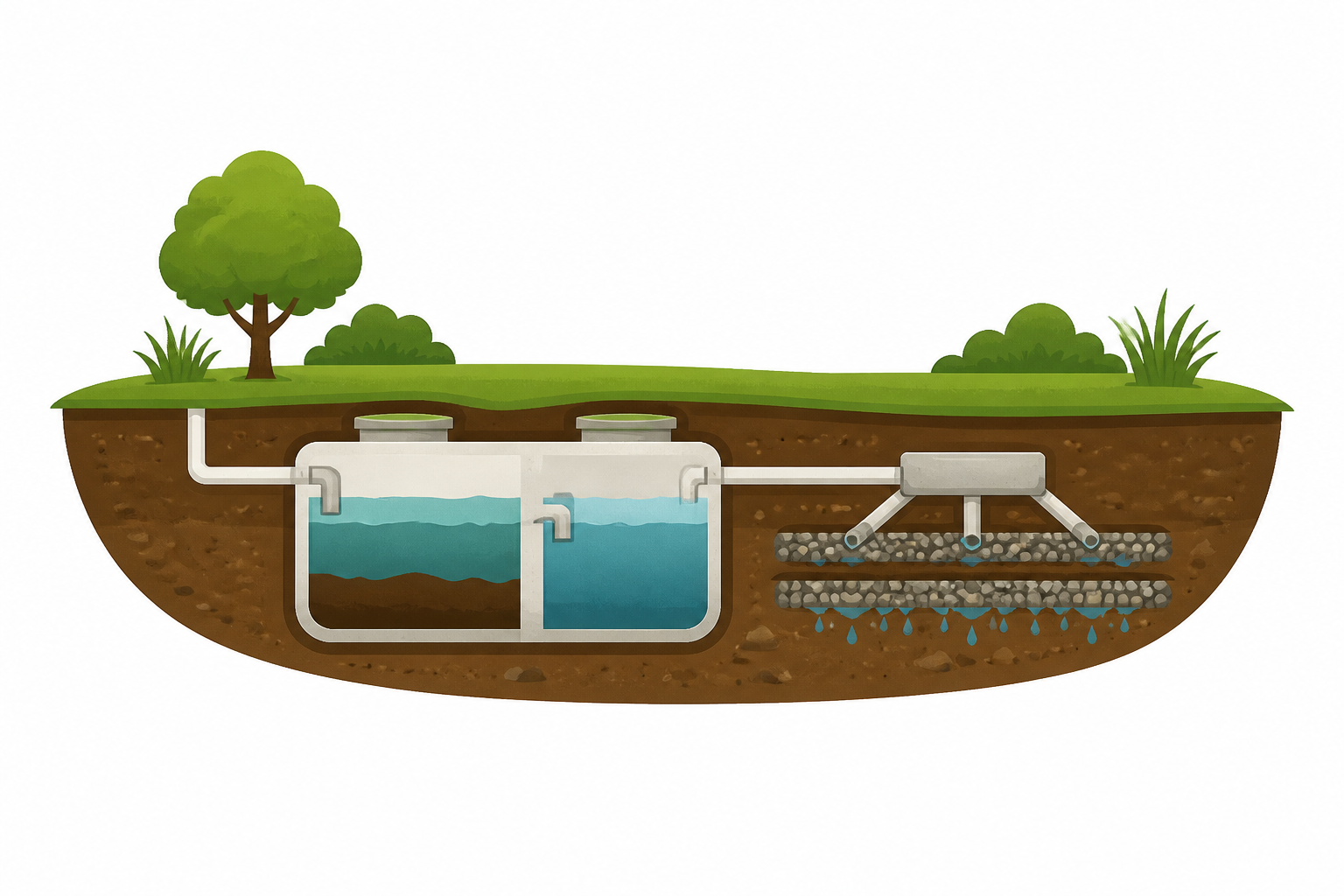
One measurement is how far below the surrounding ground surface—the finished grade—the tank’s top sits. For a typical residential setup in my region, that’s ordinarily somewhere in the 4-inch-to-4-foot range. Properties with steep slopes or basements can push that figure much deeper.
The other measurement involves the invert elevation—the interior floor level at the exact point where incoming and outgoing pipes meet the tank shell. This is where the real design work occurs. Your installer performs a reverse calculation starting from where your home’s sewer line departs from the foundation. That line must descend toward the tank at a gradient of roughly 1/4 inch per 12 feet of length. Gravity alone is what transports the waste. Once your installer locks in where that descending sewer line will meet the tank, they determine the necessary depth of the tank’s outlet invert. The tank itself then gets positioned to place that outlet invert at the precise altitude. The lid location—and everything else about the tank’s vertical placement—flows directly from those calculations.
When someone poses the question “how deep,” the honest response becomes: “as deep as the elevations in your yard demand.” It’s not discretionary. It’s engineering.
Why Burial Depth Carries Consequences: The Real-World Tradeoffs
That acknowledged, the actual distance your tank sits below the surface does generate genuine ramifications—they’re just not what homeowners typically anticipate. Complications emerge when you push toward either extreme.
Insufficient Depth: Load-Bearing Failure and Frost Penetration
When a tank finds itself positioned too near the surface—perhaps with only a handful of inches of earth covering its top—you face a pair of serious issues. One is load capacity. The concrete lids sitting atop most precast tanks have engineering specifications for maximum earth weight plus whatever machinery or automobiles might traverse overhead. Without adequate soil insulation, those lids fracture if a pickup truck parks over them or equipment gets stored in the wrong spot. I’ve witnessed this damage firsthand more than once.
The other issue emerges in regions experiencing hard freezes—something I encounter more frequently from northern customers than here in the Deep South—where shallow tanks and their connecting lines become vulnerable to ice formation. The tank body itself rarely freezes solid once it’s underground and radiating warmth from bacterial activity, though the pipes feeding into and out of it are absolutely at risk if they’re only a couple of feet down. In places experiencing severe seasonal frost penetration, pipe installation often needs to descend below that threshold or get wrapped in insulation as backup protection. This isn’t a constant concern in rural sections of the Carolinas or Georgia, yet it’s important perspective if you’re reading from somewhere like North Dakota or Vermont.
Excessive Depth: Accessibility Issues and the Riser Question
Yet the situation I witness most regularly is this: tanks positioned excessively low underground minus the installation of proper riser systems. A riser functions as a sealed extension conduit raising the tank’s service opening to a level that sits nearer to the earth’s surface, eliminating the need for significant excavation whenever your septic technician needs to pump the contents.
When your tank descends past roughly a foot beneath the surface, proper riser installation becomes essential to your system’s practicality. When tanks go deeper than roughly 18 inches, most experienced contractors factor risers into the base specifications. Yet I routinely encounter property owners who nixed them during the planning phase to trim several hundred bucks from the startup cost, and they spend years regretting that choice. What should be a straightforward 30-minute pumping visit balloons into a full-day excavation undertaking. Across the life of your system, this compounds into substantial expense and inconvenience.
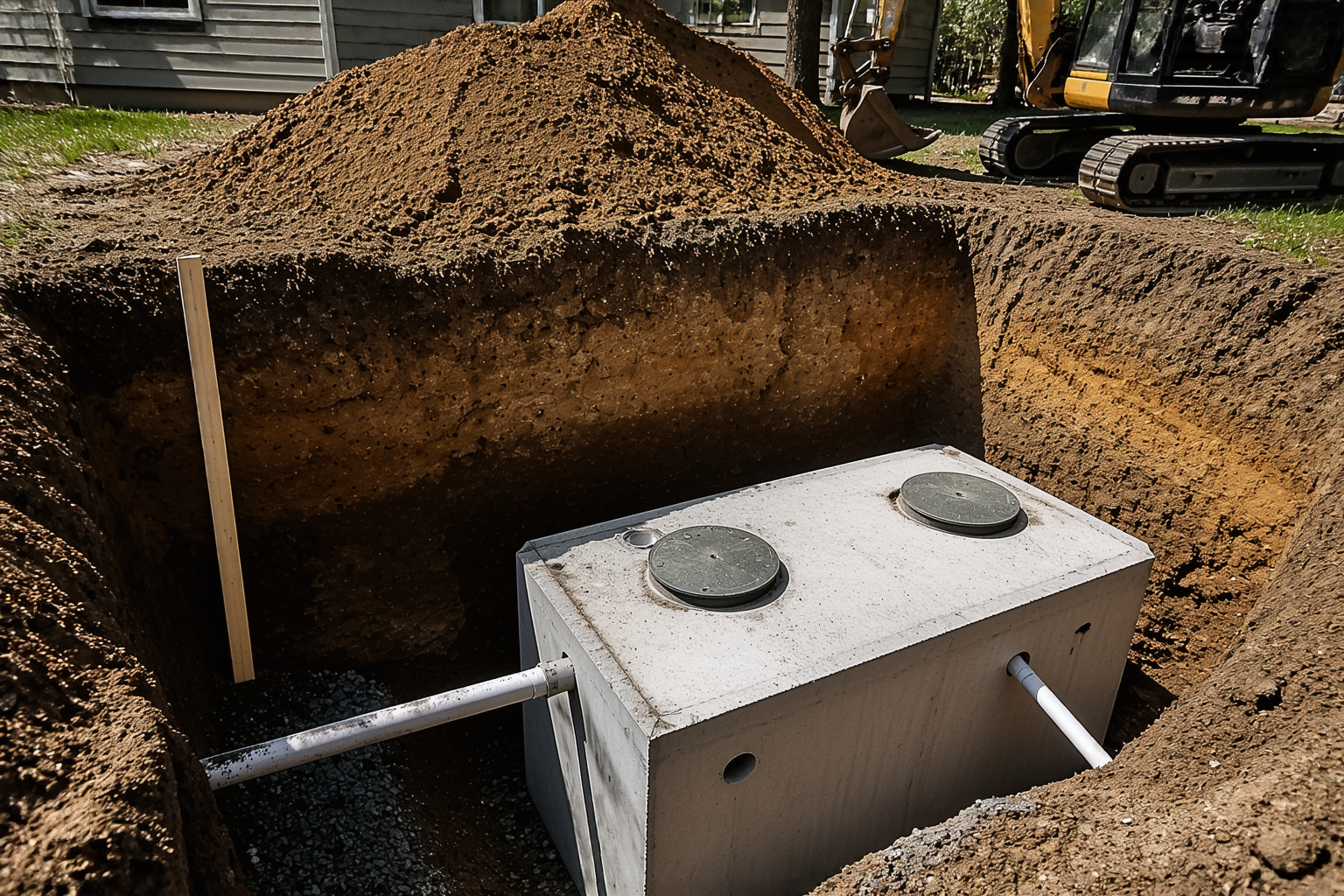
One occasion roughly five years prior involved a hillside parcel in the Spartanburg vicinity. The residence’s discharge line emerged at an altitude that necessitated burying the tank roughly 4 feet beneath the surface. The property owner rejected risers to reduce initial expenditure. Two years onward: the first septic service visit demanded heavy machinery to excavate down to the tank opening. The property owner reached out, absolutely livid. Risers went in the following week. That installation should’ve occurred before the project commenced.
Engineering: Weight Distribution and Tank Specifications
All factory-assembled concrete tanks arrive with manufacturer specifications governing maximum permissible burial depth and allowable soil pressure from above. Greater underground placement generates amplified force bearing down upon tank covers and walls. In regions characterized by dense clayey earth or elevated groundwater conditions, I’ve encountered scenarios where the site’s requirements would surpass the tank model’s rated capacity—requiring me to either place the unit shallower than ideal or construct an elevated mound with supplementary soil spread atop a tank nearer to the surface to satisfy local guidelines. This isn’t a theoretical constraint; it’s a practical limitation. Your installation expert must validate that the tank model selected is engineered to handle the depth your particular terrain requires.
What Remains in Your Hands as the Property Owner
The bottom line is straightforward: your tank’s depth shouldn’t be determined by guesswork or personal preference. It’s predetermined by the site assessment, percolation test results, lot topography, and the elevation at which your home’s sewer lateral emerges from the foundation. All of that gets locked in during the design phase, before excavation commences.
Yet there’s one practical action within your authority: obtain a dimensioned site sketch from your installation contractor prior to any earth-moving activity. That documentation must denote the tank’s positioning depth, the inlet and outlet invert altitudes, and the riser arrangement. If your tank will sit lower than 12 inches beneath the surface, verify that the riser configuration is explicitly included in the plan. Ask your contractor to justify excluding them if they’re not there—and object strenuously if the justification amounts to mere cost-cutting.
Should your original design omit risers and you end up with a deeply positioned tank, retrofitting them is technically feasible but comes with a heftier price tag because it demands tank penetration and earthmoving performed after the system is currently in operation. It’s far more economical to establish it correctly from the outset.
For deep tanks, I recommend the Aero-Stream AS-R10 Septic Tank Riser kit (23.5″ Diameter X 10″ Tall). It’s a solid, durable option that brings the tank access up to a manageable level and pays for itself in avoided excavation costs within a couple of service cycles.
The Bottom Line on Tank Burial Depth Requirements
Your septic tank’s elevation underground emerges from slope mathematics, gravity requirements, and the altitude of your home’s sewer connection—not from a preset code specification. In most residential installations, the tank’s uppermost portion ends up positioned between 4 inches and 4 feet beneath the surface. Insufficient depth invites structural deterioration and, in colder regions, pipe freezing complications. Excessive depth demands riser installation to maintain reasonable upkeep procedures. The selection you’ll need to make as a homeowner boils down to one thing: demand a scaled blueprint before installation starts, mandate that risers become part of the plan if your depth will be more than approximately 12 inches, and refuse to eliminate them purely for initial cost reduction. Your future pump-out appointments will be infinitely easier.
Joel Grayson holds current licensing as a septic installation specialist and professional inspector, bringing 18 years of hands-on experience with septic infrastructure across the Southeast’s rural communities. He has personally completed and assessed hundreds of system installations with a focus on new-build applications and failure investigation.
Aero-Stream AS-R10 Septic Tank Riser kit (23.5" Diameter X
I used this to raise my tank access point to ground level and stopped breaking my back reaching down into the hole.
Check Price on Amazon →This post contains affiliate links. As an Amazon Associate, I earn from qualifying purchases.