

Most homeowners assume their septic tank’s distance from the house is just a matter of convenience or aesthetics. They’re wrong. That setback requirement isn’t red tape—it’s rooted in real structural, hydrological, and safety problems that show up years after installation if you get it wrong.
This post contains affiliate links. As an Amazon Associate, I earn from qualifying purchases.
Over my 15 years installing and inspecting septic systems throughout Georgia, Alabama, and South Carolina, I’ve personally evaluated more than 2,000 tanks and drainfields. What I’ve found is that the distance between your tank (or absorption field) and your home’s foundation isn’t a suggestion or a nice-to-have. It’s an engineering requirement that protects your investment, your health, and your foundation itself. I’ll break down what the code actually says, where those numbers come from, and how to navigate setback rules without creating headaches later.
Standard Setback Distances in the Southeastern United States
Most health departments across Georgia, Alabama, and South Carolina mandate a minimum of 10 feet between your septic tank and the house foundation (whether that foundation is a poured slab, basement, or pier-and-beam). For the drainfield or absorption field itself, that requirement grows to 20 feet from the foundation.
That said, local enforcement varies. I’ve worked in upland counties where 15 feet for the tank and 25 feet for the field are the baseline rules. Your local health department or environmental services branch always has the last word, and their local ordinances might be stricter than what the state suggests. Phone them first—before you stake the location.
These numbers aren’t pulled from thin air. They reflect decades of documented problems that occur when systems are positioned too close to occupied structures. The reasoning is solid, and it’s worth understanding.
Why Regulators Set These Distance Requirements: Four Key Reasons
1. Foundation Structural Integrity and Soil Bearing Capacity
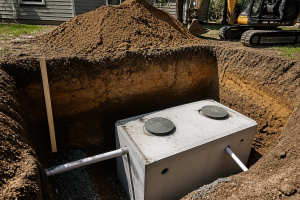
Digging a septic tank trench or laying drainfield laterals means moving a tremendous volume of earth. If you perform that excavation within a few feet of your home’s foundation footing, you directly reduce the bearing strength of the soil supporting your house.
Throughout the Southeast, clay-based soils dominate. Clay holds its strength when it remains compacted and untouched, but the moment you excavate near a footing line, that soil’s capacity to carry weight diminishes. I’ve documented foundation settlement cracks emerging 4 to 6 months after a septic job because earth moved unevenly around the footing. By then, you’re hiring a structural engineer, considering underpinning repairs, or facing a five-figure foundation fix. The 10-foot rule exists precisely to position tank work far enough away that excavation cannot affect your foundation’s stability.
2. Hydrostatic Pressure and Interior Wall Moisture Problems
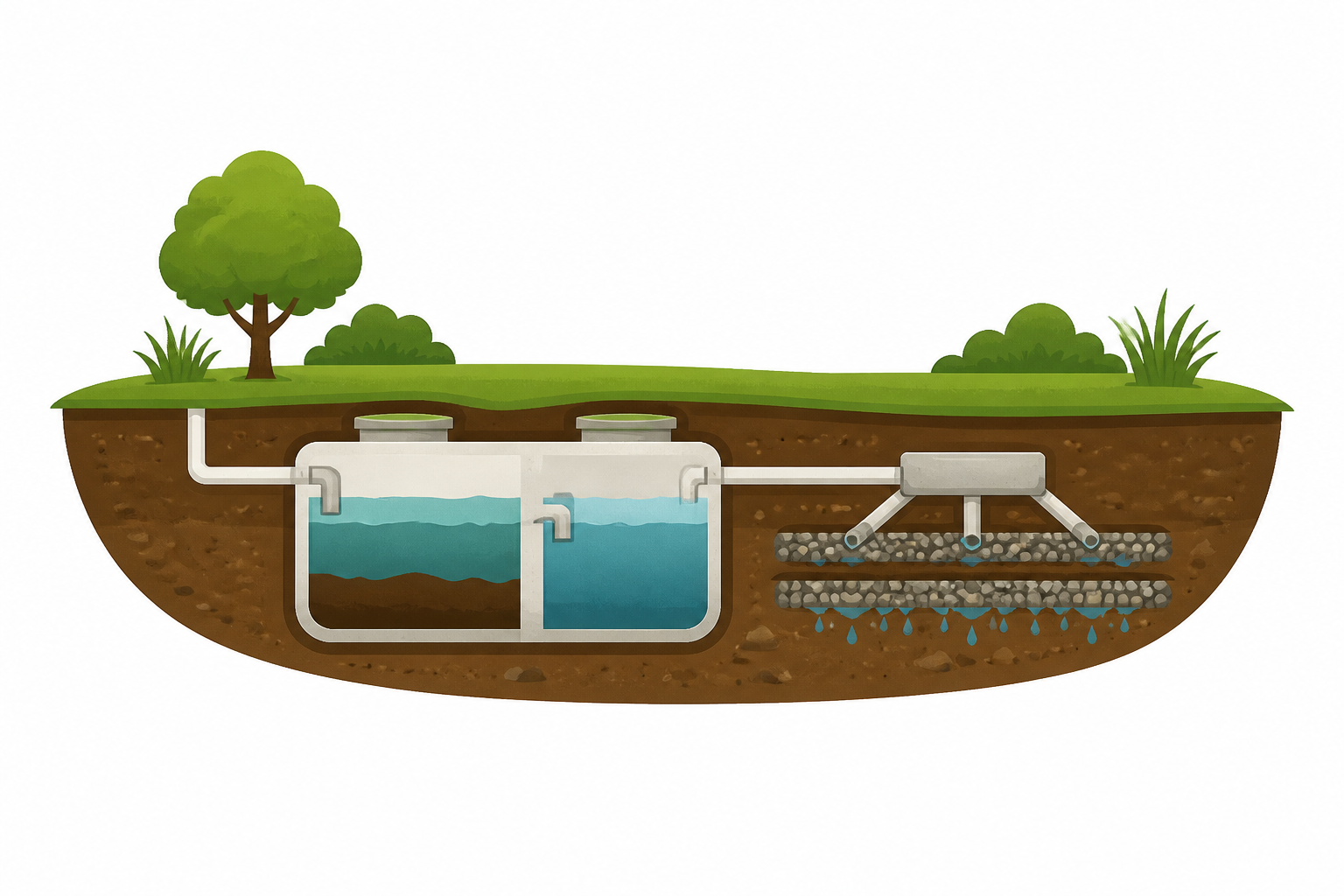
The drainfield’s entire function is to soak treated effluent into the soil around it. The soil itself acts as your system’s final treatment stage. But when a drainfield sits too near a basement or crawlspace perimeter, that saturation can wick through the concrete or block into your living space. I’ve inspected residences where a drainfield was positioned only 15 feet from a basement wall, and within 24 months, that wall stayed perpetually damp. Mold colonization on rim framing followed shortly.
In storm conditions or when a drainfield is overloaded, you face hydrostatic water pressure—essentially, groundwater pushing inward against your foundation wall. The 20-foot spacing for drainfields creates enough horizontal distance that soil-profile moisture remains isolated from your foundation structure.
3. Backup Events and Human Health Risks
Septic systems function dependably most of the time, yet mechanical and biological failures do happen. A tank can overflow if it’s neglected or pushed beyond capacity. A line can rupture. When your tank or field sits within proximity to a basement window well, a vent opening in a crawlspace, or any slab penetration (like where supply lines enter), effluent or untreated wastewater can end up in your occupied space. Beyond being repulsive, this becomes a serious public health emergency and a contamination liability. Proper setbacks guarantee that even during a system failure, discharged material stays outside your living boundaries.
4. Buried Utilities and Future Excavation Safety
Your incoming water line, gas service, electrical conduit, and perimeter footing drain all run underground within a few feet of your foundation perimeter. When a septic tank or field encroaches too closely, you’re setting the stage for a future disaster. Someday someone will need to dig near the tank for roof work, deck expansion, or utility repair. Without knowledge of the tank’s exact location, or with the tank sitting just 5 feet away, a shovel can easily strike a water line, a gas line, or electrical service. The 10-foot separation provides a protective buffer for future work.
My Process for Tank Siting on New Construction
When I’m brought in for a new build, I always coordinate with the builder before the foundation footprint is excavated. This step is essential. My methodology:
- Mark the foundation perimeter: I obtain house plan documents and physically delineate where foundation work will occur. I map out crawlspace layouts or basement configurations as well.
- Orient toward downslope positions: Gravity-fed systems are simpler and more reliable, so I position the tank downhill from the residence when possible. On level terrain, I choose the property side that maximizes distance and steers clear of buried utilities.
- Steer clear of utility corridors: Water service lines and gas pipes typically enter on a single side of the structure. I position the tank on the opposite quadrant of the lot whenever feasible.
- Ensure pump-out accessibility: Tanks need pumping every 3 to 5 years. I confirm that the tank position permits a pumping truck to maneuver into position, and I document the location on a site record so future owners know where it is.
- Juggle all applicable setbacks: I’m thinking beyond just distance from the house. Property line offsets, well separations, surface water buffers, and neighboring property constraints all factor into positioning. Tank siting is a multi-directional puzzle, not merely “far from the house.”
On a sloped quarter-acre parcel in north Georgia last year, a builder wanted to position the tank near the street for straightforward truck access. But the house sat only 60 feet from the road boundary, and once I factored in the 10-foot foundation setback, the county’s property line spacing, and a shallow water well at 150 feet distant, the tank’s viable position narrowed considerably—downslope, rear-side, with room for truck maneuvering. Advance planning paid off, and the permit process moved through without complications.
A Case Study: What Happens When Setbacks Are Ignored
Let me describe a situation from roughly five years back. A buyer acquired a mid-1970s single-story home in rural South Carolina with its original septic system intact. The tank rested just 8 feet from the brick exterior wall—a distance that predated current code standards. The absorption field occupied approximately 18 feet from the foundation line.
One year after purchase, the basement’s eastern wall—the side facing the drainfield—began absorbing moisture. The new homeowner installed additional guttering, suspecting a roof drainage problem. This didn’t resolve the dampness. After two years of persistent moisture, mold started spreading. By year three, concrete was deteriorating (flaking and spalling), and structural rim joists turned soft and compromised.
When a septic professional finally inspected the system, the diagnosis was unmistakable: the drainfield was positioned far too close. Resolution demanded decommissioning the old field, excavating and installing a replacement system 25 feet away from the foundation on the home’s opposite side, plus adding basement moisture control infrastructure (sump pump, dehumidifier, and vapor barrier work). The owner’s total expenditure: slightly more than $8,000. Proper original positioning would have eliminated the entire problem.
Dealing with Setback Challenges on Compact Properties and Existing Systems
Reality doesn’t always cooperate with current code. Many older rural residences sit on acreage too limited to accommodate modern septic setback requirements. Whether you’re purchasing a decades-old home with a grandfathered system or designing new work on a constrained lot, you have practical alternatives:
- Petition the health department for a dimensional variance (typically granted for pre-existing non-compliant systems, though more difficult for new installations).
- Deploy an engineered treatment system with a reduced footprint and higher effluent quality, which can sometimes qualify for relaxed setback standards.
- Investigate an aerobic treatment unit (ATU) option in certain Southeast districts, though these demand heightened annual servicing.
My recommendation: contact your local health department well before closing on a property or finalizing system design plans. Variances on existing systems are typically straightforward to obtain. Attempting to squeeze a new system into non-compliant spacing will get rejected at the permit stage, leaving you back to the drawing board with increased frustration and delay.
The Counterintuitive Trap: Excessive Distance Creates New Problems
I frequently encounter a recurring error: property owners or contractors reasoning that if 10 feet meets code, then 50 feet must be superior. They then relocate the tank to the far back corner of the property. Now the tank sits only 35 feet from the property boundary when 50 feet was mandated. Or it ends up uphill from the well. Or it’s positioned so remotely that a pump truck cannot access it without destroying landscaping. Setback rules exist to accomplish distinct objectives—protecting water quality, maintaining access capability, preserving foundation safety. Meeting those requirements is the objective, not exceeding them indiscriminately.