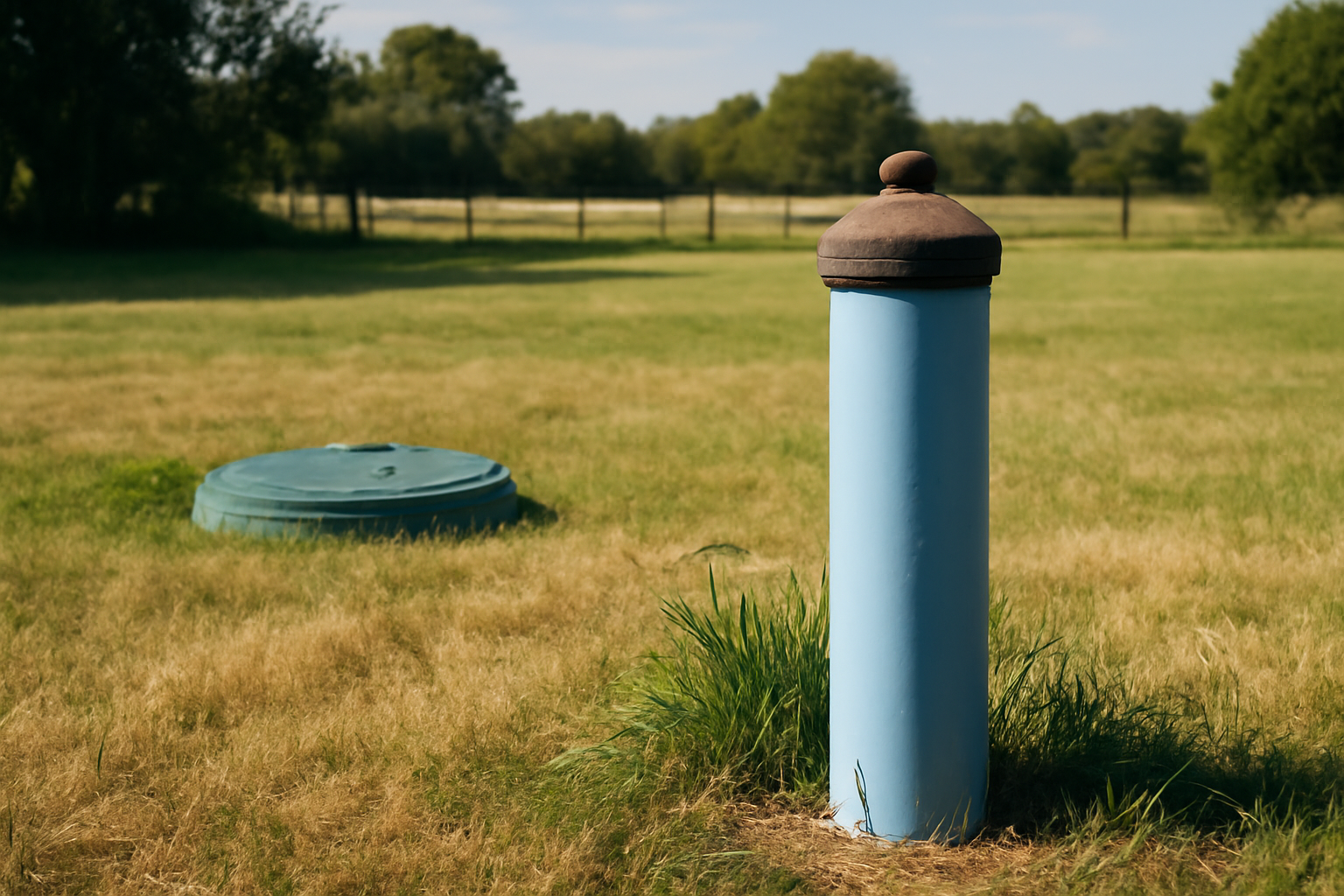
Your drainfield is quietly saturating, but the well 60 feet away won’t show contamination for another month or two — that’s how slowly and invisibly this particular failure unfolds. By the time a water test reveals the problem, your family’s been drinking compromised water for weeks.
Across 15 years of septic work throughout the rural Southeast — Georgia, the Carolinas, Alabama — I’ve personally inspected well-and-septic combinations on hundreds of properties. Most landowners believe the previous owner or some prior inspector already verified safe spacing. Sometimes that assumption holds up. Plenty of times it doesn’t. The troubling reality is that you might never discover the risk exists until pathogen testing or nitrate analysis reveals contamination already in your drinking supply.
This article covers the actual legal setback requirements, what creates the danger, the field mistakes I encounter most regularly, and straightforward steps to protect your household’s water quality. I’ll be honest about which situations demand a licensed professional and where a property owner with a tape measure and some diligence can do the work themselves.
Safe Spacing Between Well and Septic: What the Law Actually Requires
First thing to understand: no uniform federal mandate exists. The EPA issues guidance documents, but the actual separation minimums get established by your individual state’s regulations and enforced through your county health department. The benchmark distance cited most often is 50 feet between well and septic tank, plus 100 feet between well and drainfield. You’ll find these thresholds in documents like Georgia’s Chapter 511-3-1 (DHR guidelines), North Carolina’s 15A NCAC 18A .1950, and similar regulatory frameworks across most Southeastern states.
Nonetheless, certain counties maintain stricter limits. My experience shows that rural jurisdictions with sandy or fast-draining soil compositions frequently mandate 150 feet or greater from well to drainfield. The reason is straightforward: loose sandy ground lets pollutants move much more rapidly than dense clay does. On your particular lot, soil composition can be just as controlling a factor as the linear distance itself. A 100-foot spacing on sandy loam presents bigger risk than a 75-foot spacing in dense clay soils.
The EPA’s Onsite Wastewater Treatment Systems Manual (EPA/625/R-00/008) incorporates groundwater elevation, land slope, and regional aquifer structure into its analysis. In particular, if your well taps a shallow aquifer — meaning the water table sits less than 50 feet down — your local health authority may establish setbacks that exceed the typical baseline figures. Your best move is to retrieve the original permit documentation from your county health office. Those records spell out precisely which setbacks were legally approved when your system went in.
Why Drainfield Spacing Outweighs Tank Spacing: The Contamination Pathway
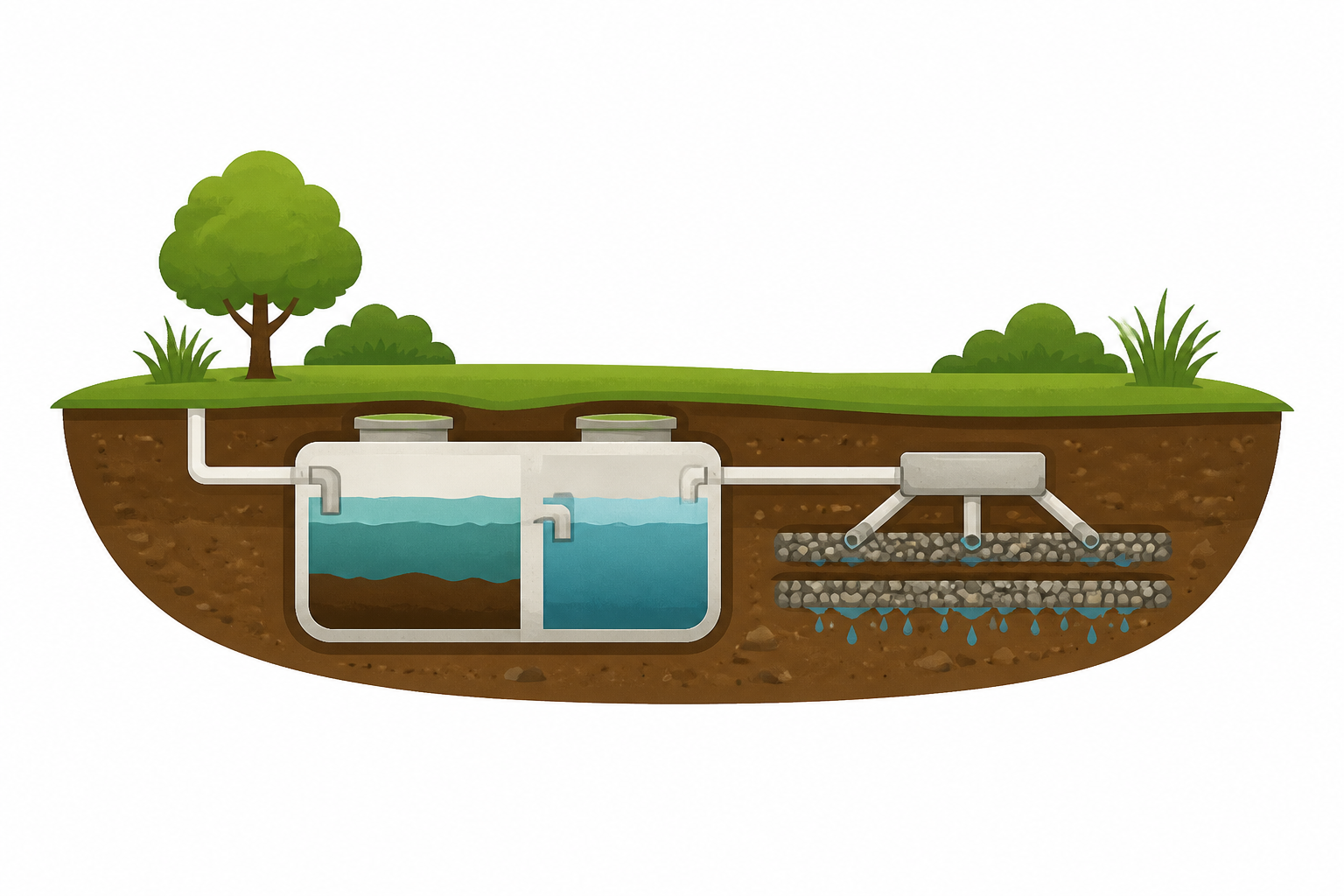
Homeowners frequently ask why regulators worry more about distance to the drainfield than distance to the tank itself. The explanation becomes clear once you grasp the mechanics. A septic tank is a closed vessel — whether cast concrete or fiberglass — designed to hold sewage, settle solids to the bottom, and route treated liquid out into the drainfield. When properly constructed, the tank operates as a sealed container. Leakage from the tank itself represents relatively minimal contamination hazard.
The drainfield operates under entirely different conditions. Here, treated effluent seeps continuously out through hundreds of feet of perforated piping directly into surrounding earth. Organisms including E. coli and hepatitis A possess the capacity to endure in soil long enough to travel considerable lateral distances, particularly following downpours or irrigation events. Nitrate compounds — the residual products from decomposition of human waste — migrate readily through groundwater, traveling distances that tank-based contamination rarely reaches.
I ran into this directly while helping out on an Oconee County project. The crew lead approved a drainfield location measuring approximately 95 feet from the well — technically within the 100-foot state threshold that was current then. The health department rubber-stamped it. Twenty-four months passed before that owner rang up with water test findings showing elevated nitrate concentrations. We could never definitively tie it back to the drainfield, yet there existed no alternate contamination source nearby. That lesson has shaped every placement decision I’ve made since. Whenever property layout permits, I push for buffers considerably beyond the minimum regulatory distance.
Recurring Issues That Compromise Well-Septic Separation on Actual Properties
Throughout nearly two decades of property site visits, the same spacing miscalculations appear repeatedly. These represent the biggest challenges I witness:
- Trusting that older installations met standards. Most systems constructed before 1980 across rural regions arrived with zero regulatory oversight. A landowner simply excavated, installed a tank, ran drainage pipe — frequently with no health office involvement or measured separation distances.
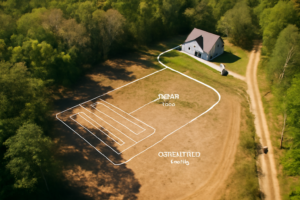
- Calculating distance to only the closest drainfield section. Many property owners quantify their distance measurement only to the drainfield portion nearest the well. Nonetheless, biological activity and chemical transport originate across the entire field — encompassing possibly the opposite terminus of a 300-foot lateral system.
- Disregarding elevation differential and flow direction. Subsurface water movement follows terrain slope. A 120-foot separation distance still represents serious danger if the drainfield occupies higher terrain and the flow direction runs toward the well. Piedmont properties with rolling terrain present this scenario constantly, yet landowners rarely consider it.
- Failing to conduct routine water sampling. The CDC and EPA jointly recommend sampling private wells minimum once yearly for pathogenic bacteria and nitrogen compounds. The reality in rural areas: the majority of householders I engage with have never executed a single water analysis.
- Expanding drainfield capacity without rechecking distance requirements. When a drainfield reaches end of service life and gets expanded, the replacement field zone must conform to the identical distance standards. I’ve seen permitting approvals for growth areas that allowed new piping runs closer to existing wells because nobody performed fresh measurements.
Earlier this year, I evaluated a 12-acre purchase in Habersham County where the buyer had relied on a real estate inspection. Measuring with a wheel, I found the approved reserve drainfield area — marked on the original permit documentation — positioned about 65 feet from the well. Under today’s Georgia regulations, this arrangement violates the code and would have resulted in $15,000 to $20,000 in remediation if that reserve field ever required activation due to primary field failure.
Measuring Your Property’s Well-to-Septic Distances: A Step-by-Step Process
Assessing spacing on your own property doesn’t require licensing or specialized credentials. Follow this methodology I’ve used to walk countless landowners through the exercise:
- Obtain your system’s permit records. Visit your county environmental health office and request a copy of your septic system permit. The drawings on that permit display the official layout and placement. Many counties now digitize these records and post them online; others require in-person visits, typically charged at $10 to $25 per copy.
- Physically locate each component. Septic tank lids typically sit between 6 and 18 inches beneath grade. A soil probe or pointed metal rod can help you pinpoint the location. Drainfield sections frequently surface as faint linear depression marks or slightly elevated grass growth patterns during dry stretches.
- Perform precise distance measurements. Employ a 100-foot fabric tape or a wheeled distance counter. Take readings from the well casing itself — not the cap or pump housing — to the tank’s closest point, then to the drainfield’s closest edge, and finally to its farthest edge.
- Verify current standards with your county authority. Ring up your county environmental health division and ask what separation distances presently apply in your jurisdiction. Regulatory standards have shifted over time in many locations since the day your system was permitted.
- Schedule annual water quality screening. Irrespective of what your site measurements show, perform yearly water testing through a certified laboratory. Standard bacteria and nitrate testing runs $40 to $80. Local cooperative extension offices typically stock or distribute sample collection kits.
Whenever I help property owners run through this sequence, something unexpected emerges. Either the spacing turns out narrower than anticipated, or buried system elements surface — perhaps an old overflow outlet, an earlier well that’s since been capped, or an unpermitted secondary tank from a prior owner’s renovation work.
The Resource That Explained Well Setback Fundamentals Before I Nearly Made a Serious Spacing Error
Most amateur system owners don’t grasp that well-to-septic spacing represents a binding legal requirement with differences depending on your specific county and state. Before I had solid reference materials, I nearly gave faulty guidance to neighbors. When I obtained a comprehensive manual addressing these distance specifications, I was able to immediately catch the Georgia family’s dangerous configuration.
Strengths of this approach
- Provides concrete numerical setback figures for wells, tanks, and drainfields — precise regulatory thresholds rather than approximate guidance that leaves room for interpretation.
- Furnishes explanatory context for each distance standard so you appreciate exactly why the 40-foot tank-to-well buffer gets rejected across most regions (and how soil character and subsurface hydrology affect real-world risk).
- Tackles field-specific obstacles such as hillside installation and changing seasonal water levels — the real-world complications you face on actual terrain, not just theoretical textbook examples.
Notable gaps
- Local ordinances get revised on an ongoing basis, meaning you cannot depend exclusively on published material to confirm current requirements — direct contact with your local environmental health authority remains necessary.
- Doesn’t present concrete procedures for correcting a system that’s already positioned too near a well — focuses on evaluation and avoidance rather than correction methodologies.
I almost told that Wilkes County family their setup was fine based on a rough estimate, but I grabbed this manual from my truck first and realized I was about to give them dangerous misinformation. The Septic System Owner’s Manual has been the reference I pull out on every property inspection since.
Sources and further reading
About This Article

Written by Joel Grayson. Rural property owner who learned septic systems the hard way after my own failed 15 years ago. I created Backyard Septic to give homeowners honest, practical guidance on septic installation, maintenance, and troubleshooting. More about this site.
Scope and limits. Joel is an experienced rural property owner, not a licensed septic inspector. Have a licensed septic professional handle pumping, permits, and any diagnosis you plan to act on — and never enter a tank.
Verify this against a primary source
Specifics change, and your situation may differ from the one described here. These are the authorities worth checking directly:
- EPA SepticSmart — septic system care, inspection intervals and failure signs
- NSF International — treatment unit and tank certification standards