
You’ll hear contractors and neighbors say that Arizona’s desert soils are “pretty much like anywhere else” and that septic costs should track with national averages. Then someone spends $23,000 on what they expected to be a $12,000 system, and the reason becomes obvious: they never got a perc test, didn’t understand caliche, and hired someone unfamiliar with desert excavation. By then, the contract was signed.
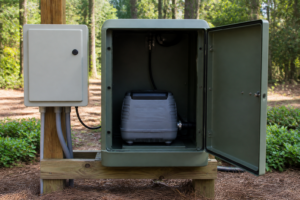
Installing an ATU in Mesa and Gilbert reflects a specific regional reality rooted in the Sonoran Desert’s geology and Arizona’s regulatory framework. If you’re considering property development in the East Valley suburbs around Phoenix—particularly in Maricopa County—understanding why caliche dictates system type, what the permitting process actually entails, and how excavation complexity drives your final invoice is essential. My background spans 18 years installing and troubleshooting systems across Georgia, South Carolina, and Alabama, and I’ve worked enough Arizona projects to recognize that desert soils operate under entirely different constraints than southeastern clay and loam.
Understanding Caliche and Why It Eliminates Conventional Options
Caliche forms as a cemented calcium carbonate layer in arid environments over geological timescales. Throughout the Phoenix metropolitan region, particularly in unincorporated sections of Maricopa County near Mesa and Gilbert, this hardpan layer sits shallow in the soil profile. When a percolation test encounters caliche, water movement stops abruptly. Results typically fail outright or register percolation rates that fall short of what ADEQ (Arizona Department of Environmental Quality) permits for standard gravity-fed drainfield design.
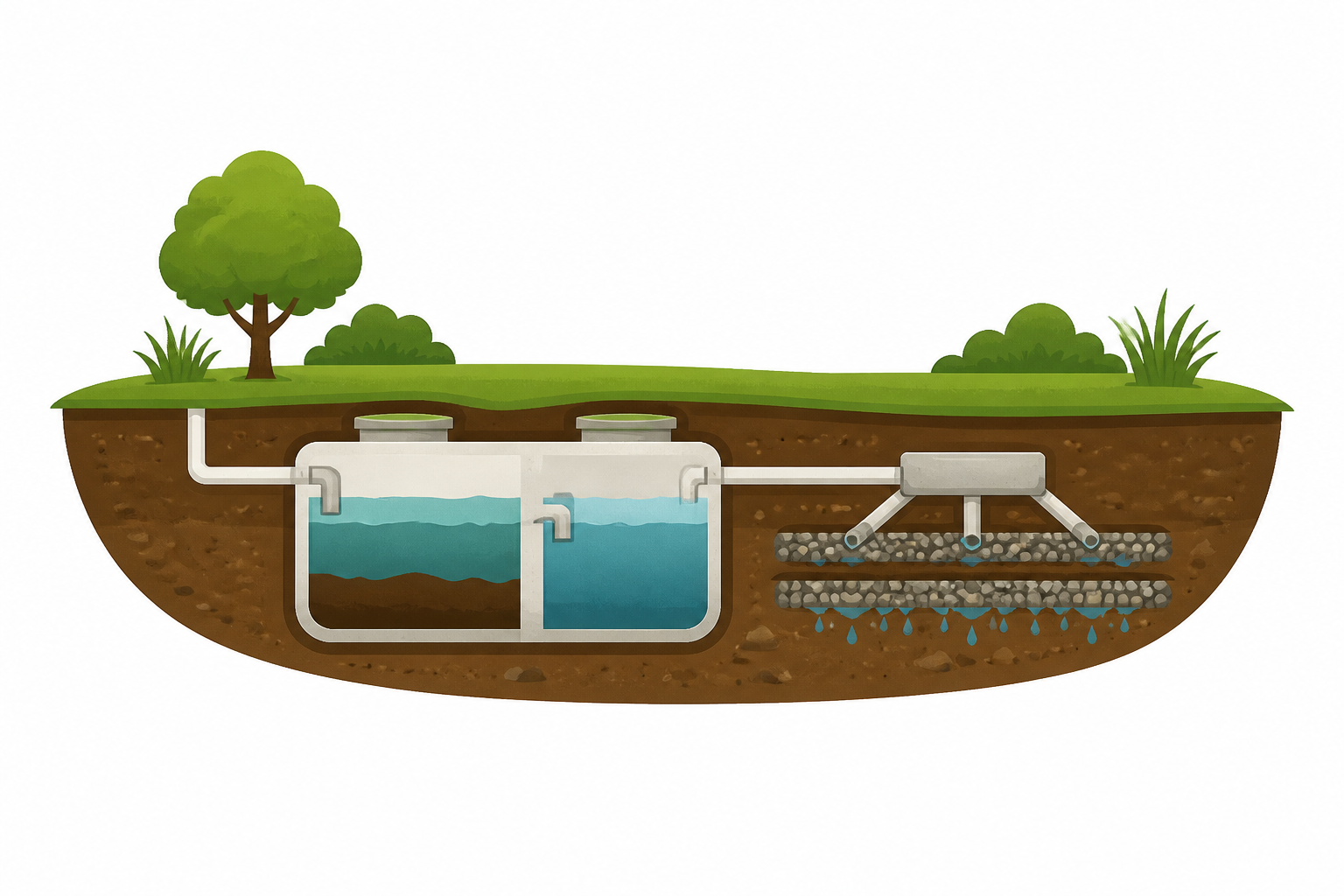
Once a perc test reveals inadequate percolation, Maricopa County Environmental Services and ADEQ will not approve a conventional gravity system. An Aerobic Treatment Unit—a mechanical system that oxygenates and actively biologically treats wastewater before it exits to the soil—becomes the mandated choice among several engineered alternatives. While other options exist (sand media filters, constructed wetland cells, recirculating textile filters), ATUs tend to solve the East Valley problem most efficiently on smaller residential parcels because they occupy less ground footprint than traditional drainfield trenches.
For your planning purposes, this means a percolation test isn’t exploratory—it’s the single decision point separating a roughly $10,000 system from a $20,000-plus one. Complete testing before emotional or financial commitment to the property.
Navigating Arizona’s Engineered Permit and Design Requirements
Arizona’s onsite wastewater regulatory structure operates on two separate approval pathways. Conventional gravity systems, where soil conditions permit their use, qualify for general permitting—ADEQ issues the authorization, the county processes it, and you typically receive approval within two to three weeks. Advanced systems like ATUs operate under individual engineered permits since each installation depends on site-specific calculations and design parameters.
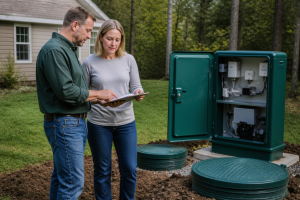
The engineered permitting pathway is where elapsed time and expenses accumulate. Your contractor or a separate design professional—typically a registered professional engineer—produces site-specific system plans accounting for soil properties, topography, setback distances from washes and potential flood zones, and other location factors. Maricopa County Environmental Services subjects these plans to detailed technical review, a process routinely requiring four to eight weeks depending on departmental workload. In high-volume periods, you may see longer delays; during slower months, faster turnarounds occur. Conservative planning assumes six weeks from contract execution to permit issuance.
The professional engineering design component carries its own cost, typically falling between $1,500 and $3,500. This fee exists separately from the contractor’s installation price in many cases, though some contractors incorporate it into a unified estimate. Clarify this distinction during your initial conversations.
Caliche Excavation and the Reality Behind Mesa ATU Pricing
The most consistent surprise for homeowners comparing ATU installation costs to national figures: extracting through caliche transforms the economics and timeline entirely.
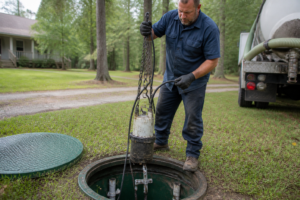
Throughout the Southeast where my primary work occurs, soil composition typically includes clay, silts, and sandy matrices. A standard tracked excavator with conventional bucket attachment cuts through these materials at predictable rates. Caliche presents a different problem—a stone-hard calcium carbonate formation that resists standard excavation teeth. Contractors either deploy a jackhammer-equipped attachment (effective but slow) or bring in a heavier-duty machine equipped with a ripper tool designed to fracture the caliche stratum. What might represent an eight-hour excavation window in Georgia routines into a full two-day undertaking in Arizona.
This excavation reality explains why my general-purpose ATU content references a typical range of $12,000–$20,000, while Mesa and Gilbert quotes realistically land in the $18,000–$28,000 neighborhood for equivalent 3–4 bedroom systems. Caliche-specific excavation alone commonly adds anywhere from $2,000 to $5,000 to the final bill.
Beyond caliche removal, Mesa-area ATU installation encounters several additional cost pressures:
- Regional labor compensation rates (exceeding rural Southeast figures)
- Equipment rental expenses for heavy machinery
- Professional engineering and regulatory review fees (noted previously)
- Concrete reinforcement structures or engineered vaults (occasionally mandated when caliche sits extremely shallow or presents structural instability)
- Power supply infrastructure and electrical panel configuration for mechanical aeration components
Solicit detailed quotes from multiple ROC-licensed Arizona firms. During each conversation, ask: “What volume of caliche work comes through your shop annually? Which equipment do you own outright versus lease? Can you itemize the excavation portion separately and estimate the timeline?” Contractors who dodge these specifics typically haven’t accurately priced caliche removal.
I once reviewed a Gilbert project where the contractor’s initial quote of $16,000 overlooked caliche depth by approximately four feet and made no provision for jackhammer-assisted removal. The corrected estimate came in around $23,000. That homeowner was relieved to catch the discrepancy before signing a contract based on incomplete assumptions.
Ongoing Service Contracts: Regulatory Obligation, Not Optional Add-On
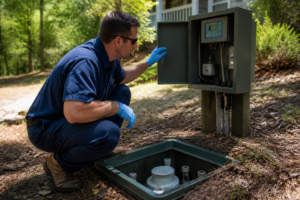
Arizona’s regulatory position on ATU maintenance differs fundamentally from the approach to passive gravity systems. Your aerobic treatment unit’s permit carries an attached condition: you must maintain an active service contract with a certified maintenance company. ADEQ and Maricopa County actively enforce this requirement through compliance inspections. Routine service visits occur twice yearly, during which technicians verify blower operation, check air diffuser condition, measure treatment tank parameters, and test electrical components.
This obligation isn’t hidden or negotiable—it directly ties to permit validity. Neglecting these contracts can result in county designation of your system as non-compliant. Annual service contract costs typically range from $600 to $1,200. Confirm whether your contractor’s initial quote includes first-year service or if this represents an add-on expense.
One maintenance note: chlorine tablets are sometimes part of ATU operation if your system uses a chlorine-disinfection stage before final dispersal. If that applies to your design, stock on products like the Septicfit Septic Chlorine Tablet – 6 Tablet Pail, and make sure your service provider instructs you on proper dosing and storage.
What Mesa and Gilbert Property Owners Need to Know Before Committing
ATU installation across Mesa and Gilbert emerges as more costly and heavily regulated than conventional systems in permeable soil regions, and geology—specifically caliche—is the reason. Before purchasing land or commencing construction, invest in percolation testing and soil investigation work. These diagnostics typically cost $300–$600 and definitively establish whether a simple gravity system remains feasible or whether an engineered ATU represents your required path. This early data point returns its value many times over in budget predictability and decision confidence.
Partner with an ROC-credentialed contractor demonstrating substantial experience navigating caliche conditions throughout Maricopa County. Request references specifically addressing soil excavation difficulties and realistic project timelines. Set expectations for the engineered permitting cycle—anticipate four to eight weeks as standard. Recognize that your system will require twice-per-year professional service contracts throughout your ownership period.
My licensure is limited to the Southeast, and this information functions as educational scaffolding to sharpen your questioning and evaluation capabilities when vetting Arizona contractors and proposals. Licensed Arizona professionals will handle your actual installation work. Armed with this foundation, you’ll recognize unrealistic pricing, ask penetrating questions, and select contractors who genuinely understand what desert caliche demands.
Joel Grayson holds licenses for septic system installation and inspection across the rural Southeast, with 18 years in the field. Outside his licensed regions, he contributes consultation on project planning and system education but cannot perform installation or permitting work. This content serves educational purposes and cannot replace guidance from a licensed Arizona contractor or engineer.
This post contains affiliate links. As an Amazon Associate, I earn from qualifying purchases.
Septicfit Septic Chlorine Tablet – 6 Tablet Pail
I use these monthly in my Mesa ATU to keep the system running between professional pumping cycles.
Check Price on Amazon →