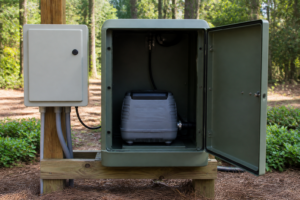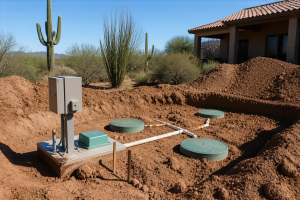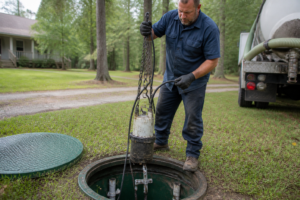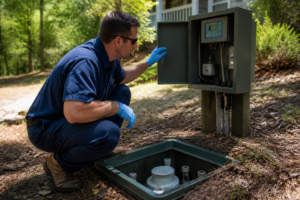
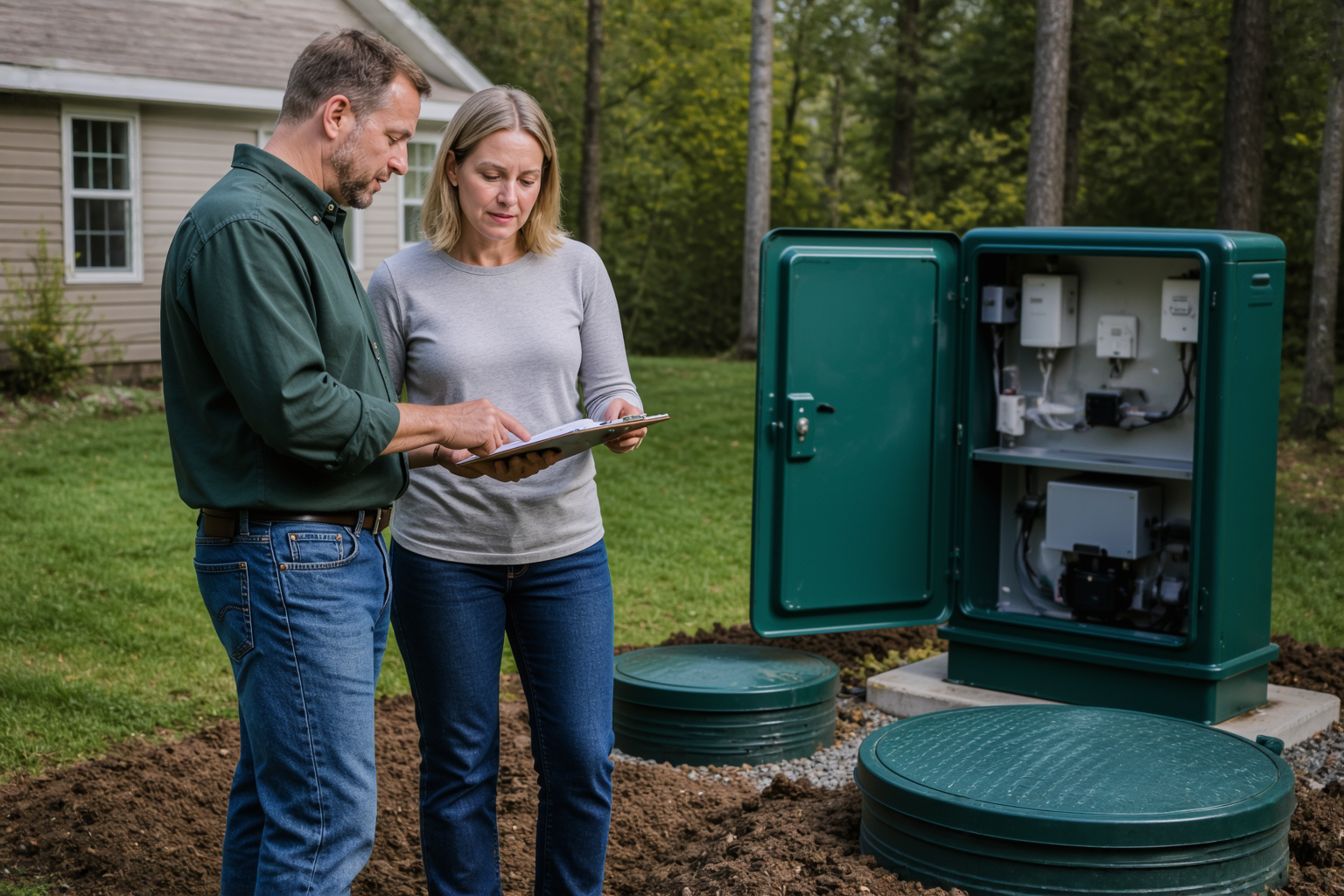

I’m staring down into an aerobic treatment unit tank in Pickens County right now, and what I’m seeing tells me exactly why homeowners get blindsided by the true cost of running this system. The blower is humming, the treatment chamber is doing its job, but the spray pump that’s supposed to move water into the drainfield is working harder than it should—and that’s a $400 repair waiting to happen.
Fifteen years ago, I earned my license to install and inspect septic systems across the rural Southeast. I’ve personally evaluated well over 2,000 tanks, drainfields, and distribution assemblies in Georgia, South Carolina, and Alabama during that stretch. I’ve become familiar with what an ATU owner actually writes checks for—not just the installation invoice, but the electricity bills that arrive month after month, the mandatory service contracts, the component failures that show up without warning. Most homeowners come in asking only about installation price. What they really need to understand is the full financial picture that unfolds over the next 15 to 25 years.
This post breaks down the real, full cost of ownership for an ATU system—not just the sticker price, but every dollar you’ll actually pay across the life of that system. This post contains affiliate links. As an Amazon Associate, I earn from qualifying purchases.
Understanding an ATU: Why the Initial Outlay Is Steeper
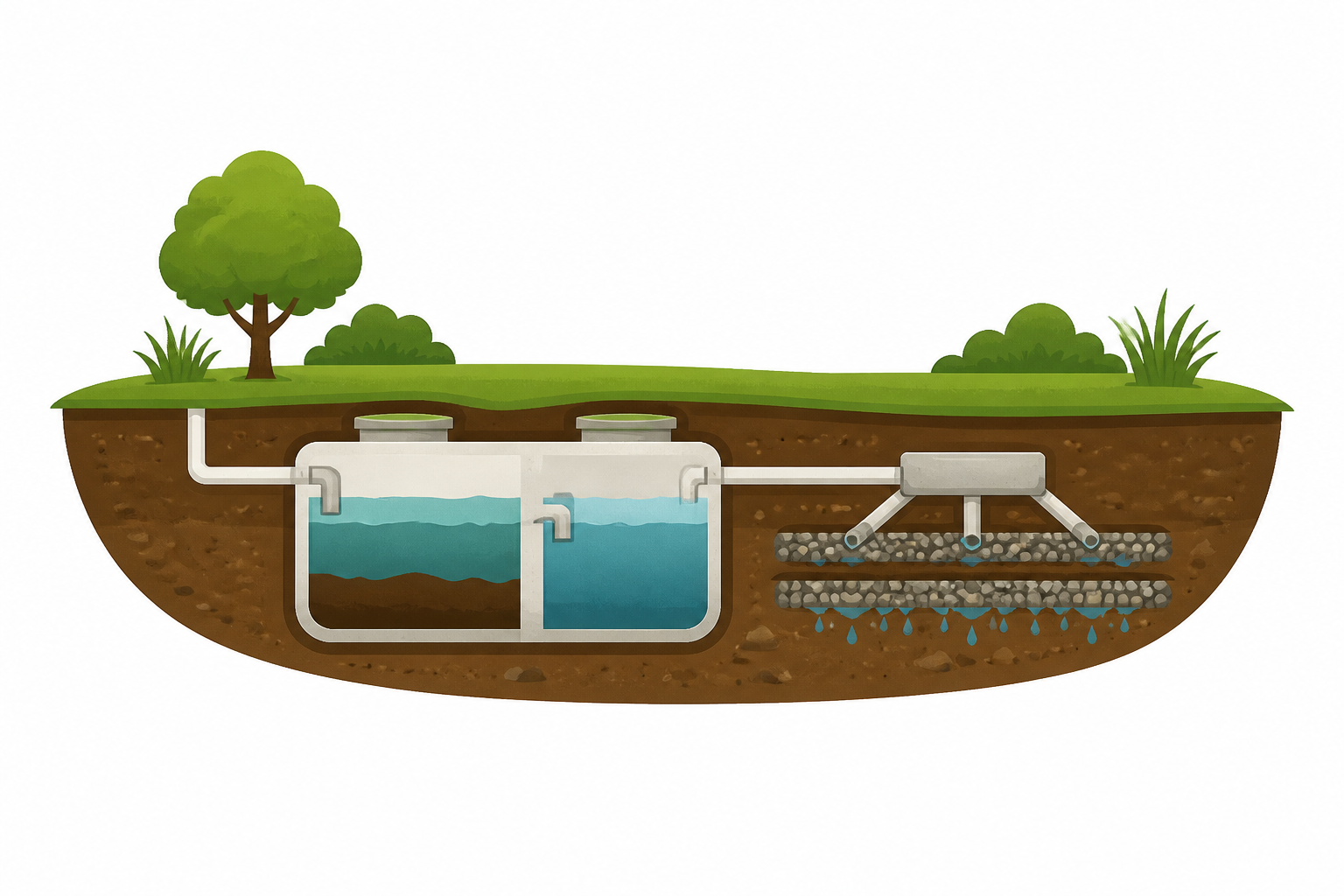
An aerobic treatment unit operates on a fundamentally different principle than the gravity-based conventional septic system. Instead of relying solely on gravity and passive bacterial decomposition, an ATU uses a mechanical blower to pump oxygen directly into the treatment chamber. This oxygen-rich environment accelerates decomposition and allows aerobic microorganisms to process waste far more efficiently than anaerobic bacteria alone can manage. The payoff is cleaner effluent that can be safely dispersed in tighter spaces, poorer soil conditions, or areas where groundwater sits dangerously close to the surface—situations where a conventional system would fail inspection.
Yet that mechanical advantage also explains why your checkbook takes a bigger hit from the moment you flip the switch.
For a residence designed to handle 3 to 4 bedrooms, expect an ATU installation to land in the $12,000–$20,000 band. A conventional gravity-fed system serving the same household typically runs $8,000–$15,000. That gap isn’t simply markup—you’re investing in machinery and infrastructure that conventional systems don’t require:
- An aeration compartment fitted with a motorized blower or compressor unit, typically rated between 1/2 and 1 horsepower
- A submersed effluent pump paired with spray dispersal heads or subsurface drip tubing (replacing the unpressurized gravity drainfield)
- A chlorine dosing apparatus or UV disinfection chamber to eliminate pathogens before water leaves the tank
- Electrical wiring, junction boxes, and automated control circuitry
- A monitored service agreement—mandatory under health code, not optional—for as long as the system operates
That final requirement deserves emphasis. Your state health department doesn’t permit you to operate an ATU without enlisting a licensed technician under a formal maintenance contract. This isn’t bureaucratic overzealousness. It’s a condition of your installation permit, and breaking it voids your warranty and leaves you personally liable. You’ll sign that agreement before the installer’s truck leaves your property.
Year One Through Year Ten: Following the Money
Let me walk through the actual expenditures, using numbers grounded in dozens of installations I’ve personally overseen across rural Georgia and South Carolina.
What Walks Out the Door in Year 1
- Installation fee: $16,000 (middle of our range)
- Year 1 maintenance agreement: $350 annually (state-certified technician, typically 2–3 site visits, routine checks and documentation)
- Blower electricity draw: approximately $140 per year (your monthly electric bill rises by $12–$15 depending on regional rates and motor displacement)
- Chlorine or disinfectant replacement: $225 annually (tablets restocked roughly every month at $30–$50 per container)
Year 1 Bottom Line: $16,715
The Cumulative Tab After Ten Years
- Original equipment and labor: $16,000
- Maintenance agreements over nine subsequent years: $3,150 ($350 per year × 9)
- Electricity cost for nine years: $1,260 ($140 annually × 9)
- Disinfectant consumables over nine years: $2,025 ($225 yearly × 9)
- Compressor or pump replacement (typically emerges during the 5th through 7th year window): $490 (averaged from the $330–$650 professional replacement range, encompassing component cost plus labor)
Year 10 Cumulative Outlay: $22,925
For comparison: a conventional gravity installation at $11,500 with zero contractual maintenance obligations and zero electrical consumption, given a serviceable lifespan of 20 to 30 years, incurs periodic pumping expenses of $300–$500 roughly every fourth or fifth year—approximately $1,500 total across a decade. Conventional system cost over ten years: roughly $13,000.
That math shows an ATU running you approximately $10,000 higher over a single decade. Understandably, this is the figure that makes homeowners pause when they’re weighing their options before signing.
Unpacking Each Recurring Expense
Maintenance Service Agreements: $350 Annually (State-Required, Not Discretionary)
Skipping the maintenance contract isn’t an option available to you. Your health department won’t permit it. A licensed professional must visit your property 2–3 times per year, inspect mechanical components, run water quality assessments, make notations in the state compliance log, and tackle routine adjustments or minor repairs. This isn’t a convenience—it’s the legal backbone of your installation. Cancel it, and your permit becomes invalid, your manufacturer’s coverage disappears, and you assume full financial and legal responsibility if the system creates an environmental or health hazard.
Annual cost range: $300–$400; standard estimate: $350.
Electrical Consumption: Nonstop Blower Operation
Your aeration pump doesn’t turn off. It cycles continuously, every single day, to maintain the oxygen-rich environment necessary for aerobic treatment. Depending on your local utility rates and whether your blower is sized at 1/2 horsepower or a full horsepower, this adds $8–$15 monthly to your power bill. A smaller 1/2 HP unit in Georgia or South Carolina typically translates to a $12/month increase; a 1 HP motor could push that to $18/month or beyond.
Realistic annual figure: $100–$180; I anchor to $140/year as a reasonable middle ground.
Disinfection Materials
The treated water exiting your tank still harbors pathogens. Before it enters the drainfield, it must be disinfected. Two primary disinfection pathways exist:
- Chlorine tablets: You buy septic-grade chlorine tablets (not pool chlorine), check the system monthly, and replace them as needed. A pail of tablets runs $25–$60. Most households use 1–2 pails per month, so budget $150–$300/year. Septicfit Septic Chlorine Tablets are a solid, affordable option that many homeowners keep on rotation.
- UV disinfection lamp: Upfront cost is higher ($400–$900 installed), but the ongoing cost is lower: a new lamp every 1–2 years at $50–$120. If you stay in the home long-term, UV often wins financially and requires less hands-on maintenance.
For the purposes of this breakdown, I’m using chlorine tablets as the standard reference point: $225/year.
Component Wear and Replacement
The spray pump and aeration blower are the workhorse components in an ATU. Neither is designed to run indefinitely. Most of the time, one or both will require replacement between the 5th and 10th year of operation.
- Spray pump swap: $330–$650 total (components run $180–$350; technician time and installation range from $150–$300)
- Blower or compressor swap: $220–$550 total (components cost $120–$350; labor covers $100–$200 of the invoice)
Across the operational lifespan of your ATU—realistically 15 to 25 years—you should budget for at least one such replacement event. Plan for $400–$500 in expenses around year 5 through year 7.
When the Whole System Needs Replacing
An ATU maintained to code typically remains serviceable for 15 to 25 years; conventional systems routinely last 20 to 30 years before failing. Once an ATU reaches end-of-life, replacement costs the same as the original installation: $12,000–$20,000. Intermediate repairs—control boards, spray heads, chamber seals—can run $500–$1,500 during the system’s middle years (typically the 10th through 15th year window).
A Case from the Field: South Carolina Lesson
About three years ago, a property owner contacted me after her ATU began failing. She’d owned the system for nine years, maintained it dutifully, and never imagined she’d face a $7,800 replacement. What she hadn’t planned for was that her original compressor had finally given up the ghost at year eight—a $450 repair she saw coming, grudgingly paid for, and then figured that was her system’s worst day behind her. It wasn’t. Three months later, the control panel started misfiring. Her certified technician flagged it during a routine inspection: the panel was degrading and would fail entirely within months. Repair or replacement? Both exceeded $600. At that point, she’d already spent nearly $13,000 over nine years (installation plus all the maintenance, electricity, chlorine, and repairs I’ve itemized). Adding another $600 to patch a failing component felt like pouring money into a sinking boat. She replaced the whole system. That $7,800 hurt because she hadn’t mentally prepared for the possibility that an ATU could fail before 15 years even if you maintained it flawlessly. Most homeowners I talk to believe their system will announce catastrophic problems, giving them time to save or plan. That’s rarely how it works. A pump weakens gradually. A compressor becomes less efficient. The control logic starts misfiring. By the time you’re facing the decision to repair or replace, you’re already committed to spending something serious—and sometimes replacement makes more financial sense than limping along with patches.
Septicfit Septic Chlorine Tablets
I’ve used these tablets in my ATU for two years with no algae buildup or odor issues.
Check Price on Amazon →