This post contains affiliate links. As an Amazon Associate, I earn from qualifying purchases at no extra cost to you.
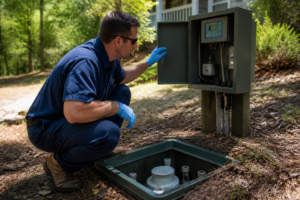
I got a call last spring from a homeowner in rural Georgia who was panicking. His septic system was spraying cloudy, foul-smelling water across his spray field. He’d bought the property six months earlier, and nobody told him it was an aerobic system. His first question was simple: “What the heck is this thing, and why is it broken?”
That conversation stuck with me because it reminded me how little most homeowners understand about how an aerobic septic system works—even though aerobic treatment units (ATUs) have been the fastest-growing alternative septic technology in the rural Southeast for the past 15 years. In my 18 years installing, pumping, and repairing systems across Georgia, South Carolina, and North Carolina, I’ve probably serviced thousands of aerobic systems. They’re reliable when they’re maintained. When they’re not, they fail spectacularly.
This post walks you through the exact 4-stage treatment process that makes an aerobic system work. I’m going to show you what’s actually happening inside the tank, why aeration matters so much, and what breaks down when maintenance gets skipped. Whether you own one of these systems or you’re trying to decide if one is right for your property, understanding how aerobic septic treatment works will save you time, money, and a lot of headaches.
Why Aerobic Systems Are Different (And Why They Matter)
Before I break down how an aerobic septic system works, you need to understand what makes it different from a conventional system. Most septic tanks are anaerobic—they rely on bacteria that live without oxygen to break down waste. It works, and it has for decades. But here’s what caught me off guard early in my career: aerobic bacteria process organic matter 3 to 10 times faster than anaerobic bacteria.
That speed comes from a simple fact of microbiology. Obligate aerobic bacteria have access to dissolved oxygen, which is the most efficient electron acceptor. They metabolize carbon, nitrogen, and phosphorus much more aggressively. They also don’t produce methane or hydrogen sulfide—the gases that make a septic tank smell like a dead animal.
Here’s the practical side: aerobic systems produce cleaner water. The EPA recognizes this, and so do most state health departments. In North Carolina and Georgia, aerobic systems can discharge to shallower soil depths and tighter setbacks than conventional systems because the treatment is more complete. Some states—like South Carolina—actually require aerobic treatment in specific soil conditions. That’s why I’ve installed so many of them.
The downside? They’re more complex. They have moving parts (pumps, air compressors, floats). They need electricity. They require quarterly maintenance and annual inspections. But if you understand the 4-stage process, you’ll know exactly what to watch for.
Stage 1: The Trash Tank (Pre-Treatment and Settling)
Every aerobic system starts with a trash tank. I call it the “trash tank” because it’s where the garbage goes first—literally. This is where your wastewater enters the system, and it’s still heavily loaded with solids, grease, and raw organic matter.
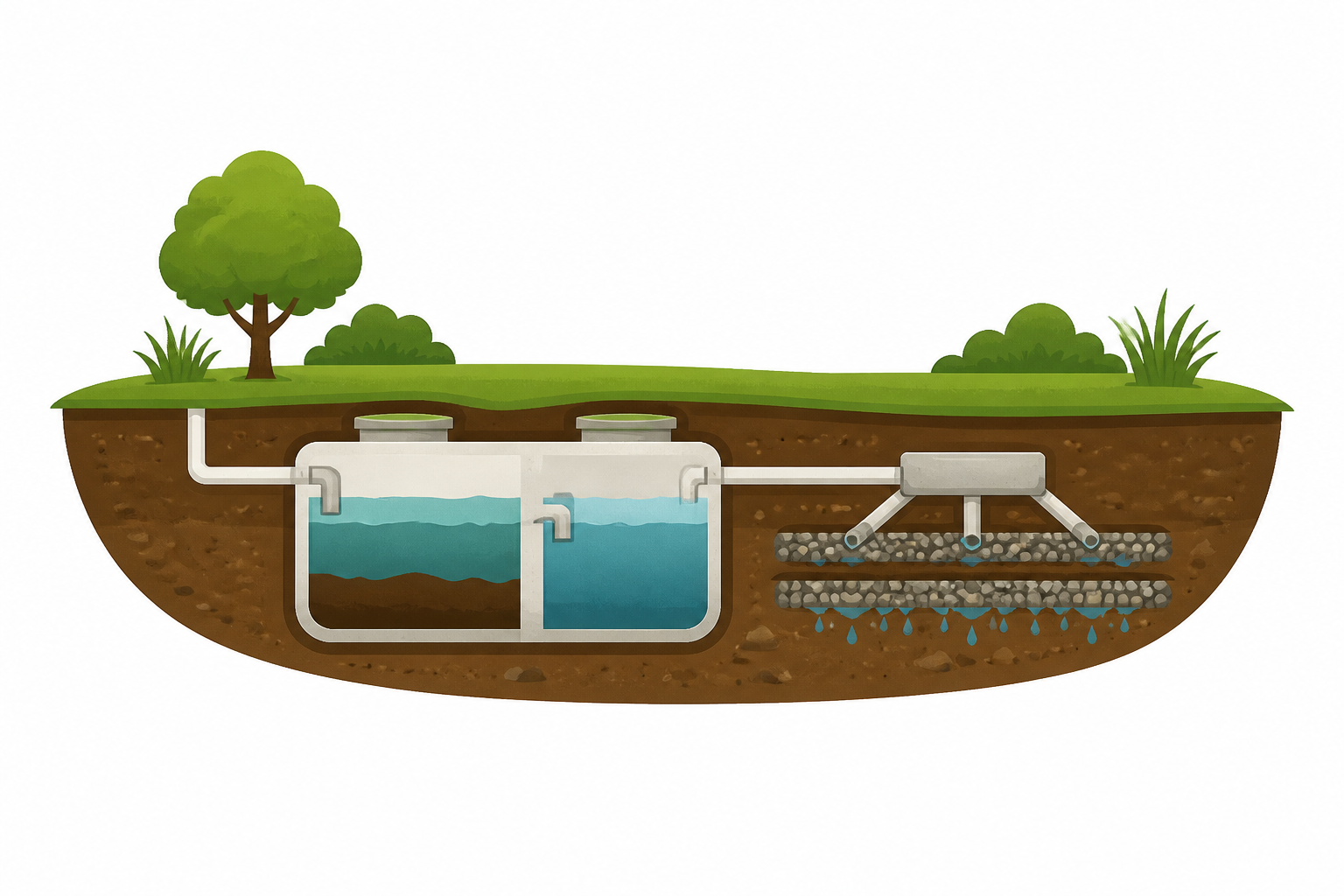
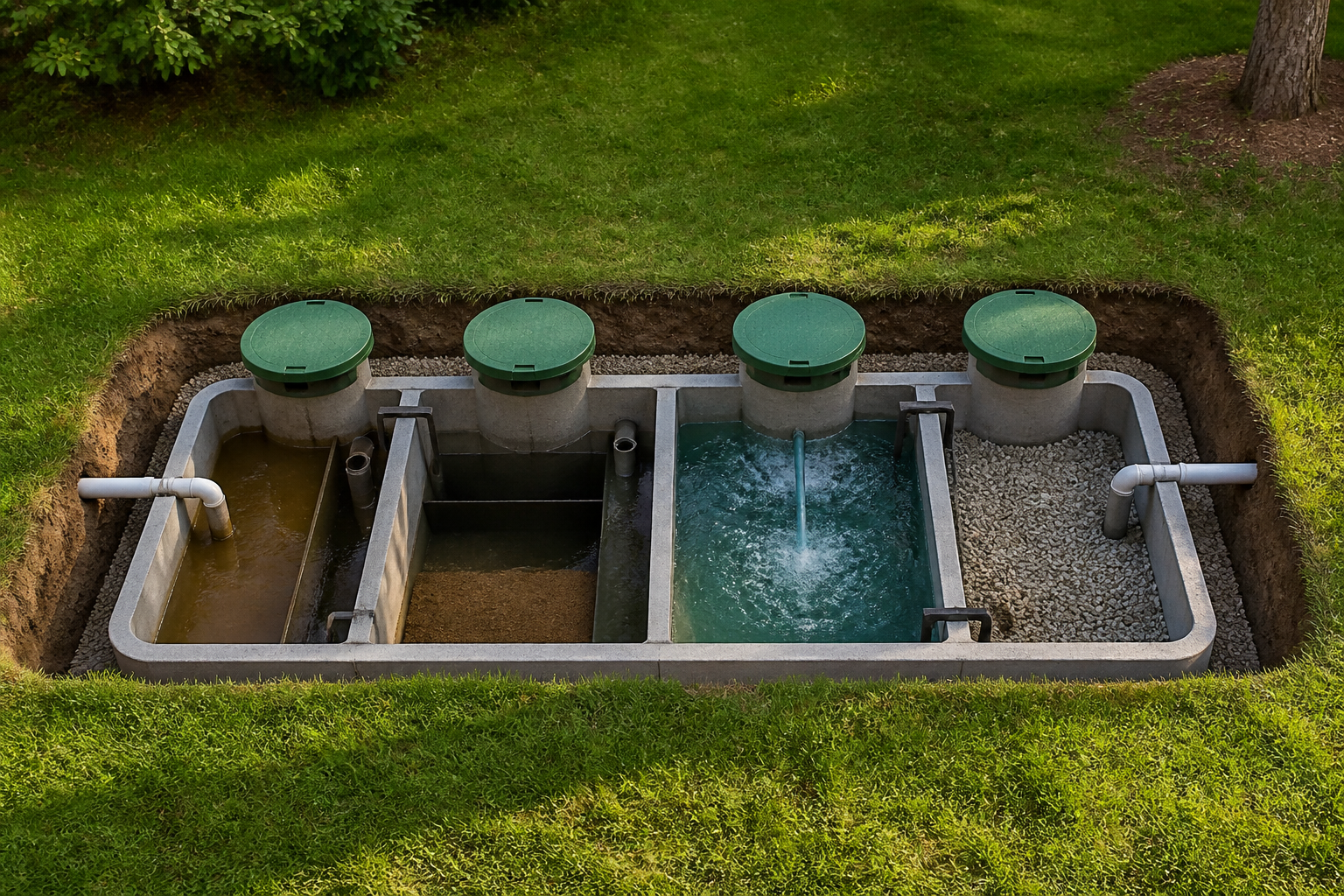
Here’s what physically happens inside the trash tank. Raw sewage flows in at the top. Gravity does the work. Heavy solids—paper, feces, food particles—sink to the bottom and accumulate as sludge. Lighter materials, especially grease and oils, float to the surface and form a scum layer. Meanwhile, anaerobic bacteria (the kind that don’t need oxygen) start colonizing the sludge and begin very slowly breaking down organic matter.
The trash tank holds wastewater for a retention time of 24 to 48 hours at a typical design flow of 500 gallons per day (GPD). That holding time is critical. It allows solids to settle out before water moves to the next stage. Think of it like a septic tank—because, functionally, it is one.
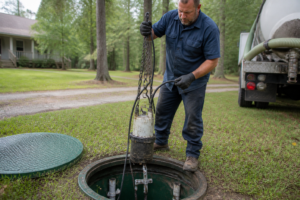
I’ve seen countless systems fail because homeowners or previous owners pumped out the trash tank too aggressively. Pump it every 3 to 5 years if you’re maintaining it properly. However, I met one family that had never pumped theirs in 11 years. The sludge was so thick it was blocking the outlet baffle. Wastewater was flowing over the top without settling. That’s when I learned the hard way that the trash tank isn’t just “pre-treatment”—it’s the foundation of everything downstream.
Stage 2: The Aeration Chamber (Where the Magic Happens)
Now here’s where the aerobic system truly earns its name. Water flows from the trash tank into the aeration chamber—the heart of the system. This is where dissolved oxygen is continuously pumped in, and where the real treatment happens.
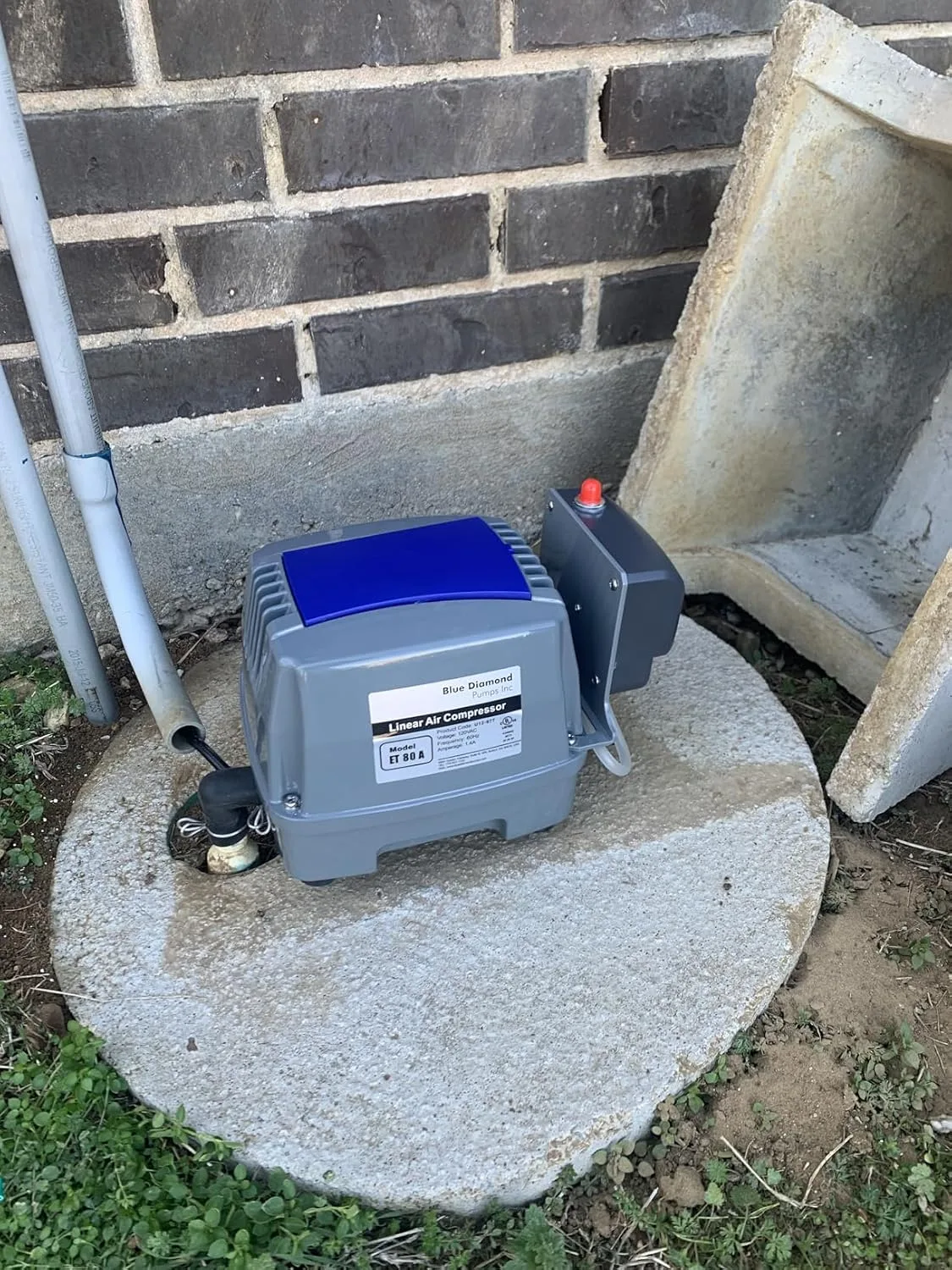
An air pump (either a compressor or a linear diaphragm blower, typically rated at 1/3 to 1/2 horsepower) runs continuously or in cycles, delivering 2 to 5 cubic feet per minute (CFM) of air into the aeration chamber. That air creates tiny bubbles that mix with the wastewater and dramatically increase dissolved oxygen levels to between 1 and 3 milligrams per liter (mg/L).
The effect is profound. Those aerobic bacteria I mentioned—specifically heterotrophic bacteria that consume organic matter and nitrifying bacteria that convert ammonia to nitrate—colonize the chamber and go to work. They’re eating the carbon, nitrogen, and phosphorus in the wastewater at a rate that would take conventional tanks weeks to accomplish.
In my experience, this is where you see the real difference. The water exiting the aeration chamber is already mostly treated. Dissolved oxygen levels stay elevated because the pump keeps running. The bacterial population is enormous—we’re talking billions of organisms per milliliter. Biological oxygen demand (BOD) drops by 80 to 90%. Suspended solids start to settle. Ammonia (NH₃) begins converting to nitrate (NO₃) through a process called nitrification.
There are two main designs you’ll see in aerobic systems: extended aeration ATUs and sequencing batch reactors (SBRs). Extended aeration units—common brands include Jet, Aerob-It, and some Norwesco models—run air continuously. The wastewater enters, mixes with the biomass, and treats continuously in one chamber.
SBRs like Fuji Clean work differently. They cycle through timed phases: fill, react, settle, and decant. An electronic controller triggers sequences. Air pumps on during the react phase. A pump removes treated water during decant. I’ve installed both designs successfully, but they have different maintenance rhythms. Extended aeration is more forgiving to maintenance lapses. SBRs are more sensitive to timer failures.
Stage 3: The Clarifier and Sludge Return (The Critical Overlooked Stage)
After the aeration chamber, treated water flows into a settling tank called the clarifier. This is where the water rises slowly and remaining solids fall back down. That sludge—now partially treated through aeration—needs to go somewhere. This is where sludge return comes in, and it’s the stage most homeowners have never heard of.
A return pump (typically a small submersible, 1/10 to 1/4 HP) automatically pulls settled sludge from the bottom of the clarifier and sends it back to either the aeration chamber or the trash tank. This continuous recycling serves a critical purpose: it maximizes treatment by keeping solids in contact with the bacterial biomass longer. It also prevents the clarifier from filling up with sludge.
Here’s what happens when sludge return fails. I was called to that Georgia property I mentioned earlier. The system had been spraying cloudy, murky water for six weeks. The homeowner had called a landscaper who told him to “just keep mowing around it.” By the time I arrived, the clarifier was 80% full of settled sludge. The return pump had failed—it was just sitting there, silent. Water quality tanked. Solids were carryover into the drip field.
Why does that matter? If the clarifier fills with sludge and you don’t return it, solids overflow into the discharge lines and clog your spray heads or drip emitters. You get backups. You get surface discharge. You get a system that looks like it’s failed when really it just needs a $400 pump replacement and a cleaning.
The return pump is one of those components that requires monitoring. Annual inspections should include testing it—listening for it to cycle, confirming sludge isn’t backing up in the clarifier. Quarterly maintenance should check the float switch that triggers the pump. This stage doesn’t get the attention it deserves, but it’s the difference between a system that works for 20 years and one that clogs in six months.
Stage 4: Disinfection and Distribution (Final Polish and Dispersal)
The last stage takes that treated, clarified water and finishes it off. Most aerobic systems in the Southeast use one of two disinfection methods: chlorine tablets or ultraviolet (UV) light. I’ve seen both work well, but chlorine is more common because it’s cheaper and leaves residual protection as the water travels through the distribution field.
Chlorine tablet contactors are simple: treated water flows through a chamber with tablets that dissolve and kill remaining pathogens. Chlorine residual drops to safe levels before the water leaves the system (typically 0.5 to 1.0 mg/L). UV systems do the same job without chemical residue—UV light damages pathogen DNA—but they cost more and require periodic bulb replacement.
After disinfection, the water is pumped to the distribution zone. Here’s where those spray heads or drip emitters come in. Most systems use one of three approaches: surface spray heads, subsurface drip lines, or shallow soil drainfields. Spray systems are common in the Southeast because they’re visible (you can see the system working) and they’re cost-effective. Drip systems are better in tight spaces or shade.
And here’s the detail that most people miss: spray zones rotate on a timer. A typical setup might have 4 to 6 zones. The timer runs one zone for 15 minutes, then shuts off for 75 minutes while the other zones cycle. That rotation prevents soil clogging and gives the biomat a chance to rest and re-establish. The biomat is that dark, biologically active layer that forms below the spray heads—it’s where much of the final treatment happens. If you keep spray heads running 24/7 on one zone, you’ll clog the soil and lose infiltration.
I’ve walked into jobs where someone disconnected the zone controller thinking they were being helpful. Water pooled in one zone while others sat dry. The soil clogged in 6 months. Installation manuals specify zone timing for a reason—it’s not arbitrary. Respect it.
How an Aerobic Septic System Works: The Complete Treatment Summary
To recap how an aerobic septic system works: raw wastewater enters the trash tank where solids settle and anaerobic treatment begins (Stage 1). Water flows to the aeration chamber where an air pump delivers dissolved oxygen, and aerobic bacteria rapidly process organics and nutrients over 6 to 8 hours (Stage 2). Treated water moves to the clarifier where solids settle and are pumped back for additional treatment (Stage 3). Finally, the clarified water is disinfected with chlorine or UV and distributed across spray zones that rotate to prevent soil clogging (Stage 4).
Each stage depends on the previous one. Skip trash tank pumping and the aeration chamber gets overloaded. Fail to maintain the air pump and dissolved oxygen crashes, bacteria die, and treatment fails. Ignore the return pump and the clarifier overflows. Disconnect the zone timer and you clog the soil. This isn’t a system that forgives neglect.
The Air Pump That Kept Me From Replacing My Whole System
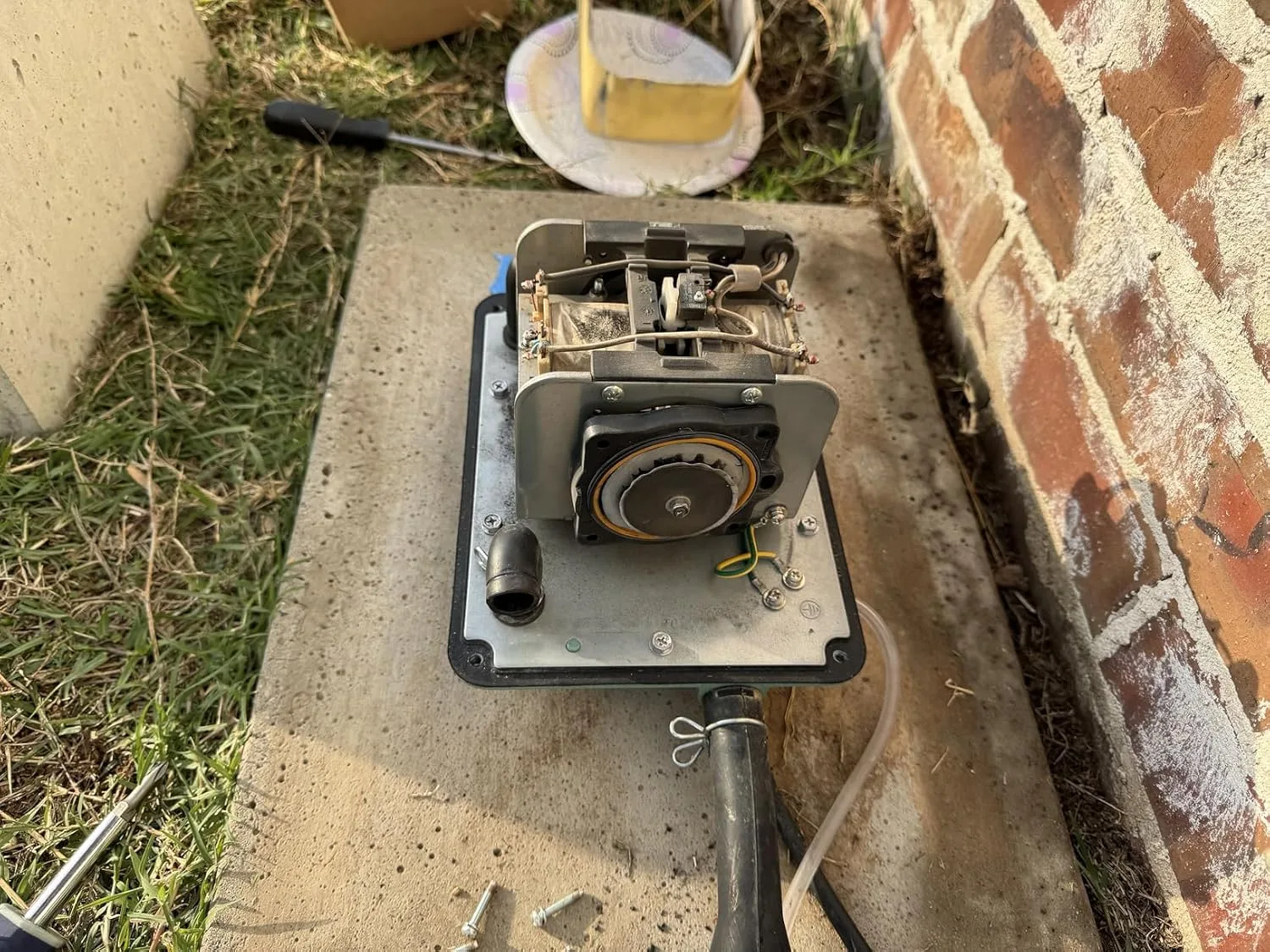
If your aerobic system is spraying cloudy effluent or backing up, nine times out of ten the culprit is a failing air pump—not a broken treatment tank. A solid replacement pump with built-in alarm monitoring is the difference between a $300 fix and a $5,000 system replacement.
What works
- The built-in alarm actually alerts you before your system fails completely—I caught a failing pump at 2 a.m. because of that alarm and had time to order a replacement instead of panicking.
- Linear diaphragm design runs quieter and more reliably than rotary vane pumps, and the parts are standard enough that rebuild kits are cheap when you need maintenance down the road.
- Installation is straightforward if you’ve got basic plumbing skills—electrical connection is simple, and the pump bolts to the treatment tank without special modifications.
What doesn’t
- The alarm is loud—and I mean *loud*—so if your treatment tank is near a bedroom window, you’ll want to relocate it or soundproof the cabinet.
- It’s not a universal fit for every aerobic system, so you need to verify your tank’s inlet/outlet specs before ordering, or you’ll be returning it.
I almost bought a generic pump from a local supplier without checking compatibility first, and the return shipping would have cost me a week of downtime. That’s when I switched to the Blue Diamond ETA 80 Septic or Pond Linear Diaphragm Air Pump with built-in Alarm, which came with clear specs and actually showed up with everything I needed to install it the same day.
This post contains affiliate links. As an Amazon Associate, I earn from qualifying purchases at no extra cost to you.