Disclosure: This post contains affiliate links. As an Amazon Associate, I earn from qualifying purchases at no extra cost to you.
Last spring, I got a call from a frustrated homeowner outside Atlanta. His conventional septic system had failed—again. The drain field was saturated. His lot was too small for a replacement. The health department had already denied his permit twice. He was facing a $40,000 excavation nightmare or losing the property’s use entirely. I walked him through his only real option: an aerobic treatment unit, or ATU. Within eight weeks, he had a permitted, inspected system running smoothly. His relief was immediate.
That conversation planted a seed for this post. After 18 years of pumping, repairing, and replacing septic systems across the rural Southeast, I’ve seen a massive shift. More homeowners are asking: what is an aerobic septic system? And honestly, they should be. If you’re on poor soil, a tight lot, or dealing with a failed conventional system, understanding aerobic treatment might save your property—and your wallet.
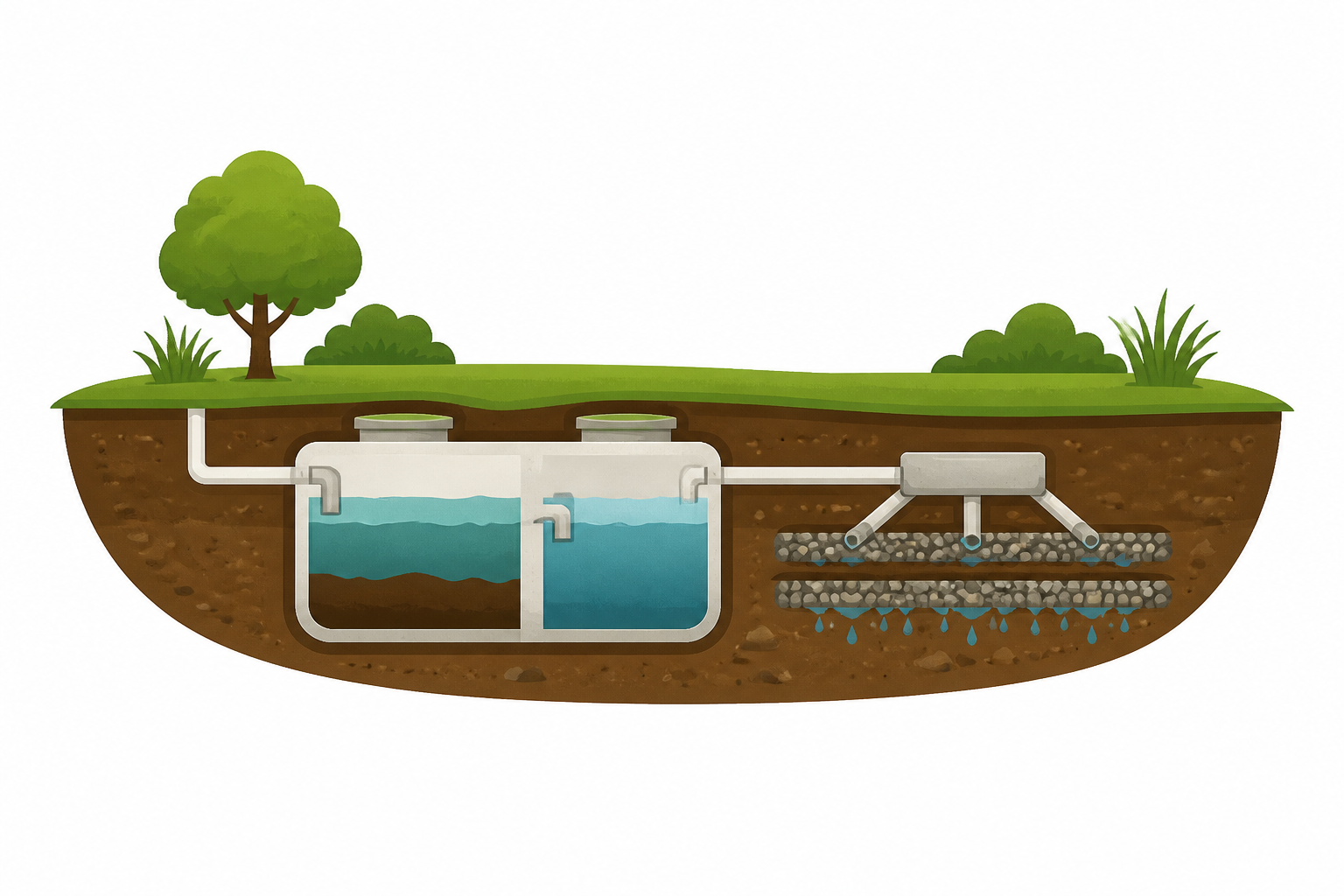
An aerobic septic system isn’t magic, but it’s close. It’s a bacteria-driven wastewater treatment plant built into your backyard. I’ll walk you through exactly how one works, why they cost more upfront, which brands I actually install, and when your health department will mandate one whether you like it or not.
What Is an Aerobic Septic System? The Core Concept
Let me start with the fundamental difference. A conventional septic system relies on anaerobic bacteria—bugs that work without oxygen. They’re slow. They produce sludge. They treat wastewater to roughly 130 mg/L BOD5 (biological oxygen demand). That’s passable for a drain field with decent soil, but it’s cutting corners.
An aerobic system flips the script. It pumps air into a treatment chamber where aerobic bacteria—oxygen-loving organisms—go to work. These bacteria are aggressive. They break down organics faster and more completely. The treated effluent leaving an ATU typically measures 20–30 mg/L BOD5. That’s one-fourth the concentration of conventional treatment.
Why does that matter? Because cleaner water means your drain field lasts longer, fails less often, and can function in soils where a conventional system would plug up in three years. On clay, tight sandy loam, or properties with high water tables, an aerobic system isn’t a luxury—it’s the difference between a viable septic system and a failed permit application.
How an Aerobic Treatment Unit Actually Works: The Three Chambers
I always explain an ATU like this: it’s three tanks doing three jobs. You need to understand each one to know what you’re getting.
Chamber One: The Trash Tank (Anaerobic Pre-Treatment)
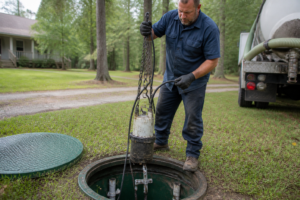
Raw wastewater from your house flows into the first chamber—the trash tank. This is essentially a holding tank where solids settle out and the anaerobic process kicks off. Heavy stuff sinks. Grease and oils float. Bacteria start breaking down organics in an oxygen-free environment. This chamber buys you time. It protects downstream equipment from toilet paper clogs and hair tangles.
I’ve seen installers skimp on trash tank volume. Don’t. In my experience, undersizing this chamber leads to premature clogging of the aeration nozzles. Most Southeast health departments specify a minimum of 500 gallons for a three-bedroom home. I usually spec 750 for good insurance.
Chamber Two: The Aeration Chamber (Where the Magic Happens)
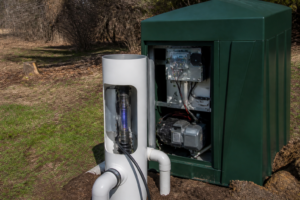
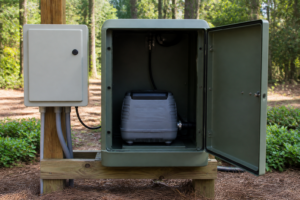
Partially treated wastewater flows from the trash tank into the aeration chamber. Here’s where aerobic bacteria colonies thrive. An air pump—typically a 0.5 to 1.5 hp motor—pushes compressed air into the tank through diffusers or bubble tubes. The oxygen-rich environment explodes with bacterial activity. Organics get oxidized. Nitrogen gets nitrified. Suspended solids clump together.
This is the heart of the system. The aeration chamber is usually 40–60% of your total ATU volume. Detention time here is typically 6–8 hours. That’s why power reliability matters so much—if that air pump fails, the bacteria colony starts suffocating within hours. I’ll come back to this in the alarm panel section.
Chamber Three: The Clarifier or Settling Chamber
After aeration, treated wastewater flows to the clarifier. This is a settling tank where the heavier, flocculated solids drop out. Clean, treated effluent rises to the top and overflows into a collection chamber. Settled biosolids—the sludge—either return to the aeration chamber or settle to the bottom for eventual removal.
The clarifier extends detention another 2–4 hours. That slow settling is critical. Rushing treated effluent to your drain field with suspended solids still floating means premature biomat formation and drain field failure. Every hour counts here.
The Chlorinator/Spray Pump Vault (Downstream Disinfection)
Finally, treated effluent flows to a chlorinator vault. Here, chlorine tablets or liquid chlorine is added to kill pathogens. The chlorinated effluent then flows to either a spray irrigation system or subsurface drip field. Most Southeast systems I install use subsurface drip—it’s safer for the homeowner and better for the local environment. The spray pump vault also contains the high-water alarm sensor. More on that in a moment.
That entire four-stage process—trash tank, aeration, clarification, disinfection—is why an aerobic system produces such clean effluent. And that cleanliness is why they work where conventional systems simply fail.
The Major ATU Brands You’ll Encounter in the Southeast
I install different brands based on local health department approval, regional availability, and specific site conditions. Here are the four I see most often across the Southeast:
Jet Inc. (Iowa-Designed, Widespread Adoption)
Jet Inc. systems are everywhere in the Southeast—Georgia, Tennessee, North Carolina. They’re engineered in Iowa but have a rock-solid reputation in our region. The design emphasizes redundancy: dual air pumps, solid clarifier design, and straightforward maintenance. I’ve pulled Jet units out of the ground after 20 years still running strong. They’re not the flashiest, but they work. Most Southeast health departments approve them without question.
Norweco Singulair (Ohio, Concrete-Body Variant)
Norweco makes excellent systems. The Singulair line features a reinforced concrete body instead of fiberglass. That matters in areas with high water tables or aggressive soils. I’ve used Norweco systems in low-lying properties where I needed that extra structural integrity. They’re equally well-regarded by health departments, though typically priced slightly higher than Jet.
Aerob-It (Texas/Oklahoma Specification, Southern Roots)
Aerob-It systems have a strong presence in Texas and Oklahoma but are less common in the Southeast. That said, they’re solid units—simple, durable, and affordable. I’ve specified them on budget-conscious jobs where the health department approves. They perform equally well to Jet for basic 500 GPD residential applications.
Fuji Clean (Florida Coastal Zone Popularity)
Fuji Clean is popular in Florida, especially in coastal areas where regulatory scrutiny is higher. Their systems are compact, efficient, and produce exceptionally clean effluent. I use them occasionally in Southeast projects requiring tighter than normal treatment standards or where lot constraints demand a smaller footprint. They’re pricier but deliver results.
My usual spec: Jet Inc. or Norweco for 80% of jobs. Both are reliable, locally serviced, and approved everywhere. Brand choice depends on site conditions and your installer’s regional relationships. Don’t get hung up on brand loyalty—all four are NSF/ANSI 245 certified, meaning they meet EPA performance standards.
Cost Reality: Why Aerobic Systems Command a Premium
Let’s talk money. I see sticker shock all the time when homeowners compare quotes.
A conventional septic system in the Southeast runs $4,000–$8,000 installed. A standard 500 GPD aerobic treatment unit runs $8,000–$15,000. That’s a $4,000–$7,000 premium. Sometimes more if you need longer drip lines or a challenging site.
Why the jump? First, complexity. An ATU has a power requirement—an air pump, a spray pump, control panels, alarms. A conventional system is gravity-fed passive hardware. Second, the unit itself is more sophisticated: multiple chambers, internal baffles, air diffusers. Third, the drain field is cleaner and longer-lasting, but initial installation requires subsurface drip or sand filter construction—more labor, more materials. Fourth, and this matters: that premium cost is often cheaper than the alternative.
Last year I consulted on a property in rural South Carolina with failing perc tests. The soil perked at 90 minutes per inch—far too slow for conventional treatment. The conventional-system option? A $40,000 engineered sand filter or $35,000 mound system. The aerobic option? $11,500 installed. The homeowner went aerobic in five minutes. Math is math.
Here’s the honest breakdown of what you’re paying for:
- Equipment: $3,500–$6,000 (ATU unit, pump, control panel, chlorine kit)
- Installation labor: $1,500–$3,000 (site prep, tank placement, plumbing)
- Drain field: $2,500–$5,000 (subsurface drip or spray field)
- Electrical: $500–$1,500 (power run, breaker, weatherproof outlet)
- Permitting and inspection: $200–$500
That’s where your $8,000–$15,000 goes. If a contractor is quoting significantly below or above that range, ask questions. Below usually means corners cut. Above might mean unnecessary add-ons.
When Your Health Department Requires an Aerobic System
Here’s the reality: in most Southeast jurisdictions, you don’t get to choose whether you install an ATU. Your health department does. I’ve seen homeowners fight this and waste $2,000 on appeals they lose. Save your energy. Know the three scenarios where an ATU becomes mandatory:
Scenario One: Failing Percolation Test (>60 Minutes/Inch)
If your soil percs slower than 60 minutes per inch, conventional septic drain fields don’t work. The soil can’t absorb the treated effluent fast enough. You’ll either need an engineered alternative (expensive) or an aerobic system (less expensive). Health departments mandate an ATU in this situation because it’s the practical solution. The cleaner effluent from an aerobic system can function in slower-percing soils.
Scenario Two: Setback and Lot Size Constraints
Many Southeast counties require 100-foot setbacks from wells, 50-foot setbacks from property lines, and 25-foot setbacks from streams or wetlands. That shrinks your usable space fast. On a one-acre lot, you might have nowhere to put a 1,500 square-foot conventional drain field. An aerobic system with subsurface drip uses 40–50% less area. Health departments approve ATUs in tight quarters because the superior treatment quality and smaller footprint reduce environmental risk.
Scenario Three: Replacement of Failed System in Sensitive Area
If your conventional system failed and you’re replacing it—especially if you’re near a sensitive watershed, coastal zone, or high water table—your health department may mandate aerobic treatment for the replacement. In Georgia, Rule 511-3-1-.29 specifically addresses septic system performance in environmentally sensitive areas. An ATU is the approved upgrade path. I’ve seen this enforced rigorously in North Carolina and Florida as well.
Bottom line: check with your county health department before you design a system. A 15-minute phone call beats a 15-day permit rejection later.
The Control Panel and Alarm System: What Those Lights Mean
Every aerobic system has two alarms you need to understand. This is where my “learned it the hard way” story comes in, and it’s important.
High-Water Alarm
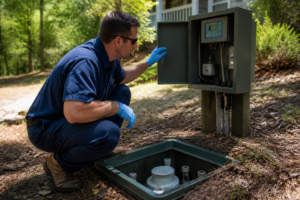
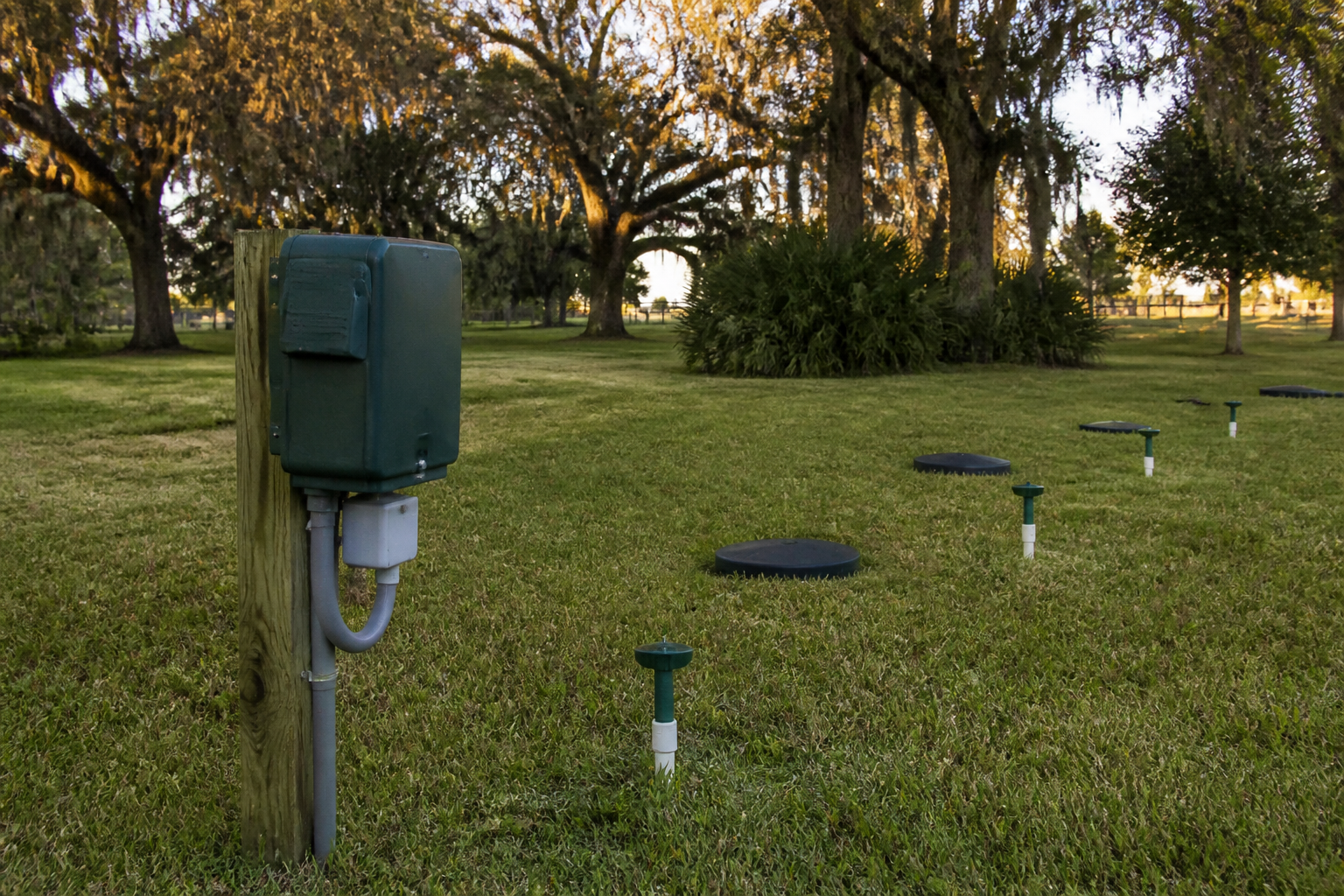
This sensor sits in the pump chamber (spray pump vault). If water level rises above normal—indicating the drain field is backing up or the spray pump isn’t cycling—the alarm triggers. You’ll see a red light, hear a buzzer, or get an alert depending on your control panel model. This is a serious signal. A high-water alarm means your system can’t discharge treated effluent fast enough. Likely causes: drain field clogging, pump failure, or valve blockage. Call a licensed installer immediately. Don’t ignore this.
Aerator/Air Pump Failure Alarm
Most modern ATUs monitor air pump operation. If the pump fails—motor burnout, check valve failure, or air line blockage—the control panel detects the loss of pressure. The alarm fires. This is also serious. Without aeration, your bacterial colony starts dying within hours. Within 24–48 hours, the system is non-functional. You need service that day.
Here’s What I Learned the Hard Way
Three years ago, I installed a Jet Inc. system for a client outside rural Georgia. Beautiful property, perfect installation, system passed all inspections. Fast forward to spring the next year. The homeowner calls—no, wait. I hadn’t heard from him at all, which was odd given that I’d explained annual service contracts pretty clearly.
I drove out for routine maintenance. I found the problem immediately: the control panel power breaker was switched off. The homeowner had turned it off to “save electricity” three weeks prior. No alarms had sounded because there was no power to sound them. The air pump hadn’t run in 21 days. The aeration chamber was completely anaerobic and acidified. Bacteria colonies were dead. The treatment quality had plummeted to worse than a conventional system. The chlorine cartridge in the vault was depleted.
I spent six hours doing an emergency restart sequence: power-up the panel, let the air pump run for 12 hours to oxygenate the chamber, monitored pH and dissolved oxygen, dosed the system with live bacteria colonies, cycled the spray pump to flush chlorine. It took a full treatment cycle restart—essentially a cold start for the entire bacterial ecosystem.
The homeowner learned an expensive lesson: never turn off power to an aerobic system control panel. That power isn’t optional. It’s the life support system for your bacteria. If you’re worried about electricity costs, talk to your installer. A typical ATU runs about 8–12 kilowatt-hours per day. That’s roughly $80–$120 per month, depending on your utility rate. You can’t cost-engineer your way around this. If electricity expense is a dealbreaker, a conventional septic system might be your answer—but if you needed an aerobic system to begin with, conventional wasn’t an option.
State and County Service Contract Requirements
This is mandatory stuff. Most Southeast states legally require an annual service contract with a licensed installer for aerobic systems. This isn’t optional or advisory—it’s a condition of your permit.
In Georgia, Rule 511-3-1-.29 mandates annual maintenance for all ATUs. Your health department files the contract. The installer visits annually, inspects all chambers, tests effluent quality, records system performance, and certifies compliance. The cost typically runs $200–$400 per visit depending on your region.
Why so strict? Because an ATU’s treatment quality depends entirely on bacterial health and mechanical function. Annual inspections catch early failures before they become expensive emergencies. I’ve caught worn air pump impellers, failing check valves, and low chlorine residual during routine service calls. Fixing those issues at maintenance is pennies. Fixing them after system failure is hundreds of dollars.
Your health department will provide a list of licensed maintenance contractors. Most areas have 2–5 options. Interview them. Make sure they’re responsive and local. A contractor three hours away won’t help if your system alarms at midnight on a Friday. I maintain systems for homeowners I installed 15 years ago. That relationship and quick response is why they call me—and why they’ve avoided major failures.
The Real Treatment Numbers: Why Aerobic Effluent Quality Matters
Let me put specific numbers to the water quality difference, because this is why aerobic systems work where conventional systems fail.
A conventional septic system discharges effluent with approximately 130 mg/L BOD5 (biological oxygen demand) and 130 mg/L TSS (total suspended solids). That means for every liter of treated wastewater, you’re introducing 130 milligrams of organic pollutants and suspended particles into your drain field. Over a typical 1,000 GPD household daily flow, that’s 130 grams of BOD and TSS per day.
An aerobic system discharges effluent with approximately 20–30 mg/L BOD5 and 20–30 mg/L TSS. That’s a reduction by a factor of four to six. Same 1,000 GPD household now introduces only 20–30 grams of BOD and TSS daily. The arithmetic is brutal for conventional systems on poor soil. That constant organic loading clogs the drain field biomat in 3–7 years.
Aerobic treatment extends drain field life to 15–25 years, sometimes longer. That’s the real financial story. Yes, the ATU costs more upfront. But the drain field replacement cost—$5,000–$10,000 on a conventional system every 5–7 years—doesn’t happen as often or as severely with aerobic treatment. Over 30 years of ownership, aerobic systems are usually cheaper.
Maintaining Your Aerobic System: Beyond the Annual Service Contract
Annual maintenance is mandatory, but you have responsibilities too.
Never flush non-degradable solids. Paper towels, baby wipes (even “flushable” ones), hair, cigarette butts, and feminine hygiene products will clog your system. I’ve had to excavate and clean trash tanks because homeowners flushed kitchen waste. Your septic system—conventional or aerobic—is designed for human waste and