This post contains affiliate links. As an Amazon Associate, I earn from qualifying purchases at no extra cost to you.
People assume that owning a septic system on large acreage means fewer rules, more flexibility, and an easier install. I hear it constantly — “Joel, I’ve got 40 acres. I can put that tank anywhere I want, right?” Wrong. In my 18 years of installing and inspecting systems across rural Georgia, Alabama, and Tennessee, some of my most complicated jobs have been on large properties. I learned this the hard way after my first big acreage job nearly failed inspection—the landowner had assumed 30 acres meant the rules didn’t apply, and I hadn’t verified the local setbacks closely enough before we broke ground. More land gives you options, but it does not exempt you from setback requirements, soil limitations, or sizing math that has to be done correctly the first time.
The first time I really understood this was on a 75-acre farm property outside of Dalton, Georgia. The homeowner had cleared a beautiful flat spot near the pond for his new house. Perfect view, good elevation — terrible place for a drain field. The soil was clay-heavy and the seasonal high water table was sitting at 18 inches below grade. We ended up installing a mound system 300 feet from where he originally planned. That job cost him an extra $6,800 and six weeks of delays. It changed how I approach every large-acreage project from that point forward.
This post is everything I’ve learned sizing and placing systems on large rural properties. I’ll walk you through how I determine tank size, how I choose drain field locations, why setbacks still matter even with wide-open space, and what mistakes I see homeowners and even some contractors make regularly.
Why Septic System Large Acreage Projects Aren’t as Simple as They Look
More land means more decisions, not fewer. On a half-acre suburban lot, your placement options are basically predetermined. On 20 or 50 acres, you’re choosing between dozens of potential sites — and making the wrong choice can cost you $10,000 to $30,000 in repairs or a complete system replacement later. I’ve seen both outcomes.
The biggest misconception I encounter is that acreage alone qualifies a site. It doesn’t. Your local health department — not the size of your property — determines whether a location is acceptable. In most rural Southeast counties, the regulations follow state-level on-site sewage programs that align closely with EPA guidelines for conventional septic systems. Soil type, slope percentage, proximity to water sources, and depth to the water table all factor in. None of those change because you own more land.
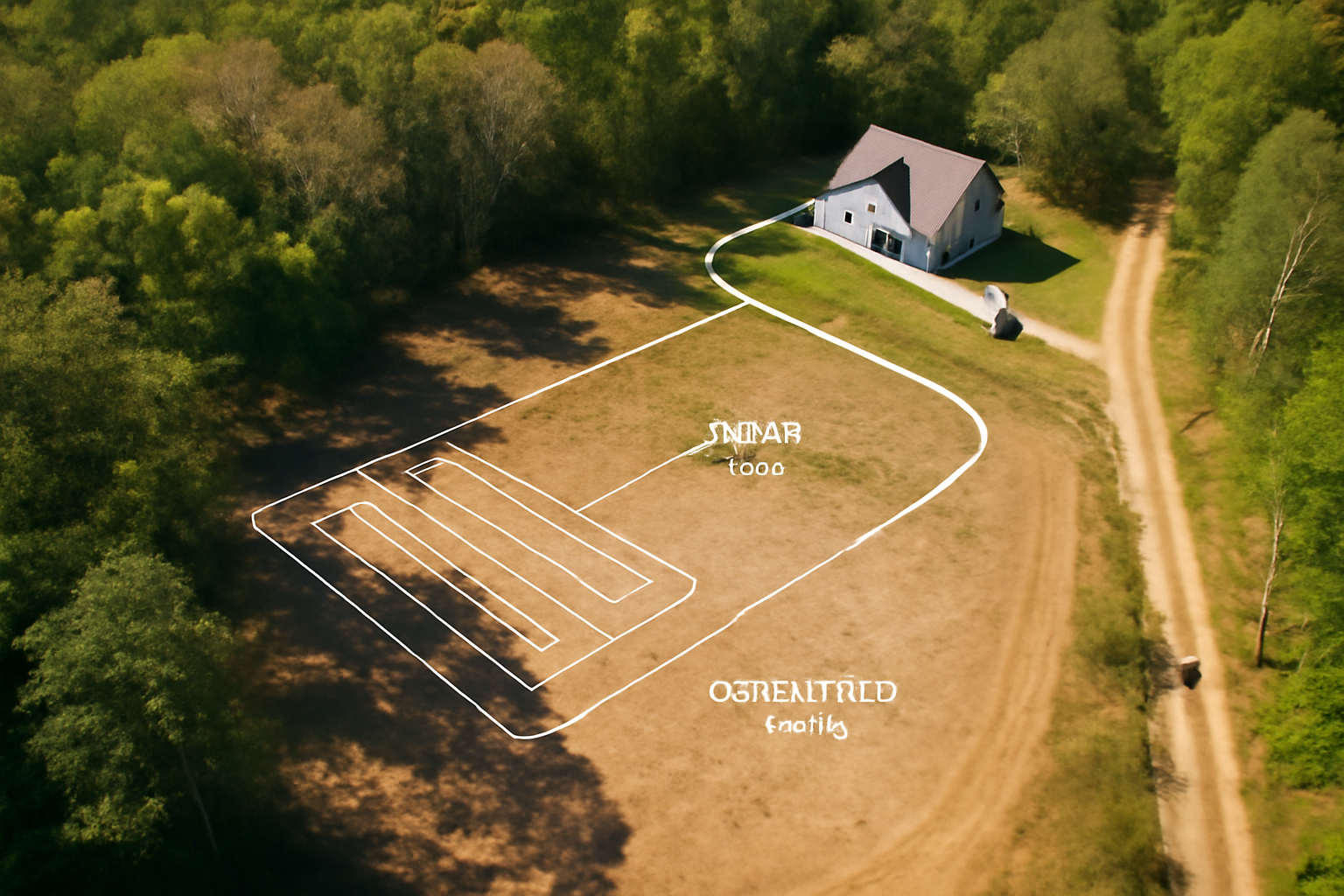
That said, large acreage does give you one genuine advantage: flexibility for future repair areas and system expansion. Most state regulations require you to identify and protect a 100% repair area adjacent to your primary drain field. On small lots, that repair area might not even exist. On large properties, I always map out both the primary field and the repair area before I finalize placement. That step alone has saved several of my clients from major headaches down the road.
How I Size the Tank and Drain Field on Rural Properties
Sizing starts with the house, not the land. I calculate based on the number of bedrooms — that’s the standard method used by most state health departments in the Southeast. A three-bedroom home typically requires a 1,000-gallon tank minimum. A four-bedroom home needs at least 1,250 gallons. However, I rarely install the minimum on rural properties. Why? Because large-acreage homes often come with larger families, guest houses, or future additions.
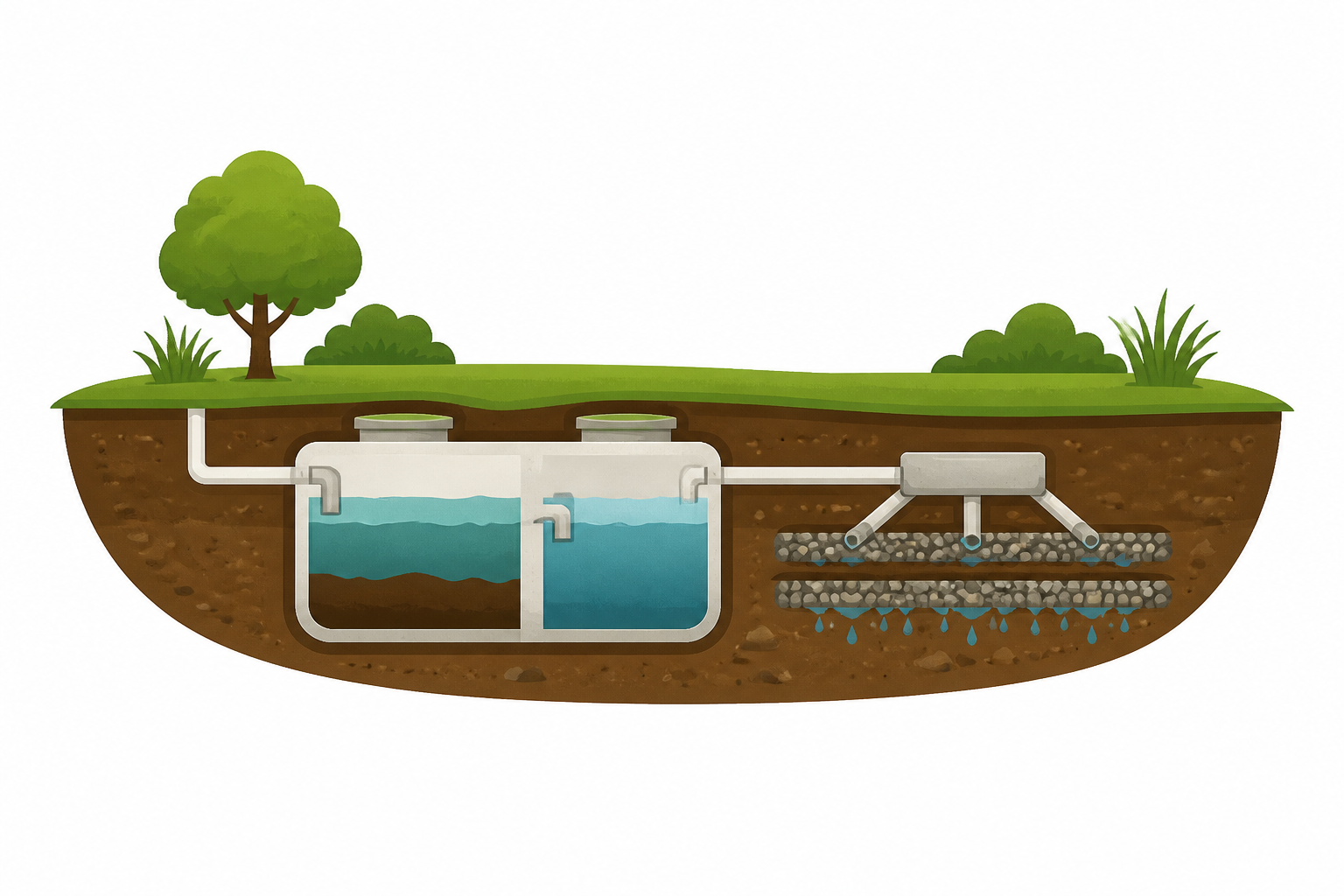
My standard recommendation for a four-bedroom rural home is a 1,500-gallon two-compartment tank. The two-compartment design allows better solids settling before effluent reaches the drain field. That matters more on rural systems because service intervals can be longer — some of my clients are 45 minutes from the nearest pump truck. In my experience, the extra $300 to $500 for the larger two-compartment tank pays for itself in system longevity.
Drain Field Sizing by Soil Type
Drain field size depends almost entirely on your soil’s percolation rate — how fast water moves through the ground. I run perc tests and soil profile evaluations before I commit to any field location. Sandy loam soils common in parts of rural Alabama and central Georgia can absorb effluent quickly, requiring smaller fields. Heavy clay soils in the Tennessee Valley corridor require much larger fields or alternative systems entirely. Specifically, here are the general sizing guidelines I use based on perc test results:
- Perc rate of 1–5 min/inch: approximately 85–100 sq ft of trench per bedroom
- Perc rate of 6–30 min/inch: approximately 100–150 sq ft per bedroom
- Perc rate of 31–60 min/inch: approximately 150–250 sq ft per bedroom, or alternative system required
- Perc rate over 60 min/inch: conventional system typically not approvable
These numbers align with guidelines published by state environmental health programs across the Southeast. Always verify with your specific county health department — I’ve seen county-to-county variation even within the same state.
Setback Rules I Never Skip — Even on 100 Acres
Here’s where I see the most overconfidence on large properties. Homeowners think wide-open space eliminates setback concerns. It doesn’t. Setbacks exist to protect your drinking water, your neighbors’ wells, and nearby waterways — all of which matter more, not less, in rural settings where private wells are common.
The setback distances I follow are based on state health department regulations, which in most Southeast states are codified in their individual on-site sewage rules. However, the EPA’s guidance document on decentralized wastewater systems also provides a solid baseline framework. Here are the minimum setbacks I work with across most of my rural Southeast projects:
- Well (your own): 75–100 feet from tank, 100–150 feet from drain field
- Neighboring well: 100 feet minimum from any system component
- Streams, creeks, lakes: 50–100 feet depending on state rules
- Property lines: 10–25 feet minimum in most counties
- Foundation or basement: 10 feet from tank, 20 feet from field
- Underground water lines: 10 feet minimum
Last fall, I had a client in rural Walker County, Alabama with 60 acres who wanted to place his drain field near a natural drainage swale to take advantage of the slope. That swale fed into a small creek about 80 feet away. His state required 100 feet from any surface water. We relocated the field and added 120 feet of additional trenching. It cost him $1,400 more upfront. That was the right call — not just legally, but ethically. That creek feeds a neighbor’s pond downstream.
The Lesson I Learned the Hard Way About Slopes
Early in my career, I installed a gravity-fed drain field on a site with about an 8% slope — right at the edge of what most state guidelines allow for conventional trenches. I thought I had it covered. However, within two years, that field was surfacing effluent downslope after heavy rain events. The problem wasn’t just the slope — it was the combination of slope and a soil horizon I missed during my profile evaluation. That mistake taught me to always dig my profile holes at the downslope edge of the proposed field, not just the center. I’ve never had that problem again.
Choosing the Right System Type for Large Rural Sites
Not every large-acreage site qualifies for a conventional gravity-fed system. In fact, some of the most challenging installs I’ve done have been on properties with gorgeous land that simply had poor soil conditions in accessible locations. Knowing your system options upfront saves enormous time and money during the planning stage.
Conventional gravity systems are my first choice when soil and slope conditions allow. They’re the simplest, most cost-effective option — typically $4,000 to $8,000 installed in rural Southeast markets, depending on field size and access. When conventional systems aren’t feasible, I move to these alternatives:
- Mound systems: Best for high water tables or slow-perc soils. Expect $12,000–$20,000 installed. Require annual inspections in most states.
- Low-pressure pipe (LPP) systems: Good for large fields with variable soil. Cost range: $8,000–$15,000.
- Aerobic treatment units (ATUs): Required in some counties near waterways. Higher maintenance cost — budget $500–$800/year for service contracts.
- Drip irrigation systems: Excellent for large acreage with varied terrain. Installation costs can reach $20,000–$35,000 but maximize land use flexibility.
On large acreage, I always recommend getting a full site evaluation done before you finalize your house placement. I’ve had clients save $8,000 to $12,000 simply by shifting their home site 150 feet to access better soil. That evaluation typically costs $300 to $600 — it’s the best money spent on any rural build.
The Manual That Saved Me from a $12K Placement Mistake on My Own Property
When you’re sizing and placing a system on large acreage, it’s easy to think you know the rules—until the inspector flags something you missed. I relied on memory and local practice for years before I realized I was working without a safety net on the technical details that separate a passing inspection from a costly redo.
What works
- Covers soil composition and percolation testing in detail—critical for understanding why acreage doesn’t mean you can ignore soil type or drainage patterns
- Explains setback distances from wells, property lines, and water sources state by state—saves you from guessing which rules apply to your specific county
- Walks through tank sizing formulas based on household occupancy and usage, so you size correctly even on properties where oversizing seems “safe”
What doesn’t
- Doesn’t replace a site-specific inspection or engineer’s design—it’s reference material, not a substitute for professional review in complex situations
- Regulations vary enough by county that you’ll still need to call your local health department to confirm what applies to your exact location
I almost placed my own drainfield 40 feet closer to the property line than code allowed because I trusted an old memory instead of verifying the actual requirement—and it would have cost me thousands to move. That’s when I grabbed The Septic System Owner’s Manual and kept it on my bench ever since.
This post contains affiliate links. As an Amazon Associate, I earn from qualifying purchases at no extra cost to you.