This post contains affiliate links. As an Amazon Associate, I earn from qualifying purchases at no extra cost to you.
Drainfield replacement cost is one of those topics where homeowners either panic when they hear the number or get blindsided because nobody gave them a straight answer upfront. I’ve been installing, inspecting, and repairing septic systems across rural Georgia, Alabama, and Tennessee for 18 years now. In that time, I’ve quoted hundreds of drainfield jobs — and I’ve watched people The problem is, I’ve watched plenty of homeowners get blindsided because they either tried every home remedy under the sun instead of getting a real inspection, or they ignored early warning signs until the drainfield was beyond saving. make expensive mistakes simply because they didn’t understand what drives the price. Last spring, I quoted three separate drainfield replacements within the same month. All three were in different counties, all three had different soil conditions, and all three came in at wildly different numbers. I want to walk you through exactly what I found on each job and why the costs landed where they did.
Here’s the honest truth most contractors won’t tell you up front: the drainfield itself is often the cheapest part of the equation. Permits, soil testing, excavation, and disposal fees stack up fast. By the time you’ve paid for everything the state health department requires, the pipe and gravel are almost an afterthought. Understanding what you’re actually paying for is the first step toward making a smart decision — and toward not getting taken advantage of.
What Drives Drainfield Replacement Cost: The Big Variables
Before I get into the three specific jobs, let me explain the core factors that move the price needle. Lot size and available repair area matter enormously. Most southeastern states follow guidelines rooted in EPA’s Onsite Wastewater Treatment Systems Manual, which specifies setback distances from wells, property lines, structures, and water features. In Georgia, for example, the EPD requires a minimum 50-foot setback from any water supply well. If your yard is tight, you may need a more expensive engineered system just to fit the replacement field.
Soil perc rate is the other big driver. A standard conventional drainfield works fine in moderately draining soil — roughly 30 to 60 minutes per inch on a perc test. However, dense clay or overly sandy soil pushes you into alternative system territory fast. Alternative systems like drip irrigation fields or mound systems can double or triple your cost overnight. I’ve seen homeowners shocked when a $6,000 estimate turned into $18,000 because the perc test revealed hardpan clay two feet down.
Labor rates in rural areas tend to be lower than urban markets, but equipment access can offset that quickly. A drainfield on a flat, open lot is a two-day job with a trackhoe. That same job on a steep hillside in North Georgia adds a full day and sometimes requires a smaller, more expensive piece of equipment to navigate the terrain. Add permit fees — typically $300 to $700 across most southeastern counties — and a required percolation test running $200 to $500, and you’re already $500 to $1,200 into the project before a shovel hits the ground.
Job #1: The Straightforward Replacement in Rural Alabama — $7,400
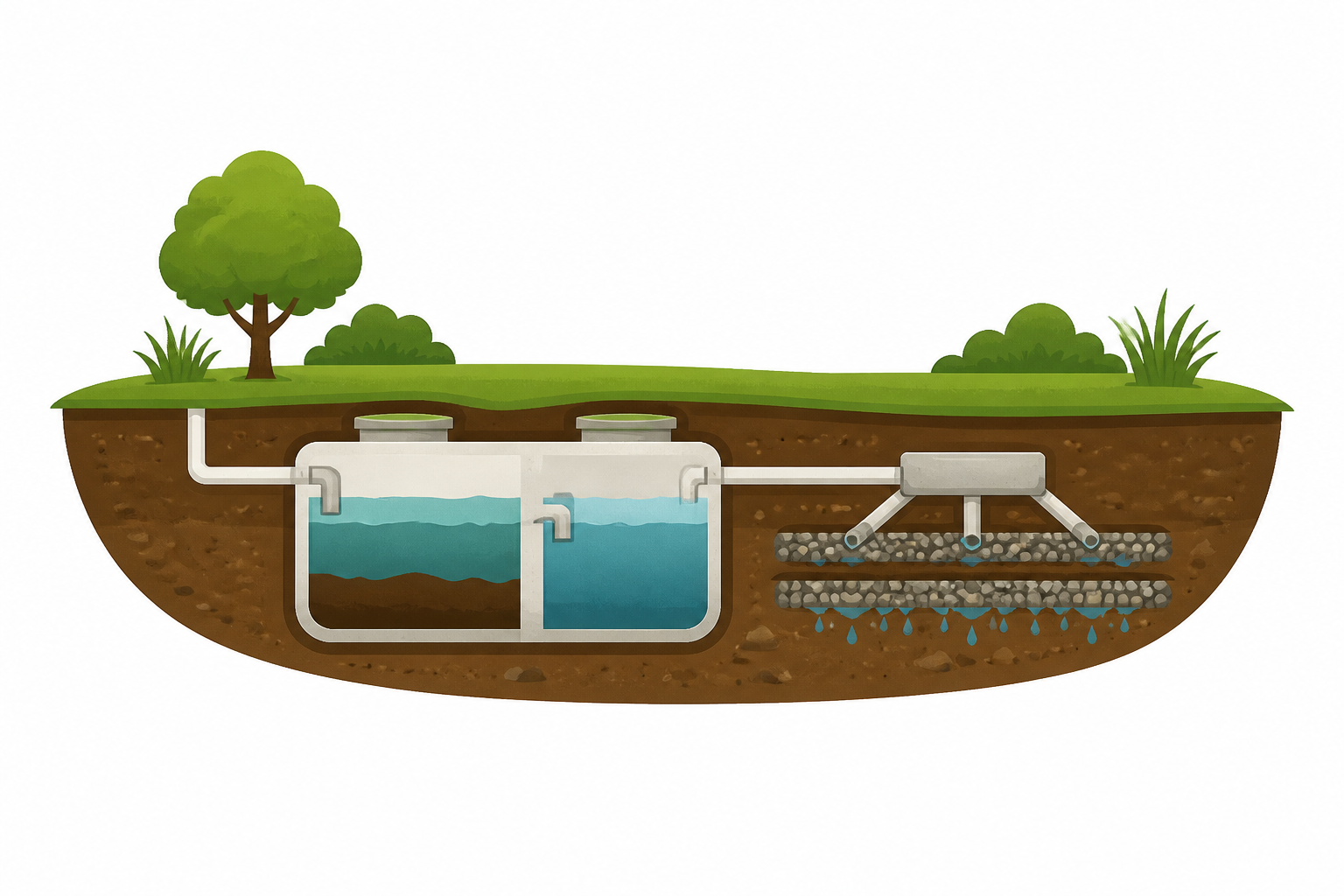
The first job was a 3-bedroom home outside of Talladega County, Alabama. The homeowner called me because the yard was perpetually soggy near the old field, and the toilets were slow-draining. Classic drainfield failure from a 25-year-old system that had never been pumped regularly. When I dug down and inspected, the laterals were completely biomat-clogged — a thick black anaerobic layer had sealed off the soil interface entirely. There was no saving it.
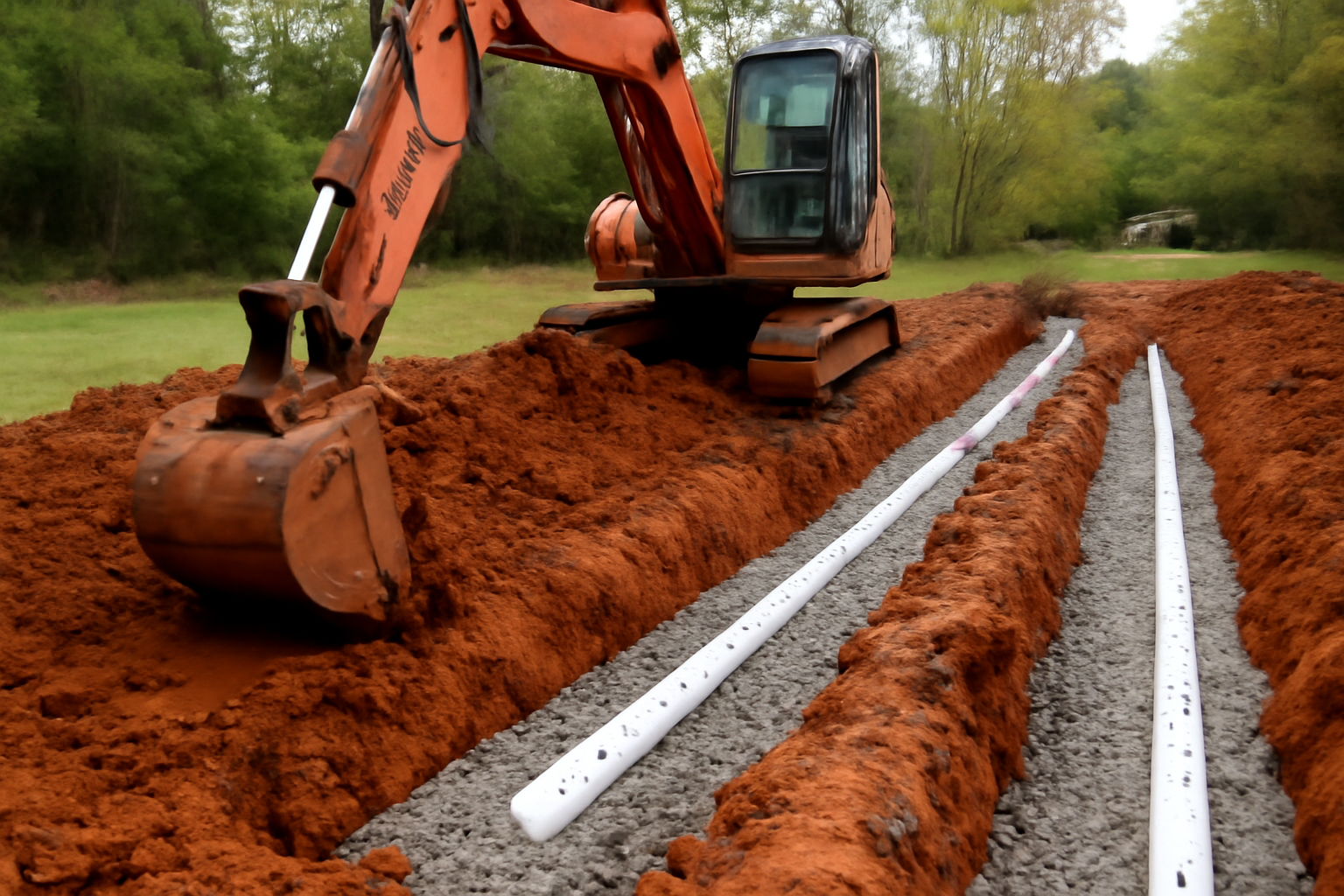
The good news: the lot was flat, open, and had plenty of repair area. Soil perc came back at 42 minutes per inch — right in the sweet spot for a conventional system. The Alabama Department of Public Health permit ran $385. I installed 300 linear feet of 4-inch perforated PVC in three 100-foot laterals, set in 12-inch gravel beds inside an 18-inch-deep trench, all connecting back to a new distribution box. Total material cost was approximately $1,800. Labor was two full days for my crew of two, plus equipment time.
Here’s the full breakdown for that job:
- Permit and perc test: $560
- Excavation and old system removal: $1,200
- Gravel, pipe, distribution box, fittings: $1,800
- Labor (two men, two days): $2,400
- Topsoil, grading, and seeding: $600
- Equipment rental and transport: $840
- Total: $7,400
That’s about as clean and affordable as a full drainfield replacement gets. The stars aligned: good soil, open space, straightforward permit process. Not every job goes this smoothly.
Job #2: The Tight Lot With Bad Soil in Middle Tennessee — $14,800
The second quote was a different story entirely. This was a 4-bedroom home in a rural subdivision outside of Cookeville, Tennessee. The lot was about three-quarters of an acre, but a creek ran along the back edge and a detached garage sat on one side. With the required setbacks under Tennessee Department of Environment and Conservation rules, the only viable repair area was a narrow strip roughly 40 feet wide along the front of the property.
The perc test came back slow — 90 minutes per inch in two of the three test holes. That’s marginal territory. In my experience, anything over 60 minutes per inch starts pushing you toward an engineered alternative. Specifically, the Tennessee regulator required a low-pressure pipe system with dosing pump, which spreads effluent more evenly to compensate for poor drainage. That pump and control panel alone added about $2,200 to the project.
I learned something the hard way on a similar job years ago. I underestimated the electrical work needed to run power to the pump chamber. My quote came up $900 short, and I ate that cost. On this Tennessee job, I made sure to include a licensed electrician in the bid from day one. That transparency actually helped me win the job — the homeowner appreciated the honesty. Here’s how that job broke down:
- Permit, perc testing, and engineer’s site plan: $1,650
- Excavation and demolition of old field: $2,200
- Low-pressure pipe system materials: $3,100
- Dosing pump and control panel: $2,200
- Electrical hookup (subcontracted): $900
- Labor (three men, three days): $3,600
- Grading, topsoil, seeding: $750
- Equipment and transport: $400
- Total: $14,800
The difference between Job #1 and Job #2 wasn’t contractor markup. It was soil, space, and system complexity. That’s the reality of drainfield replacement cost when conditions aren’t ideal.
Job #3: The Full Mound System Replacement in North Georgia — $22,500
The third job was the most complex of the three, and honestly one of the more challenging replacements I’ve done in recent years. This was a 3-bedroom cabin-style home in Gilmer County, Georgia, sitting on a hillside lot with about a 15% slope. The existing drainfield had been installed improperly — laterals ran across the slope instead of following the contour lines, which caused effluent to daylight on the downhill side. That’s both a system failure and a public health violation under Georgia EPD Rule 511-3-1.
The perc test failed entirely in the designated area due to a shallow restrictive layer at 18 inches. As a result, the Georgia county health department required a certified engineer to design a mound system — essentially a raised drainfield built on imported fill soil above the natural grade. Mound systems require significantly more material, more labor, and more precise installation than conventional fields. The engineered design alone cost the homeowner $1,800 before any dirt moved.
Here’s the full cost breakdown for that project:
- Engineering design and site evaluation: $1,800
- Permit fees (county health department): $680
- Imported fill sand and topsoil (18 tons): $2,700
- Gravel, pipe, distribution system: $2,400
- Dosing pump and timer controls: $2,100
- Excavation and old system removal: $2,800
- Mound construction labor (four men, four days): $5,200
- Electrical work: $1,100
- Final grading, erosion control, seeding: $920
- Equipment, fuel, transport: $800
- Total: $22,500
That number stings, but there was no cheaper path forward. The soil and site conditions dictated the system type, and the system type dictated the cost. No reputable contractor could have done it for less without cutting corners that would fail inspection — or worse, fail the homeowner in two years.
The Enzyme Treatment That Bought Me Time Before a Full Drainfield Replacement
Not every sluggish drainfield needs to be torn out and rebuilt—sometimes the real problem is a tank that’s sending too much solid material downstream. RID-X has been my first move on jobs where I’m trying to help homeowners extend the life of a failing system before they commit to a five-figure replacement.
What works
- The dual-action bacteria and enzymes actually break down solid buildup in the tank, which means less sludge makes it to the drainfield—I’ve seen this slow down premature saturation on fields that weren’t technically dead yet.
- Six-month supply means I don’t have to remember monthly doses; homeowners just drop a pod every other month and it stays consistent, which matters because inconsistent dosing defeats the whole purpose.
- Cheap enough that it’s worth trying before dropping $12K��$25K on a new drainfield—even if it only buys you 2–3 extra years, that’s a win most people can live with.
What doesn’t
- It’s not a miracle cure—if your drainfield is already permanently clogged with tree roots or laterally failed, no amount of RID-X is going to fix that, and I’ve had homeowners blame the product when the real problem was their system’s age.
- Works best on systems that are neglected but not yet catastrophic; if you’re already getting backups in your house, you’re probably past the point where preventative treatment makes sense.
I once recommended RID-X to a customer as a stopgap and half-expected it to do nothing, but three months in their drains started flowing noticeably better—enough that they decided to hold off on the full replacement for another season. If you’re staring at replacement quotes and want to at least try extending your drainfield’s life, grab RID-X Septic Tank Treatment Pods – 6 Month Supply, Dual Action Enzymes and Bacteria to Break Down Waste & Prevent Backups.
This post contains affiliate links. As an Amazon Associate, I earn from qualifying purchases at no extra cost to you.