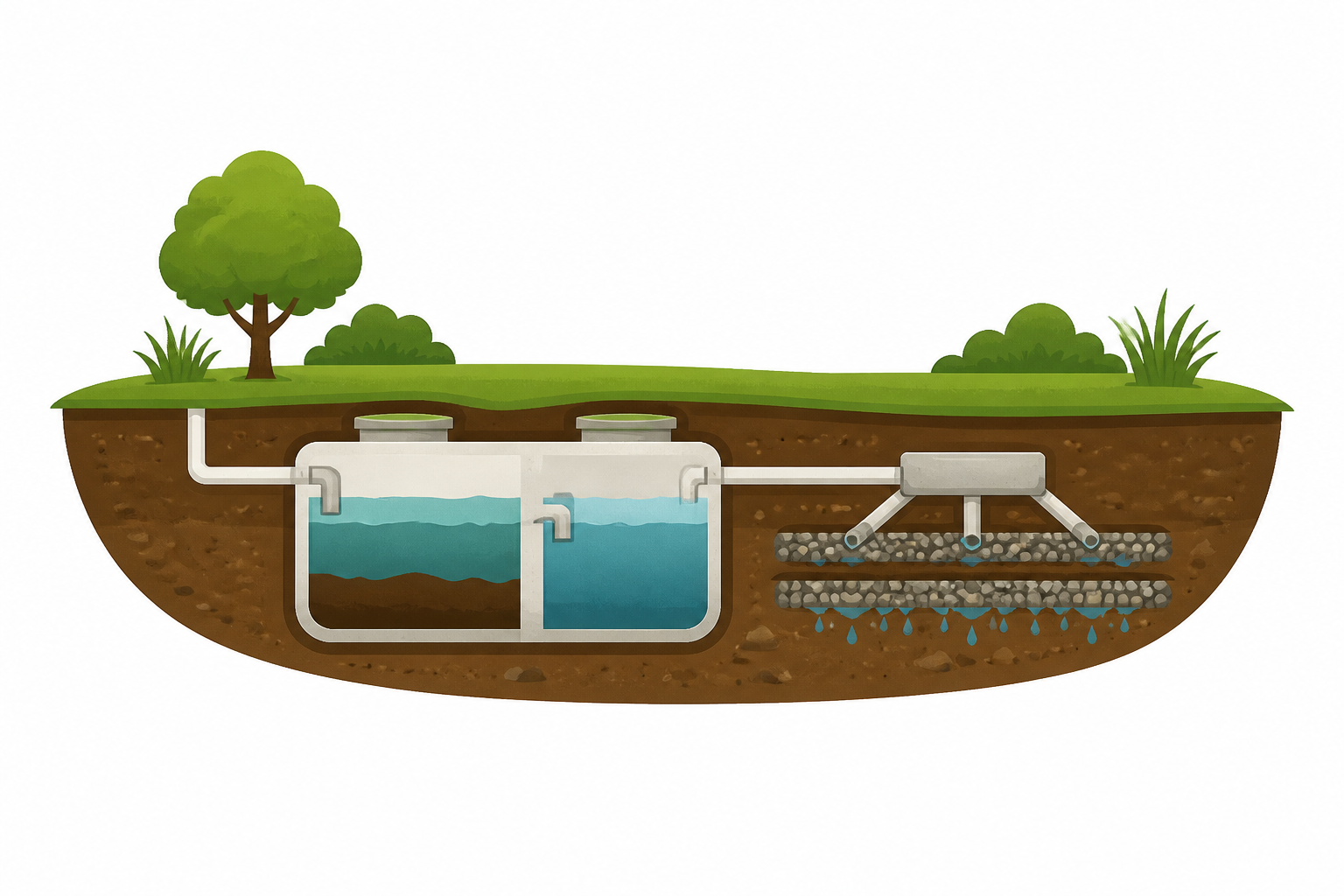
Last fall, I got a call from a homeowner in rural Tennessee. She’d just had her septic system back up into the house — raw sewage in the laundry room, ruined flooring, a $4,200 emergency pump-out and inspection bill. When I asked her how often she pumped her septic tank, she said, “I don’t know — I’ve lived here 11 years and never had to.” That’s the most common and most expensive misconception I encounter in this job. Knowing how often to pump your septic tank isn’t just good maintenance advice. It’s the difference between a $300 routine service call and a $20,000 drain field replacement.
I’ve been inspecting and consulting on septic systems for 15 years. In that time, I’ve crawled under decks, dug up forgotten lids, and walked properties from Vermont to Arizona. I’ve seen every failure mode imaginable. The question I get asked more than any other is this: “How often should I pump my septic tank?” The answer is more specific than most people expect — and it depends almost entirely on your household size and tank capacity.
Why the “Every 3 to 5 Years” Rule Is Too Vague
You’ve probably heard the standard recommendation: pump your septic tank every three to five years. That guidance comes from the EPA’s homeowner septic system manual, and it’s not wrong — it’s just incomplete. Three to five years is a wide range. For a single person with a 1,500-gallon tank, five years is perfectly fine. For a family of six sharing a 1,000-gallon tank, three years is already pushing it dangerously late.
The real variables are tank volume and daily wastewater generation. The EPA estimates the average person generates roughly 70 gallons of wastewater per day. Multiply that by your household size and you can start doing real math. A 1,000-gallon tank serving four people accumulates solids at a very different rate than a 1,500-gallon tank serving two people. Treating those situations identically is how systems fail prematurely.
In my experience, the “every 3 to 5 years” rule also assumes average water usage. High-efficiency households, homes with water softeners, or families with infants in diapers all affect sludge accumulation rates differently. That said, the rule gives you a reasonable starting point — as long as you adjust it based on the table I’m about to walk you through.
How Often to Pump Your Septic Tank by Household Size
Here’s the practical breakdown I use when advising clients. These figures align with data from the EPA’s “A Homeowner’s Guide to Septic Systems” and reflect what I’ve observed across hundreds of inspections. Your pump-out interval depends on two things: how many people live in the home and how large your tank is.
1,000-Gallon Tank
- 1–2 people: Pump every 5–7 years
- 3–4 people: Pump every 2–3 years
- 5–6 people: Pump every 1–2 years
1,250-Gallon Tank
- 1–2 people: Pump every 7–10 years
- 3–4 people: Pump every 3–4 years
- 5–6 people: Pump every 2–3 years
1,500-Gallon Tank
- 1–2 people: Pump every 9–12 years
- 3–4 people: Pump every 4–5 years
- 5–6 people: Pump every 2–4 years
These are general benchmarks — not absolutes. However, they give you a far more actionable target than “every three to five years.” If you don’t know your tank size, check your home’s as-built septic permit, which your county health department should have on file. Most states require this documentation at the time of installation.
Factors That Can Shorten Your Pumping Interval
The table above assumes average usage conditions. Certain habits and household situations accelerate sludge buildup significantly. I’ve inspected tanks on the same street that were installed the same year — one was in perfect shape after four years, the other was critically full after eighteen months. The difference was almost always lifestyle.
Things That Fill Your Tank Faster
- Garbage disposals: These introduce significant food solids. I recommend pumping 30–50% more frequently if you use one daily.
- Frequent guests or short-term rentals: A family of three that regularly hosts weekend guests is functionally operating as a household of five or more.
- Flushing non-degradables: Wipes (even “flushable” ones), feminine hygiene products, and paper towels don’t break down. They accumulate as scum and solids.
- Water softener discharge: Regeneration brine disrupts beneficial bacterial activity in the tank and can compact sludge layers.
- Heavy laundry use: Multiple loads daily, especially with bleach-based detergents, stresses the bacterial ecosystem your tank depends on.
I learned the water softener issue the hard way early in my career. A client’s relatively new system was failing within three years of installation. The tank was full, the biomat in the drain field was thickening, and the system looked like it belonged to a 30-year-old home. The culprit was a whole-house softener discharging directly into the septic. That single change cost him nearly $8,000 in repairs.
Warning Signs Your Tank Needs Pumping Now
Don’t wait for a backup to act. There are clear warning signs that your tank is approaching — or has passed — capacity. Recognizing these early can save you thousands. I tell every client: the septic system will warn you before it fails. The problem is most people don’t know what to listen for.
Signs You Need to Call a Pumper Immediately
- Slow drains throughout the house — not just one fixture
- Gurgling sounds in toilets or drains after flushing
- Sewage odors inside the home or around the tank/drain field area
- Wet or unusually green grass directly over the drain field
- Sewage backing up into the lowest fixtures in the house
Any one of these symptoms warrants an immediate call to a licensed septic professional. Two or more of them together means you may already be in emergency territory. Do not attempt to open a tank yourself when these signs are present. Septic gas — primarily hydrogen sulfide and methane — can be lethal in confined spaces. OSHA categorizes septic tank entry as a permit-required confined space for exactly this reason.
That said, catching these signs early is only possible if you know where your tank lid is. Surprisingly, many homeowners have no idea. Digging up a buried concrete lid every few years costs time and money — and that brings me to a tool I genuinely recommend to every client I work with.
Make Pump-Outs Easier with a Quality Septic Riser
One of the most practical upgrades any septic owner can make is installing a riser kit over the tank lid. I’ve recommended these for years, and I’ve personally installed more than I can count. A riser brings the access lid to grade level — or just above it — so your pump technician can locate and open the tank without any digging. This typically saves $50–$150 per service call just in labor. Over a lifetime of ownership, that adds up fast.
The product I consistently recommend is the Aero-Stream AS-R13 Septic Tank Riser Kit — 23.5″ Diameter x 13″ Tall. I’ve installed this specific kit on multiple properties and it’s held up well over the years. The 13-inch height accommodates most situations where the tank lid is buried 10 to 12 inches below grade, which is extremely common in older installations. The 23.5-inch diameter fits standard concrete tank openings, and the kit includes everything you need for a solid, sealed installation.
What I like specifically about the AS-R13 is the quality of the seal. A poorly sealed riser lets in groundwater and debris — and depending on your local health code, an unsealed riser can actually be a code violation. This kit uses a reliable EPDM gasket system that gives me confidence it won’t compromise the tank’s integrity. For most homeowners, this is a straightforward DIY install with basic hand tools on a Saturday morning.
If your tank lid sits closer to 8 to 10 inches below grade, the Aero-Stream AS-R10 Septic Tank Riser Kit — 23.5″ Diameter x 10″ Tall is the right choice. It’s the same quality and diameter as the AS-R13 but at a shorter height. I keep both models in mind when advising clients because the right fit matters — a riser that sits too high above grade can be a trip hazard and may not pass inspection in some jurisdictions.
When to Call a Professional — and When You Can Handle It Yourself
I’m a big proponent of homeowner education. Understanding your system means you catch problems early. That said, there are clear lines between what you can reasonably do yourself and what requires a licensed professional.
DIY-Appropriate Tasks
- Installing a septic riser kit (following manufacturer instructions)
- Locating your tank using your as-built permit or a probe rod
- Monitoring for warning signs and keeping a maintenance log
- Managing water usage habits and what goes down the drain
Always Call a Licensed Professional For
- Actual pump-out service — this requires a licensed septage hauler in virtually every state
- Any inspection involving opening the tank and assessing interior components
- Drain field evaluation or repair
- Any situation involving sewage backup or suspected system failure
- Permit-required work — additions, tank replacements, system expansions
Septic pump-out costs vary by region, but nationally you’re looking at $300 to $600 for a standard residential pump-out. In rural areas with limited service providers, I’ve seen costs run as high as $800 to $900. That’s not a reason to delay — it’s a reason to stay on schedule, because emergency pump-outs during a backup event cost significantly more and often include damage remediation on top of the service fee.
Always verify that your septic service provider holds a current license in your state. Most states require septage haulers to be licensed through the state environmental or health agency. In Tennessee, for example, that’s the Department of Environment and Conservation. In California, it falls under county environmental health departments. Ask for license numbers — any reputable provider will give them without hesitation.
Final Thoughts: How Often to Pump Your Septic Tank Comes Down to Math
The real answer to how often to pump your septic tank isn’t a single number — it’s a calculation. Tank size divided by daily wastewater load, adjusted for your household habits. A two-person household with a 1,500-gallon tank can comfortably go a decade between pump-outs. A family of five sharing a 1,000-gallon tank should be on an annual or biannual schedule. The difference between those two scenarios is enormous, and treating them the same is how systems fail.
Use the tables in this post as your baseline. Then adjust based on your garbage disposal use, water softener setup, and actual household traffic. Track your pump-out dates in writing — I tell clients to tape the date inside their electrical panel or keep a note in their home maintenance file. That simple habit makes it easy to stay on schedule.
Install a riser if you don’t already have one. It’s a one-time investment of $80 to $150 that pays for itself within two pump-out cycles. The Aero-Stream AS-R13 is the one I reach for first. And when in doubt, pump it out. A $400 pump-out is always cheaper than a $15,000 drain field replacement. Fifteen years in this business has taught me that much for certain.
This post contains affiliate links. As an Amazon Associate, I earn from qualifying purchases at no extra cost to you.